

🔥
5d •
On Saturday We Bake
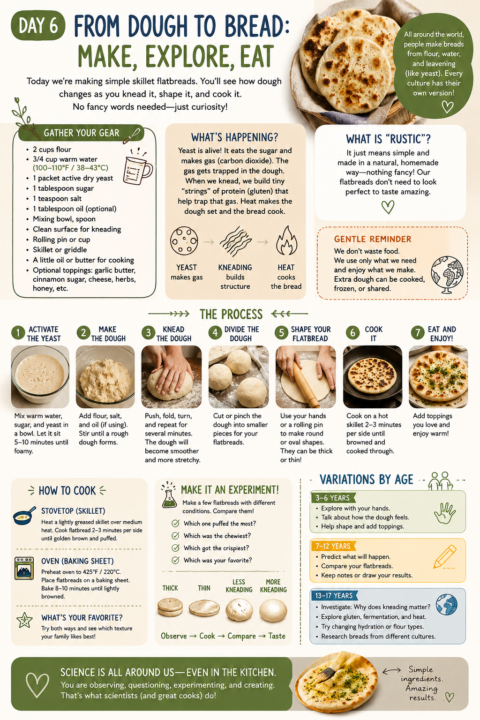
Dough Is a Structure, Not Just a Recipe One of the things that surprises kids when making bread for the first time is how physical it is. Bread dough pushes it stretches, tears, an changes texture in your hands as you work with it. A lot of modern cooking hides process from children. We buy things already sliced, frozen, sealed, or ready to heat. Bread-making slows everything down enough to actually watch transformation happen. What we call “kneading” is really the process of building structure. As flour and water combine, proteins called glutenin and gliadin begin forming gluten strands. Those strands create an elastic network capable of trapping the carbon dioxide produced by yeast. Without that structure, bread would stay dense and flat. That’s why kneading matters. Too little kneading and the dough struggles to hold shape but too much flour and the dough becomes stiff and too much handling and some doughs become tough. Kids can actually feel these changes happening in real time, which makes this a surprisingly powerful science lesson. They are learning through resistance, texture, observation, and adjustment instead of memorization. Bread-making also teaches something we do not talk about enough anymore: transformation often looks messy in the middle. Sticky dough eventually becomes smooth. Shaggy dough becomes elastic. A rough beginning becomes something workable through time and attention. Honestly, that may be one of the best lessons in the entire process. Today, you have two options, in the Classroom check out #Day 6: Rustic Skillet Flatbreads or Kids Can Bake Personal Pan | https://skoo.ly/kids-pan-pizza One dough ball, one little baker. Bring a kid to the counter. What are you baking today?
🔥
5d •
Welcome New Members
Thank you for believing in my vision. Let’s extend a warm welcome to our newest members @Charlotte Bick @Cam Parkes @Wendy Venema @Paula Artis and @Sandy Chong Charlotte is my real life assistant and she’s helping me organize the classrooms. She also has years of homeschool experience and I’m glad she agreed to help me here. Cam is new and runs an RPG community. I’ve asked him to schedule a game play session so so let us know if you’re interested. Thinking of you @Gus Gray @Daniel Cavaretta @Evelene Sterling @Michelle Fuentes as you were interested in our last live game night. Wendy has a mom’s group that some of you might be interested in and Paula is offering an AI camp for kids in June. Sandy and I know each other from Crust and Crumb Academy. A few days ago, she shared her dough was looking at her and I used that idea and her picture to create this welcome video. Enjoy and take a minute to introduce yourself. Then pop over to #Welcome to Connected Through Play to see how the community works.

🔥
4d •
This or That
I’m in the AI Storytelling community and working on ideas for our about page. Which video do you prefer:
Poll
6 members have voted

🔥
3d •
The Power of Play
Have you ever watched a child try to fix something during play? Not a big dramatic problem. Just the everyday kind. You know, the one where the block tower tumbles, the art project becomes a giant mess, or the game rule doesn’t feel fair anymore. This is usually the moment where we are often tempted to step in. I know I do, and not just with kids, it happens at work, too. Can anyone else relate? We think we see the solution. We think we know where the stronger chair should go or that the tower needs a wider base. We know how the rule could be adjusted in about five seconds. But if we jump in and solve things too quickly, we may accidentally remove the useful part for our kid or even for other adults. The useful part is the trying, adjusting, and trying again and that’s where I’m encouraging you to pay more attention to this week. I suggest encouraging failure, curiosity, and trying again. That’s we’re learning and play intersect. When they get frustrated, consider asking some gentle questions like: What did you try first? What changed? Did you listen to each other? Did you get frustrated and come back? Did you notice something you missed the first time? These little moments are easy to overlook, but they are where a lot of the learning lives. Enough “teaching” let’s put this into practice. As you go through your day, what did you notice? Did you change you approach? Let’s help each other. Oh, if you really want a deeper look, I found this video from Harvard’s Center on the Developing Child on how play supports problem-solving and other life skills. Check it out and let’s start a conversation about the power of play in your life.
1
0
🔥
5d •
Did You Know?
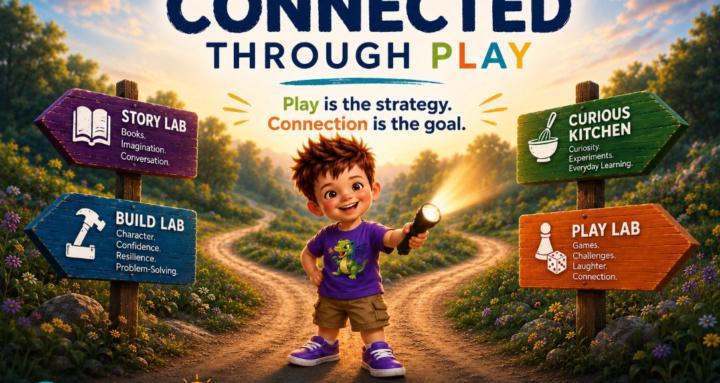
Did you know that there are classrooms? I'm slowly organizing all of our past play prompts and ideas into structured classrooms. I've been suggesting the Curious Kitchen Lab as a starting point for this week's activities with the theme of #Welcome to Mix, Bubble, and Bake where you can help. 1. Visit the lab. 2. After you read the content, click the checkmark in the top right corner, this records your progress and helps me decide if the labs are working. 3. If you wait to do an activity in the future, you will find a link to the related discussion, this way, you can always join in no matter when you do the activity. Let me know if this method of organizing is helpful. Each month I'll introduce a new lab - Curious Kitchen, Play, Build, and Story. I'm enjoying creating with you and look forward to making this community more helpful.

1-30 of 155
skool.com/connectthruplay
Helping families create more moments that feel real again.
Leaderboard (30-day)
1

+85
2

🔥
+65
3

+59
4

+50
5

🔥
+48
Powered by