
Pinned

Mar 15 •
Welcome to Clief Notes. Here's where to start.
1. Watch the intro video and introduce yourself in the intro post here 2. Start with The Foundation (free course). Concepts, folder architecture, prompting framework. Everything else builds on this. 3. Check in at the bottom of each lesson. Polls, discussion posts, other members working through the same stuff. Use them. 4. When you're ready to build real things, move to Implementation Playbooks (Level 2). When you're ready to build your own tools, Building Your Stack (Level 3). 5. Post your work. Ask questions. Help others when you can. What are you here to build?
Poll
5497 members have voted
Pinned

👑
⭐
12d •
I come asking for help! (NEW ROUND! VOTE ONCE A DAY PLS)
Because of the Amazing support you all gave for the first Round Wylder (my step daughter) made it into the second round! You can vote once a day and some days are 2x votes ! I would love love love if any of you support her going to work with some of the best animal rescues in the world to just cast at least one free vote if you can! You can vote here! Not Ai related so sorry for that ! Wylder | Junior Ranger
Pinned
👑
⭐
19h •
New Video: We Audited a Vibe Coded Production App. Three Holes Found.
Dropped a new one for you all. Mike from Urban Pulse let me share footage from his security audit. He vibe coded his whole platform using my routing architecture, then hired me and my team to read every line before he opened it up to high ticket clients. We took our time over many hours. We found three holes that I share here. A Google Maps API key that had already been flagged and locked down by Google. A second cryptographic auth layer the AI built on top of Supabase, which already handles all of this for you. A JWT verification step that never checked the issuer, meaning any valid Supabase token from any project on the internet would have passed. This is what real building and shipping looks like in the AI world. Mike built something that used to take a year and a couple hundred grand. He did it solo. Then he paid engineers to audit it before any customer touched it. Copy his move. If you are vibe coding anything you plan to put in front of paying clients, watch this one.

4h •
Deployment
I'm struggling with a gap in knowledge. Forgive me if this is already mentioned somewhere else. And if so point me in the right direction. Building and working with the folder structure is great, but how are people deploying these projects? Building for yourself, obviously the project is on your machine. But what about building for other people? Are you providing the repo for friends, colleagues, clients etc or sending them the folder structure so their own claude can use it? I'm kind of getting hung up on this point. And feel if I understand this a bit more it will help with more prospective shaping how the projects are built.

2d •
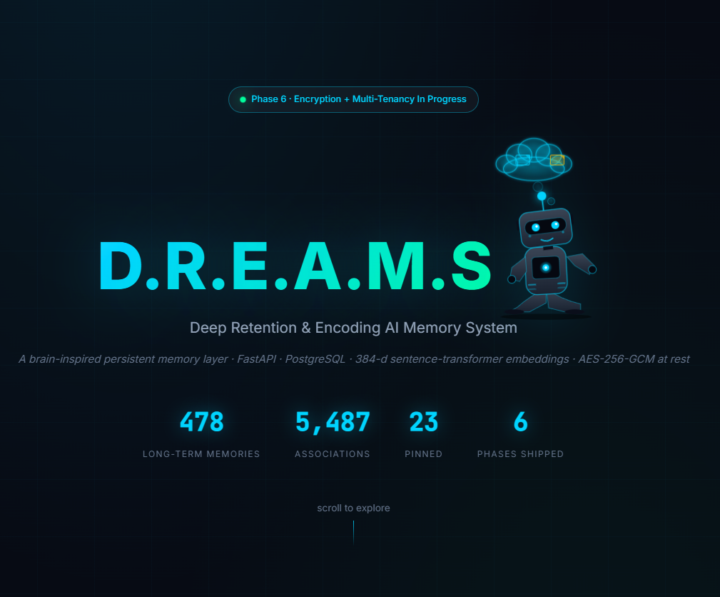
D.R.E.A.M.S, Interactive Memory System. Builder breakdown
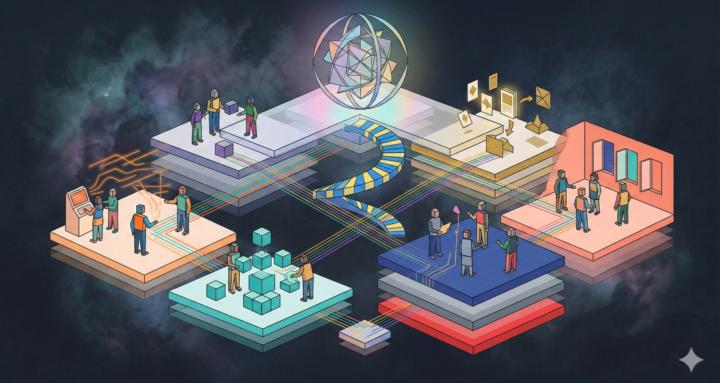
If you've ever had a great conversation with an AI assistant and watched all that context vanish the next morning, you know the problem. Models forget. Every session started from zero. We have all been there and we have either use prompts, handoff documents, and structured workflows. Or some mix of the three. I needed my AI to truly know my development environment. So, I built the structure of all three into the memory system. Not just the code, but the cohesion, not just the functions, but the impact. I've spent the past several months building a fix. It's called D.R.E.A.M.S, Deep Retention & Encoding AI Memory System, and I just put up an interactive breakdown of how it works. Overview @ DREAMS, Deep Retention & Encoding AI Memory System What it is, in one paragraph: DREAMS is a persistent memory layer for AI assistants, modeled on how biological memory actually works. Inputs flow through an encoder, sit in a working buffer, get evaluated by a consolidator, and graduate to long-term storage based on emotional weight and reinforcement, not just recency. Six memory types (episodic, semantic, procedural, emotional, contextual, perspective) get encoded, retrieved, and weighted differently. Memories are permanent. Append-only by design. Recall finds them forever. The non-negotiable: Your memory, in your database. DREAMS writes into a database instance you control. Not a vendor cloud. Not a black box. The corpus you build is yours. The continuity, the lessons, the perspective, the entire graph of associations, you take it with you. Any model that can call MCP can read it. Models will change. Your continuity won't. What you can do on the site: - Step through the live architecture, click each stage to see what it does - Read the six memory types and what each one is for, hover any card to see it in action - Type into the simulator and watch a memory encode, consolidate, and promote to long-term storage in real time - Run semantic recall against a seeded library of fifty memories from the build itself
1-30 of 1,224
skool.com/cliefnotes
Jake Van Clief, giving you the Cliff notes on the new AI age.
Leaderboard (30-day)
1

+992
2

+903
3

+815
4

+702
5

+426
Powered by