
Write something
Pinned

👑
⭐
14h •
Welcome to Clief Notes. Here's where to start.
1. Go check out 📚Navigating The Course to see how to get around and what's here. 2. Start with The Foundation. Concepts, folder architecture, prompting framework. Everything else builds on this. 3. Check in at the bottom of each lesson. Polls, discussion posts, other members working through the same stuff. Use them. 4. When you're ready to build real things join in on our Biweekly competitions and win some real cash. ⭐ Competitions Mega Thread 5. If you are wanting to dive into the masterminds, grab all the past templates, artifacts and resources. Upgrade and head into the The Vault for Premium and The Drawing Room (VIP) for VIP 6. Post your work. Ask questions. Help others when you can. What are you here to build?
Pinned

2d •
🏆 HOW COMPETITIONS WORK FROM NOW ON 🏆
Quick update on the competition schedule so everyone knows what to expect. 📅 NEW CADENCE: TWICE A MONTH We're dropping comps on the 15th and the 30th of every month. Two chances to compete, every month, on a set schedule you can plan around. ✍️ WHY THIS SCHEDULE Spacing them out this way means we can give tailored feedback on every single submission. Not just the winners. Everyone who enters gets notes on what worked, where it's weak, and what to do next. 🎁 WHAT WINNERS GET Along with the prize, every winner gets a 15-minute one-on-one with Jake. Use it to talk through your build, ask questions, or bring whatever else is on your mind. Two comps a month. Feedback on every entry. Direct time with Jake for the winners. Mark your calendar for the 15th and let's get to work!
Pinned
2d •
🎆 GOOD NEWS: THE SALE STAYS OPEN. HAPPY 4TH 🎆
We're holding the last sale through the holiday weekend so nobody misses it. 🎉 Premium: $27 → $14/mo 🎉 VIP: $97 → $67/mo This is the cheapest it will ever be. Once it closes, the price is gone for good. ⏰ New deadline: July 5th, 10:00 AM EST. This is the last extension. If you've been on the fence, sign up now. You lock this rate in and keep it every month going forward. 🖥️ ONE MORE REASON TO JOIN The week of July 5th we're dropping the software we've been building for this community. It goes out for beta testing first, and only Premium and VIP members get access. Sign up before the sale closes and you're in from day one.

4h •
The best AI prompt usually isn't the first one
Most people spend time trying to get a perfect answer immediately. The better approach is to treat AI like a collaborator. Give context. Review the output. Refine your instructions. Repeat. The quality of the conversation often matters more than the first prompt. That's true for AI and it's true for people. How many iterations do you typically go through before you're happy with an AI-generated result?

1m •
Build the Refusal First
Here I go again - realizing that @Bas Rosario post today, about pointing an AI model at his own setup and asking it to make itself cheaper, unveiled insights I thought would be of value to those who read both (original post https://www.skool.com/cliefnotes/i-just-spent-the-last-few-hours-asking-fable-to-make-itself-cheaper?p=cc666986). Bss wrote "It found a file that reported its own size as 450 tokens. The file was 7,000." I ran the same thing on my own system and found my version of it. A status file that declares a 10KB limit in its own header while sitting at 39KB. I'd read past that number a hundred times. That's not the part I want to talk about, though. What his post really did was make me look at where verification lives in a system, and I think most people keep it in the wrong place. The common setup is to build something first. A workflow, a stack of tools, an integration. Then you add checking at the end. You generate, then you verify. Verification becomes the last step, the thing you bolt on when you're worried the output might be wrong. I built mine the other way around, and not on purpose. I had nothing to start with. No existing architecture, no integrations. I built through the method itself, one worker at a time, and the first thing each worker learned was when to refuse. Verification wasn't a step I added later. It was the floor everything else got built on. Here's why that ordering matters more than it sounds. When verification is the base, the model stops being the important part. The AI gives you access to skill. Think of it as a set of clubs. A professional golfer can put the ball where they want with a lesser club, because the skill is in the swing, not the gear. Enforced verification is the swing. It's what lets you reach for the cheap, fast model when the job is grunt work, and the expensive one only when the job actually needs it. The right club for the setting, instead of swinging your driver at every shot because it's the fanciest thing in the bag.
0
0
1-30 of 2,201
skool.com/cliefnotes
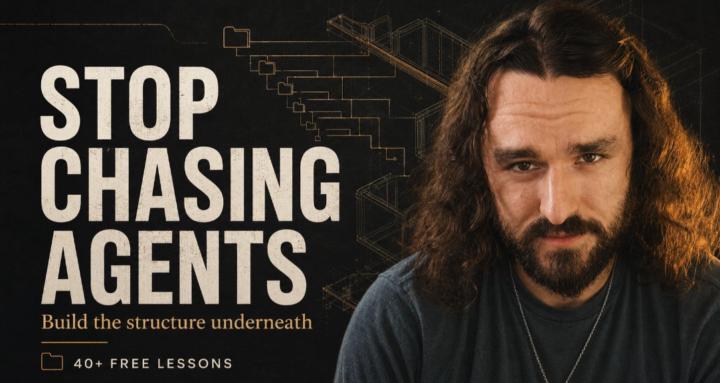
What we give away free beats most paid courses. Build durable AI systems with a Marine vet and Edinburgh researcher. 40+ lessons, growing.
Leaderboard (30-day)
1

🔥
+1718
2

🔥
+1674
3

+1255
4

+964
5

+621
Powered by