
Pinned

👑
⭐
15d •
Welcome to Clief Notes. Here's where to start.
1. Go check out 📚Navigating The Course to see how to get around and what's here. 2. Start with The Foundation. Concepts, folder architecture, prompting framework. Everything else builds on this. 3. Check in at the bottom of each lesson. Polls, discussion posts, other members working through the same stuff. Use them. 4. When you're ready to build real things join in on our Biweekly competitions and win some real cash. ⭐ Competitions Mega Thread 5. If you are wanting to dive into the masterminds, grab all the past templates, artifacts and resources. Upgrade and head into the The Vault for Premium and The Drawing Room (VIP) for VIP 6. Post your work. Ask questions. Help others when you can. What are you here to build?
Pinned
👑
⭐
15h •
🏆 COMP #8 RESULTS: THE WILDCARD 🏆
📦 AND SOMETHING NEW: EVERY ENTRANT GETS A FEEDBACK FILE 📦 🔍 WHAT WE DID DIFFERENTLY THIS TIME Every submission was cloned at the exact commit that was public when we read it, and read file by file. The brief. The identity. The rules. The reference layer. The code. Where a repo made a claim we could check, we checked it. Arithmetic recomputed by hand. Sample photos opened and compared against the outputs that cited them. Files diffed. Self-tests traced. Thirty-two repos, read at the code/word level. And one lens over everything, because it's the lens this whole community is built on: does the build keep the human's judgment where it pays and put the deterministic work in code, where it can't hallucinate? 📦 THE FEEDBACK PACKAGE This is the new thing, and it's for everyone not just the podium. 📦 COMP #8: THE WILDCARD - The Vault Every entrant gets a markdown file. Three parts: 1️⃣ The read. What your build actually is, and the strongest thing in it cited to your own files. Rule numbers. Function names. Your own examples. 2️⃣ One push. The single change that most improves your build. Not a list. One. 3️⃣ An idea worth naming something original in YOUR build, credited to you, that the rest of the community is told to take from. Plus links to the builds your feedback points at. Nobody walks out of this comp empty-handed. Thirty-two builds, thirty-two named ideas. The roster alone is worth the download. 📍 The package + the full write-up (what held up, what was missed) live in the new Feedback module: 📦 COMP #8: THE WILDCARD - The Vault 📚 WHAT THE FIELD TAUGHT Three lines split thirty-two repos: ✅ Enforcement. A must in a markdown file is a request. A must in code is a constraint. (That line is from one of your repos. It's in the package. Go find whose.) ✅ Evidence. The builds that shipped receipts of a REAL run transcripts, dated logs, before-and-after fixes read differently every single time.
Pinned

2d •
❗The Lyceum opens this Thursday: live webinar at 7 PM ET❗
Thursday, July 16 at 7:00 PM ET. Quick version for anyone who hasn't been following: The Lyceum is Eduba's 12-week AI certification program and the first credential we've ever issued. Over 3,000 people are on the waitlist and seats per cohort are limited. What we'll cover in the hour: 01 / The structure. 12 weeks, three sprints, nine live sessions, 18 hours of instruction, 12 instructors per cohort. 02 / The cohorts. Technical, Business, and Creator. Same core curriculum, weighted differently. We'll walk through how to pick yours. 03 / The competition. $250,000+ in prizes across the tiers and how your capstone feeds into it. 04 / The certification. What you have to do to earn it and what it actually certifies. 05 / The investment. What it costs, how payment works, and who should not enroll. Then live Q&A until the questions run out. One more thing. At the end of the session we're doing something for the people actually in the room. It's capped at a small number, it goes in the order people claim it, and we're not putting it in writing. Be there and stay to the end. The session is live only. No recording going out. Thursday · July 16 · 7:00 PM ET skool.com/live/XM7969jTG7L Come with the hard questions. Bring the skeptical ones too. That's what the hour is for.

37m •
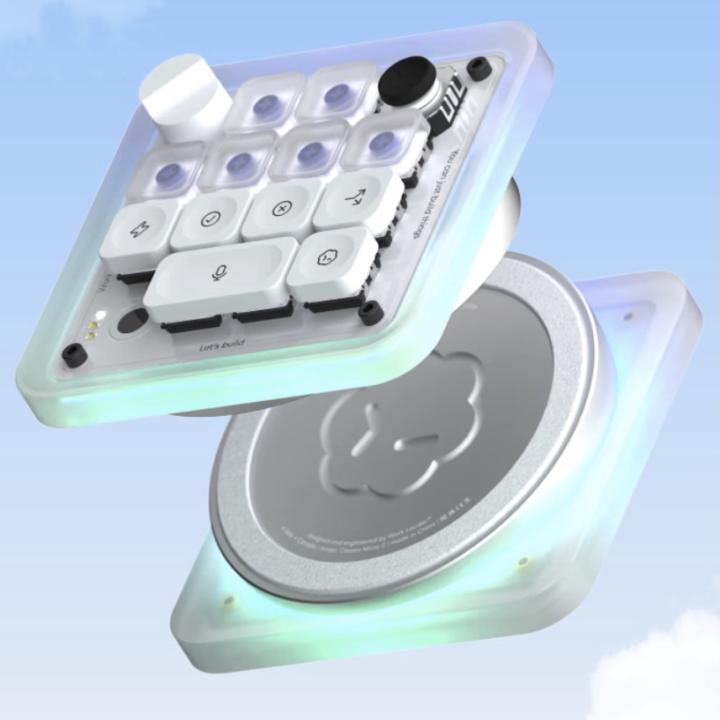
Designing For AI As A Physical Good
Codex Micro is a small product with a large design implication. It does not treat AI as another application to open. It gives the agent a physical interface. A dial for reasoning depth. Keys for commands and agent states. A joystick for skills. Lighting for feedback. Layers for different workflows. The invisible parts of working with AI become tactile. That is the interesting bit. The design question is no longer: Where can we add AI? It becomes: - What should be physical? - What should be visible? - What should be adjustable? - What should happen without a screen? - Where should the human intervene? - What does the AI need to communicate back? The product is designed around the behaviour of the AI, not just the existing shape of a keyboard. That is a useful test for any physical product built for this next phase of computing: If you removed the AI, would the object still make sense in exactly the same form? If the answer is yes, perhaps the AI was added to the product. It was not designed around the AI. The future of physical product design will not be about putting an AI button on familiar objects. It will be about designing around delegation, feedback, memory, autonomy, and human intervention. The result might look like a keyboard, a camera, a notebook, or something completely new. But the design logic will begin with a different question: What does the AI do, and what should the human be able to feel, see, or change? That is the shift. Not AI added to objects. Objects designed around AI. https://worklouder.cc/codex-micro //A<3
0
0

9d •
Business Owners who are not marketers/sales people, what do you use?
I have a lot of ideas, which I want to test but I have very little experience with marketing or sales(storytelling). I see a lot of skills(on skills.sh) but they don't seem to help me much since I don't really know how it is supposed to work(without AI) to judge the outcome. Do you hire talent to help your set up things to judge how your pipeline is performing? Do you practice your content making and then feed it to AI to get your voice? Or is it a creative process and you don't really outsource that to AI?
1-30 of 2,527
skool.com/cliefnotes
What we give away free beats most paid courses. Build durable AI systems with a Marine vet and Edinburgh researcher. 40+ lessons, growing.
Leaderboard (30-day)
1

🔥
+1744
2

+1232
3

+1043
4

+878
5

+758
Powered by