
Pinned

👑
⭐
6d •
Welcome to Clief Notes. Here's where to start.
1. Go check out 📚Navigating The Course to see how to get around and what's here. 2. Start with The Foundation. Concepts, folder architecture, prompting framework. Everything else builds on this. 3. Check in at the bottom of each lesson. Polls, discussion posts, other members working through the same stuff. Use them. 4. When you're ready to build real things join in on our Biweekly competitions and win some real cash. ⭐ Competitions Mega Thread 5. If you are wanting to dive into the masterminds, grab all the past templates, artifacts and resources. Upgrade and head into the The Vault for Premium and The Drawing Room (VIP) for VIP 6. Post your work. Ask questions. Help others when you can. What are you here to build?
Pinned
👑
⭐
10h •
📢 Recordings of Tea Masterminds are live: The Second Brain
🧠 This round was about what a second brain actually is: a context layer you and your AI both read, not a notes app. The Afternoon Tea is the teaching. The High Tea is the room putting it to work on scale, memory, trust, and security. Here is what I want you to understand about these drops, because it is the whole point of being in here. While the videos are valuable and being able to sit and answer your questions is a big reason for them that's not the only value they hold. 📄 Every drop is a set of working files. Markdown built to be used and reused. Each one ends with the exact data to give your AI for your own situation. This round also ships a starter folder you can open, run the self-audit on, and walk away with the skeleton of your own second brain in a sitting. 🤖 I build them expecting you to feed them to your AI. That is the design. Hand a whole round to Claude in a few minutes, whether or not you made it live. The room's thinking is in the files, so you lose almost nothing by catching it later. 🔄 They adapt. A prompt pack is frozen. These are meant to be reshaped: update the context, swap in your own work, bend the templates to your process. And they grow on my side too, as we learn together in these calls. The call is dialogue. The package is that dialogue, crystallized into something you can run. Next round builds on this one. ☕ Afternoon Tea 6 →Afternoon Tea 6 (Second Brain Chat) 🫖 High Tea 10 → High Tea 10 (Second Brain Deep Dive) 🧭 How you should use these: 🔹 Show up live when you can. Your questions shape the next drop. 🔹 When you can't, rewatch, or drop the files into your AI and run the prompt at the bottom. 🔹 Open the starter folder and build your own version. Rename it to your work. It is yours to keep. 📚 A mastermind ends when the call ends. What you get here keeps working after: a structured version of your own thinking (and some of my own thinking!) that improves every round. In my opinion that is worth more than the hour in the room. (or three as some of you stick around in these calls to chat)
Pinned
👑
⭐
2d •
Ai before ChatGPT: The Interview.
In this interview I sit down with Matt from NLP Logix. He's been working in the AI space longer than most people have been working in general. We dive into what changed and what is it going to be important about the future. This is a three part series, I will be posting another two videos from another two experts in mathematics and Engineering! Please like and comment on YouTube if you have time as well!

2d •
3 Questions
Hi! I made it to the end of section 2 in the free material and then got a bit carried away. Returned and finished the courses after building my workspace and paid for Premium. I've a couple questions id appreciate some thoughts/guidance/insight on. 1. Cloud based workspace 2. Applying the vault 3. Creating workspaces as a service 1. Cloud based workspace I've seen (yet to read) the remote access lesson but im pretty sure this will just be operating your desktop Claude and not what im thinking. Im thinking of moving the desktop folder to the cloud using proton drive and Termux on my phone, to make it accessible anywhere. Does anyone have any better suggestions? Reasons why this might be a bad idea? The implications of doing this when there is more than just your own data in the workspace (confidential, others personal etc.) 2. Applying the vault I shouldn't have got carried away and just followed the lessons step by step. But I didnt. I've got quite meta with my workspace capabilities operating behind the actual outputs and implemented a lot of things ive yet to see covered in the lessons (basic learning loops at every HITL step, audit processes to address drift (skill level and workspace level), session continuity protocols, context mining the session at hand off for processing later into optimally formatted source material for things like content, reporting, achievements etc. There's more but i share to make the point, im a little apprehensive at running the vault. I dont know what I dont know and id hate to accidentally wipe what ive built already. Im thinking about pointing my workspace at the vault and asking it to see what we can learn and implement. Does anyone have any suggestions or insight into this that may help guide me? 3. Workspace creation as a service One of the projects ive set up in my workspace is one to create workspaces for other people without them needing to fully understand whats happening under the hood. Since signing up for Premium, I see Jake is basically doing this for us. I've got a lot to dig in to and learn but ahead of that, I wonder if anyone might be able to help prime me on this topic in particular? Any suggestions on how to approach learning this or implementing it?

1d •
The missing layer behind better AI writing?
Everyone wants AI to “sound like me.” So they keep fixing outputs one prompt at a time. More warm. More direct. Less corporate. More founder voice. But the model is guessing because the real *source layer* is missing. A simple fix: Separate Identity from Voice. Your identity profile tells the systm who or what must not be distorted: principles, judgment patterns, boundaries, points of view, public-use limits. Your voice profile tells the system how that identity behaves in language: tone, pacing, examples, vocabulary, anti-patterns, channel shifts. - Identity is not copy... - Voice is not strategy... - One draft is not the source of truth. First dfine what must stay true, then define how it should sound. lastly, generate the post, email, page, script, or deliverable. If you define *identity* and *voice* separately, you stop prompting for tone every time and start building a reusable writing system. Curious how others in Clief Notes are handling this: Do you define identity and voice separately, or do you keep them in one brand/persona file?
1-30 of 2,340
skool.com/cliefnotes
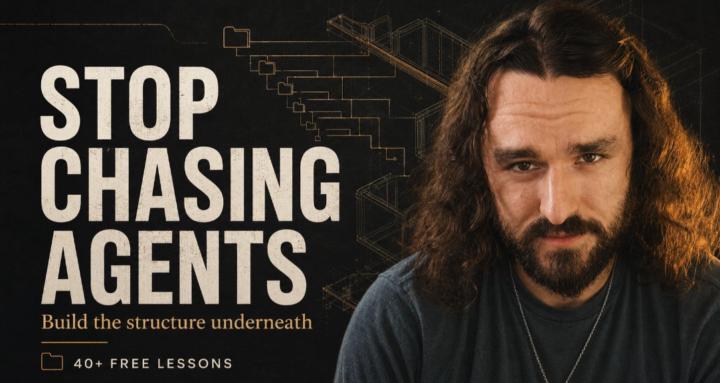
What we give away free beats most paid courses. Build durable AI systems with a Marine vet and Edinburgh researcher. 40+ lessons, growing.
Leaderboard (30-day)
1

+1582
2

🔥
+1574
3

🔥
+1561
4

+892
5

+776
Powered by