
Pinned

May 3 •
The Folder System Became My Agency
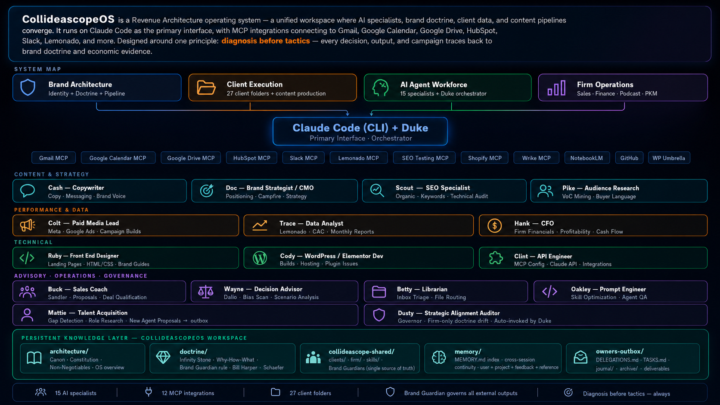
Twenty-four days ago I posted about Jake's folder system video. This is what happened next. Same foundation — markdown files, orchestration prompts, clear roles. I just kept building. Fifteen named specialists. Each one with a soul file, guardrails, and a playbook. Duke orchestrates. Cash writes. Trace pulls the data. Hank runs the financials. Clint handles the MCP integrations. Behind each one is either a human counterpart doing the real work alongside them — or a role I can't afford to hire yet. Katie who's been with me for 18 years, now has her own orchestrator running the same system. Twenty-seven client folders. Twelve live MCP integrations. One shared repo. The folder system isn't replacing my agency. It becoming my agency. Jake gave me the unlock. This is how it's going.
Pinned

Mar 15 •
Welcome to Clief Notes. Here's where to start.
1. Watch the intro video and introduce yourself in the intro post here 2. Start with The Foundation (free course). Concepts, folder architecture, prompting framework. Everything else builds on this. 3. Check in at the bottom of each lesson. Polls, discussion posts, other members working through the same stuff. Use them. 4. When you're ready to build real things, move to Implementation Playbooks (Level 2). When you're ready to build your own tools, Building Your Stack (Level 3). 5. Post your work. Ask questions. Help others when you can. What are you here to build?
Poll
6608 members have voted
Pinned
6d •
🏆 WEEKLY COMP #7: THE OPERATOR 🏆
🎟️ PRIZE: FREE SEAT IN THE LYCEUM 🎟️ Pick your cohort. Technical, Business, or Creator. Your call. ---- 🇬🇧 We're back. Good morning from London. 👋 Thanks for the patience last week. Jake and I needed a few days to breathe before London Tech Week kicked off, and you all responded with nothing but support. We don't take that for granted. Now let's get back to building. ---- 📋 THE CHALLENGE Build a folder-based AI operator that handles ONE operational workflow end-to-end. You pick the workflow. This week's deliverable is one operator folder that someone could drop into a Claude project and use to handle a real business workflow without babysitting. ---- 🎯 PICK YOUR WORKFLOW The workflow is yours. Pick something specific. Pick something you'd actually use. A few sparks to get you thinking: - 🎫 Customer support triage (which tier handles this ticket?) - ✅ Content review and approval - 📨 Lead intake and qualification - 💸 Refund request handler - 🤝 Partnership pitch evaluator - 🎙️ Podcast guest pitch sorter - 💼 Freelance project intake - 📄 Resume screen for one specific role - 📅 Meeting request triage (book, decline, delegate) The more specific, the better. "Customer support" is too broad. "Refund request triage for an ecommerce store doing under 200 orders per month" is right. 📎 If you want a fully written client brief as a reference, the attached PDF walks through one example. Don't build the example. Use it as a template for how to think about scoping your own operator. ---- 🗂️ THE METHODOLOGY If this is your first comp, welcome. Here's what you need to know: This week (and every week) you're learning interpretable context methodology. Folders as architecture. Each file does one job well. Your operator is a folder with five things: - 📄 identity.md (who the operator is and what workflow they own) - 📐 rules.md (the decision logic: criteria, edge cases, escalation rules) - 💬 examples.md (decisions in action, including at least one edge case) - 📚 reference/ (checklists, templates, rubrics) - 📖 README.md (how to use it)

17d •
ICM is awesome for one person, but what if there is two?
Been building an AI system for our agency for the last several months — custom tools, automations, outreach, all structured so the AI knows what context to pull and when. We run most of it through our own website. Found Jake's content and immediately recognized what we'd been building toward. The ICM framework — structured context over complicated multi-agent setups — we'd been doing a version of this without knowing it had a name. Here's the thing though. Everything I've seen assumes one person running the system. We're two founders. And the team layer — who owns what, how handoffs work, how you avoid overlap when the AI is already handling coordination — nobody seems to be talking about that. Just getting into the classroom so maybe it's in there. Curious if anyone's figured out ICM for a small team or if that conversation is even happening yet.

🔥
9d •
How I keep my AI workspace clean, accurate, and safe (the two rituals that I run every single session)
💡Let me start with the truth of things first, because the truth is the lesson. ================= Token Warning ⚠️========== Before anyone comes for me 😅 📝 Note: depending on what you are loading, you are accruing token cost. And token cost can balloon if you are not careful. If any of the files in the initializing phase or handoff phase are large this can become a token intensive practice so when curating this process, BE INTENTIONAL only load what is absolutely needed for the project to start up and for you to get to the fun part, building! I budget for my own needs, for me this initialization for me is between 5k and 10k, I have made the mistake of making 40k, don't do that! If you want to understand an estimate of what your character to token ratio is use the site below: Tokenizer - OpenAI API Anthropic tokenizer has not been released yet, but Its a few % higher than OpenAI in some cases. Plain English sentence (115 characters) - OpenAI GPT-4: 23 tokens - OpenAI GPT-4o: 23 tokens - Claude (content only): 23 tokens - Result: identical Code and markdown snippet (86 characters) - OpenAI GPT-4: 24 tokens - OpenAI GPT-4o: 26 tokens - Claude (content only): 27 tokens - Result: Claude a few percent higher Numbers and punctuation (55 characters) - OpenAI GPT-4: 25 tokens - OpenAI GPT-4o: 25 tokens - Claude (content only): 27 tokens - Result: Claude about 8 percent higher One honest footnote: Claude's API adds roughly 7 fixed tokens per message for formatting. On a single short line that looks like a big gap. On a real document it amortizes down to almost nothing. ✅The takeaway: for the same English text, the tokenizers land within a few percent of each other. The scary "Claude costs way more tokens" headlines do not hold up when you actually measure it. Verified beats confident, every time. You have been learned and you have been warned! ============ Back to it! 👇=================
Poll
21 members have voted
1-30 of 1,743

skool.com/cliefnotes
Jake Van Clief, giving you the Cliff notes on the new AI age.
Leaderboard (30-day)
1
🔥
+1616
2

+1444
3
+1181
4

+628
5

+422
Powered by