
Pinned

Mar 15 •
Welcome to Clief Notes. Here's where to start.
1. Watch the intro video and introduce yourself in the intro post here 2. Start with The Foundation (free course). Concepts, folder architecture, prompting framework. Everything else builds on this. 3. Check in at the bottom of each lesson. Polls, discussion posts, other members working through the same stuff. Use them. 4. When you're ready to build real things, move to Implementation Playbooks (Level 2). When you're ready to build your own tools, Building Your Stack (Level 3). 5. Post your work. Ask questions. Help others when you can. What are you here to build?
Poll
5404 members have voted
Pinned
4d •
Premium and VIP: Questionnaires Are Live
Saturday Tea is coming, get your questions in. If you want your questions answered live this Saturday, fill out the questionnaire for your tier below. Premium (Afternoon Tea): https://forms.gle/k6oSAzeo6LY5pUqA7 VIP (High Tea): https://forms.gle/ngkMV1oSGDHWYHEf8 Drop your questions in early so we can work through as many as possible on the call. See you Saturday!
Pinned

👑
⭐
10d •
I come asking for help! (NEW ROUND! VOTE ONCE A DAY PLS)
Because of the Amazing support you all gave for the first Round Wylder (my step daughter) made it into the second round! You can vote once a day and some days are 2x votes ! I would love love love if any of you support her going to work with some of the best animal rescues in the world to just cast at least one free vote if you can! You can vote here! Not Ai related so sorry for that ! Wylder | Junior Ranger

1d •
When does a prompt become a skill?
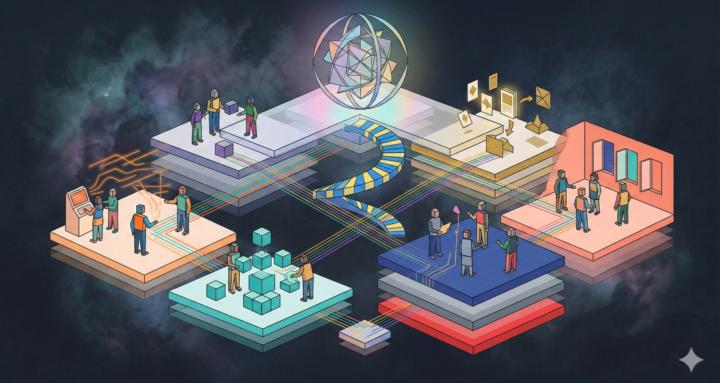
Every catalogue of an AI workflow stack lists the same parts in a slightly different order. Prompts, skills, connectors, MCPs, hooks, scripts, plugins. Useful vocabulary. None of those lists answer the question a working operator carries into Monday morning. I have run this prompt four times this week. Is it a skill yet, or am I overbuilding? That is the promotion question, and the vocabulary does not solve it. Naming the seven layers tells you nothing about which one the thing on your screen right now belongs in. The threshold decisions are the work. The taxonomy is the easy part. The dividing line under every promotion decision There is one axis that runs underneath every layer of the stack: deterministic versus probabilistic. Scripts compute. Hooks fire on event. Connectors pass structured data. Prompts and skills guess inside a band of plausible outputs. Deterministic versus probabilistic — the axis that runs underneath every layer of the stack Every promotion decision sits on that axis. The question to ask before moving any unit of work up one level is whether the work needs a right answer or a good one. A price band is good. A tax number is right. A caption is good. A file path is right. The promotion direction follows. Probabilistic work climbs toward skills and plugins. Deterministic work climbs toward scripts and hooks. Mixing the two in one layer is the first sign a piece of work is in the wrong layer. Prompt to skill: the trigger is fidelity, not volume A prompt earns promotion to a skill when one of two things is true. Either you have run it three or more times, or forgetting one of its rules would produce a wrong-feeling output rather than a wrong one. Prompt to Skill — the first promotion gate: three runs or fidelity to a standard Three runs is the lower bound because anything you have done three times you will do thirty times if it stays useful. The cost of writing it as a skill once is repaid on run four. The wrong-feeling test is the upper bound. If the output is technically correct but reads off — wrong register, missing a refusal, breaking a voice rule the operator could not name on demand — then the rules live in the operator’s head, and a fresh session does not have access to them. A skill is the place those rules become loadable.
3d •
Six weeks ago I was making Instagram graphics. Today I'm shipping public AI worker repos.
What ICM, 60-30-10, and a lot of GitHub stalking taught me. Six weeks ago, I was using Claude to produce daily content artifacts — Instagram squares, captions, blog posts. A publishing operation with a workflow that mostly held together. Today, four public ICM-structured AI repositories live under github.com/NFTYoginis. Three more shipping this week. Each one is a fork-able starter that demonstrates a working architecture: orchestrator dispatches, workers build, briefs serve as contracts, memory persists across sessions. The path between those two states isn't "I learned to code." It's a six-week stretch of reading public repositories, trying patterns, deleting most of them, and slowly understanding what ICM (Internal Coherence Maximization, from Jake Van Clief) actually means when you stop treating it as theory. This is the tour: where I started, what changed, what I built, and where you can fork it. Where I started Six weeks ago, my Claude workflow looked like this: - One Claude session per task. Each session loaded brand-voice files, content samples, and whatever else seemed relevant. Context bloated by lunch. - I'd ask Claude to do something. It would produce something close. I'd correct it. Repeat. - "Memory" was telling Claude "remember our convention is X" at session start, which it forgot the next session. - The token bill kept growing without the output growing proportionally. That setup works at small scale. It collapses under any real production load. The collapse moment, when it came, was specific. I caught one of my daily routines burning roughly 800,000 tokens — for a routine that needed to do one thing: write three dispatch briefs and hand them off. The actual creative work happened in the workers being dispatched. The orchestrator was just routing. Eight hundred thousand tokens for routing. That was the first time I read about ICM. What ICM actually says (the part that mattered) Most "AI architecture" content I'd been reading was either too high-level to act on, or too tied to a specific framework I'd have to adopt wholesale.
1-30 of 1,200
skool.com/cliefnotes
Jake Van Clief, giving you the Cliff notes on the new AI age.
Leaderboard (30-day)
1

+850
2

+835
3

+822
4

+683
5
+394
Powered by