
Pinned

👑
⭐
15d •
Welcome to Clief Notes. Here's where to start.
1. Go check out 📚Navigating The Course to see how to get around and what's here. 2. Start with The Foundation. Concepts, folder architecture, prompting framework. Everything else builds on this. 3. Check in at the bottom of each lesson. Polls, discussion posts, other members working through the same stuff. Use them. 4. When you're ready to build real things join in on our Biweekly competitions and win some real cash. ⭐ Competitions Mega Thread 5. If you are wanting to dive into the masterminds, grab all the past templates, artifacts and resources. Upgrade and head into the The Vault for Premium and The Drawing Room (VIP) for VIP 6. Post your work. Ask questions. Help others when you can. What are you here to build?
Pinned
👑
⭐
3h •
🚀 Ledger is live — alpha, go kick the tires
We just shipped the alpha of Ledger 📋 —https://ledger.eduba.io the talent platform we've been building on top of this community. Free for VIP and Premium Members. Here's the idea, plain: every other job board matches on a resume. Ledger matches on ICM. Every candidate in there has been through the methodology you're already using here — that's the whole point. Companies aren't guessing whether someone "gets it." They know it going in. 🎯 It works kind of like a job board, but more anonymous — right? 🕶️ Employers see an anonymized profile: skills, bio, portfolio, a short video intro if you want one. No last name, no email, no current employer. Every conversation runs through the platform's relay instead of real inboxes, so nobody's exposing contact info before they're ready. Two doors in: - 🏢 Company hiring — freelance or full-time — sign up and get access to a pool of people who already speak ICM fluently. - - 🙋 Candidate looking for work — freelance or full-time — list yourself. Takes a few minutes: profile, skills, a short video if you've got one. We're vetting both sides before anyone gets full access — companies and candidates — so the quality holds up on both ends. ✅ That means it's not instant approval; you might wait a beat while we look at it. Bear with us there. It's alpha 🧪, so: things might be rough around the edges, we're watching it closely, and if something breaks or feels off, tell us — that's exactly what this stage is for. Be nice to us and we'll be fast about fixing it. 🙏 Sign up: https://ledger.eduba.io 👇
Pinned

9h •
🏆 WEEKLY COMP #9: THE EDITOR 🏆
🎟️ PRIZE: FREE SEAT IN THE LYCEUM 🎟️ Pick your cohort. Technical, Business, or Creator. Your call. 🎯 PICK YOUR DOMAIN The domain is yours. Pick something specific. Pick something you'd actually use. A few sparks to get you thinking: - 💻 Code review editor for a specific language and level (junior TypeScript, senior Python) - 📊 Pitch deck editor for pre-seed founders - 🎨 Grant application editor for arts nonprofits - 📄 Resume editor for career switchers into tech - 📰 Op-ed editor for policy publications - 🎙️ Podcast script editor for interview shows - ⚖️ Legal brief editor for civil litigation - 📋 Product spec editor for early-stage PMs - 🎓 Academic paper editor for one specific field The more specific, the better. "Writing editor" is too broad. "Op-ed editor for tech policy publications targeting a policy audience" is right. 🗂️ THE METHODOLOGY If this is your first comp, welcome. Here's what you need to know: This week (and every week) you're learning interpretable context methodology. Folders as architecture. Each file does one job well. Your editor is a folder with five things: - 📄 identity.md (who the editor is, what work they review) - 📐 rules.md (how they critique) - 💬 examples.md (what good critique looks like) - 📚 reference/ (style guides, checklists, frameworks the editor uses) - 📖 README.md (how to use it) Drop the folder into a Claude project. Claude becomes the editor. Reusable. Shareable. Portable. 🔥 THE ANGLE THIS WEEK An editor is NOT a rewriter. An editor doesn't do the work for you. An editor surfaces what's weak and pushes you to fix it. That distinction is the whole assignment this week. When someone hands the editor a draft, the editor shouldn't produce a "fixed" version. The editor should point at the three lines that don't work, explain why, and hand it back to the writer to solve. ✍️ Generic feedback like "consider strengthening your intro" is a fail. Specific feedback like "your intro assumes the reader already knows what a Series A is, but this pub is read by generalists, so lead with the stakes instead of the jargon" is what a real editor does.

6d •
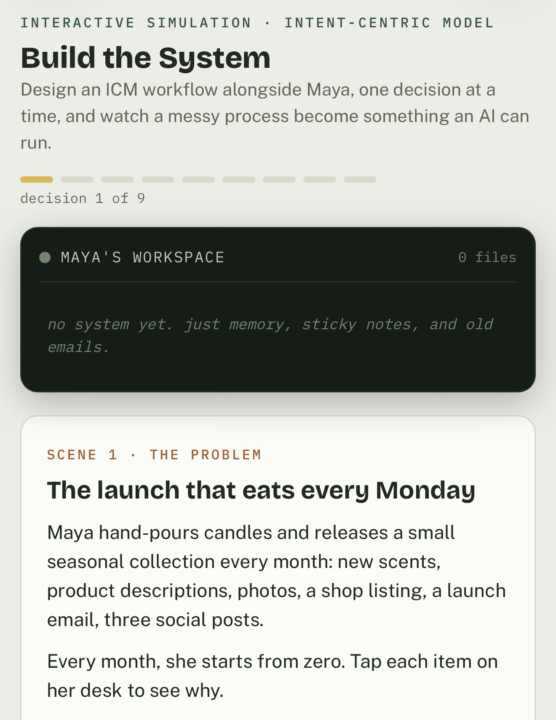
New to ICM? Get hands on learning experience here
Step-by-step interactive guide from idea to output. Design an ICM workflow alongside Maya, one decision at a time, and watch a messy process become something an AI can run again and again. Right now, Maya has to try to remember what needs to be done and where each piece of information is kept. She needs a better solution. https://claude.ai/public/artifacts/7c9618f4-8324-4048-902c-cbcf77c9c102 Let’s build one with her. 😀

2h •
ICM vs OKF
Someone asked about this on the call tonight ... According to AI ... ICM (Interpretable Context Methodology) — developed by Jake Van Clief, this treats folder structures as agentic architecture, using numbered stages (01_research, 02_drafting) where each stage operates under a strict contract in a CONTEXT.md file (AI Tinkerers) . It's the workflow layer — the filesystem literally is the state machine, so one AI agent can execute complex, transparent, human-reviewed pipelines without heavy orchestration code. Google's OKF (Open Knowledge Format) — this is not OKR. It's a separate, newer standard (announced June 2026) for the memory layer — essentially a structured way of storing "facts" an agent can read/write from, one markdown note per fact. How they fit together: Google's OKF handles the memory layer while the ICM methodology handles the workflow layer — a workflow reads from memory and writes back to it, so each run makes the agent's memory smarter (Theaioperator) . Practically: two folders — memory/ (OKF-style, one note per fact) and workflow/ (ICM-style, one CONTEXT.md per step) — with a human check between steps. Is anyone extending their folder to combine these?
1-30 of 2,536

skool.com/cliefnotes
What we give away free beats most paid courses. Build durable AI systems with a Marine vet and Edinburgh researcher. 40+ lessons, growing.
Leaderboard (30-day)
1

🔥
+1752
2

+1217
3
+1035
4

+839
5

+767
Powered by