
11h • 📚 Resources & Finds
Folders are the architecture, not the code around them
I just watched the Jake Van Clief breakdown, and the biggest thing that stood out to me was that folder structure can replace orchestration code.
It clicked because I already run my travel brands from one structured workspace, and the video explained why the structure matters and why the agent still drifts from it.
My main takeaway was that one agent reading the right files at the right moment can do what a multi-agent framework does, with fewer tokens and a system I can open and read myself. The experiment at the end helped me understand.
Going forward, I’m going to run my next new process through the ICM workflow first, with a contract file and a check at every step, before I write any automation code.
Why the AI doesn’t follow the ICM structure
- The structure is advice, not enforcement. The agent only obeys a CONTEXT.md if it opens it. Nothing forces that, so under time pressure it reads the entry file and starts working.
- The entry file gets too big. The method says the entry file should stay under about 60 lines and only route. Rules buried in a long file get skipped, and they are the first thing lost when a long session is summarized.
- No check at the end of a step. Without a check, a misplaced file is never caught. The method’s answer is that every step ends at a check, and a fail stops the run.
- Nobody owns cleanup. The agent drops new files next to whatever it has open instead of on the right shelf. With several sessions running at once, each one adds mess and none removes it. Your git add <directory> incident is this same problem in git.
- Cleanup is risky, so agents avoid it. Moving a file means finding everything that points at it, including things outside the tree. Skipping the move is the safe choice for the agent.
How to make it clean up
Run the method’s own Restructure steps, with you approving at one point:
- Inventory only. List the tree and what points at each file. Nothing moves yet.
- Classify every file as catalog, contract, factory, product or dead.
- Propose a migration map (old path, new path, role, referrers). You approve it.
- Copy, verify, then remove. Dead files go to _archive/, never deleted.
- Run the walk test. An agent with no memory must orient itself from the files alone. python -I _tools/links.py checks that every link and input path still resolves.
When
- At the end of every stage, as that stage’s check.
- At the end of every session. The method says a session should end in artifacts the structure can shelve.
- When a routing file grows, because it is absorbing content that belongs on a shelf.
- After parallel sessions, before anyone commits.
- Never in the middle of a task, and never by deleting.
The step with the best payoff is a Stop hook that runs links.py, the same way your memory link check already runs. That makes the check happen without anyone remembering to ask.
1
0 comments
Folders are the architecture, not the code around them
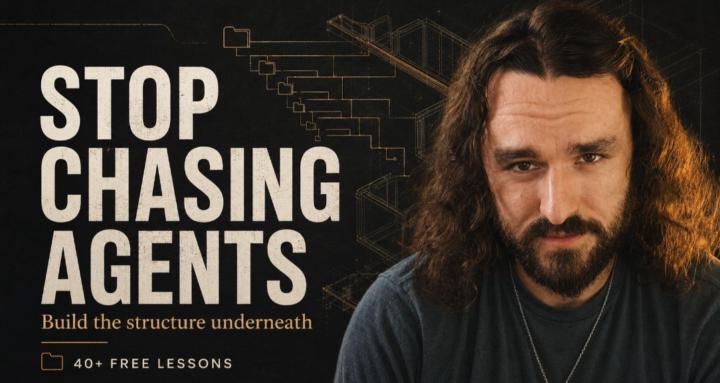
skool.com/cliefnotes
What we give away free beats most paid courses. 40+ lessons, growing.
Leaderboard (30-day)
1

+698
2

+515
3

+429
4

+339
5

+325
Powered by