
Write something

May 24 •
Your Team Is Not the Problem — Your Systems Might Be
One of the biggest things leadership has taught me is this: Most organizations do not need more motivation.They need stronger leadership systems. Over the years I have watched incredible employees burn out inside organizations where: - communication was unclear - accountability was inconsistent - managers were overwhelmed - systems were reactive instead of intentional - leadership was operating in survival mode The problem usually was not that people did not care. Most people cared deeply. But motivation alone cannot fix broken systems. At some point organizations need: ✔ Clear communication ✔ Leadership development ✔ Operational structure ✔ Consistent expectations ✔ Accountability systems ✔ Sustainable workflows Strong leadership is not just inspiring people to work harder. It is creating environments where people are actually supported enough to succeed. Some of the most important leadership work is not flashy. It is: - rebuilding trust - improving communication - addressing difficult issues - creating clarity - building systems that reduce chaos instead of adding to it That is the kind of leadership work that changes organizations long term. What do you think organizations are struggling with most right now: People problems… or systems problems?

May 23 •
I forgot the cookie today… and apparently life as we know it was over
Every horse person knows this rule: if you forget the cookie, there will be consequences. And trust me… I paid for it. She made sure I understood my mistake. 😂 But honestly, it got me thinking about leadership. If something as small as a cookie can completely change a horse’s attitude, energy, and willingness to work with you… what are the “cookies” we’re giving our teams? Not huge bonuses. Not giant corporate initiatives.The small things. • Recognition • A thank you • Feeling heard • Flexibility • Encouragement • Trust • A quick check-in • Celebrating small wins Sometimes the smallest gestures create the biggest shift in morale, motivation, and connection. People don’t just remember how hard the work was. They remember how they felt while doing it. So… what’s the “cookie” your team needs right now?
2
0

Apr 18 •
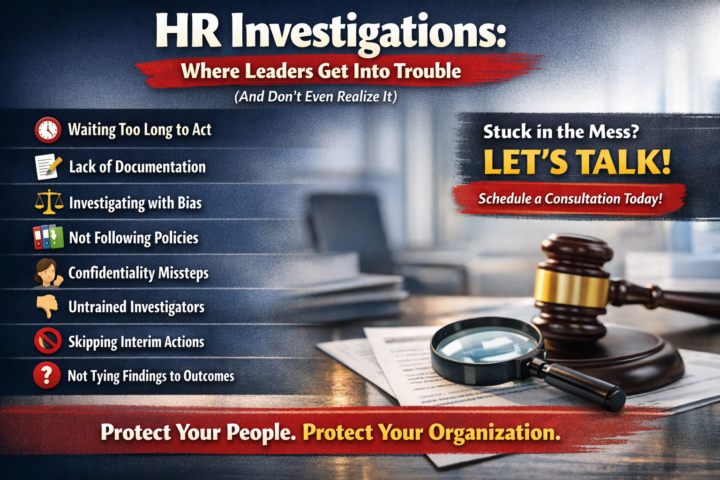
🚨 HR Investigations: Where Leaders Get Into Trouble (and Don’t Even Realize It)
Let’s talk about one of the most high-risk areas in leadership and HR: workplace investigations. I’ve seen this firsthand—good leaders, strong organizations… still end up exposed because of how an investigation was handled, not just the situation itself. Here are the biggest trouble spots I see over and over: 1. Waiting too long to actDelays create liability. The moment you become aware of a potential issue—especially involving harassment, discrimination, or vulnerable populations—you are on the clock. “Let’s see if it resolves itself” is not a strategy. 2. Lack of documentation (or poor documentation)If it’s not documented, it didn’t happen—legally speaking.But worse? Inconsistent or biased documentation that can be picked apart later. 3. Investigating with biasThis one is huge.Pre-judging based on tenure, personality, or “who you trust” will completely undermine the integrity of your process. 4. Not following your own policiesYour handbook is not a suggestion.If your process says one thing and you do another, that becomes a compliance issue fast. 5. Confidentiality misstepsOver-sharing OR under-communicating can both cause damage. You need to protect privacy while still maintaining transparency of process. 6. Untrained investigatorsNot every manager should be running an investigation.There’s a difference between managing people and conducting a legally sound investigation. 7. Skipping interim actionsSometimes you need to act before the investigation is complete (schedule changes, administrative leave, separation of parties).Not doing so can put people—and your organization—at risk. 8. Not tying findings to outcomesYou completed the investigation… now what?If your conclusions don’t clearly connect to your disciplinary decisions, you open yourself up to claims of inconsistency or unfair treatment. 💡 Bottom line:Investigations are not just about finding the truth—they’re about protecting your people, your culture, and your organization. If you’re in the middle of something messy… or even just feeling unsure if you’re handling it correctly—don’t wing it.
1
0
1-3 of 3
powered by

skool.com/business-leadership-trenches-8973
Real-world business leadership. Practical tools, tough conversations, and honest support for leaders in the trenches.
Suggested communities
Powered by