
Write something

Jun 30 •
"It's just temporary."
In 1974, a temporary 20-inch bypass pipe was installed to keep production running while a reactor was repaired. Then it failed under pressure, released 30 tons of cyclohexane, and killed 28 people. 1.Apply strict time limits to temporary changes - Set a hard expiration and a named owner. 2.Require the same hazard review for temporary work as permanent work - Production pressure is exactly when shortcuts feel justified and are most dangerous. 3.Confirm the people designing the change are qualified to design it - At Flixborough, the bypass was installed by personnel who weren't professionally qualified engineers.
Jul 2 •
"MOC was completed by someone, I don't see that item but I'm sure they considered it."
If the MOC isn't a technical review this could still have dire consequences when production is established. 1.Pressure-test the technical basis of every change against its protective systems - The question isn't "does this work?" but rather "what does this change isolate, defeat, or bypass?" 2.Put a fresh set of eyes on overpressure protection - Isolation from a PSV is one of the most common and lethal review misses. 3.Don't confuse a thorough process with a thorough analysis - A signed MOC with a flawed hazard review is more dangerous than no MOC, because it creates false confidence.
Jul 2 •
"Let's fix this now before the review is done, I don't want to have to start an MOC"
We've heard it before and it is a common thread. Incidents have different decades, different chemicals, different industries, same root cause: a change that wasn't properly identified, reviewed, documented, or communicated. 1.Stop treating MOC as paperwork - It is the management system that prevents uncontrolled change from becoming unacceptable risk. 2.Recognize the pattern repeats across all contexts - Imperial Sugar was a dust explosion from conveyor modifications; MOC applies far beyond classic PSM chemical processes. 3.Audit your program against recurring failure modes - Unmanaged temporary change, ignored organizational change, inadequate hazard review, and incomplete documentation/PSSR.
Jul 1 •
"The process isn't effected, no MOC needed"
Most plants run MOC on equipment and chemicals. Far fewer run it on organizational change like budget cuts, staffing reductions, restructuring. Both Bhopal and BP Texas City show what happens when workforce and resource changes get implemented with no safety-impact review. 1.Expand your MOC trigger definition - Staffing levels, budget cuts to mechanical integrity, and reduced qualified workforce are all changes that demand review. 2.Ask "what safeguard does this decision lean on?" - At Bhopal, disabled safety systems and a thinner workforce stacked invisibly. 3.Make the safety-impact review of organizational change documented - Quantifying this impact is crucial to maintain an efficient, safe process.
0
0
Jun 30 •
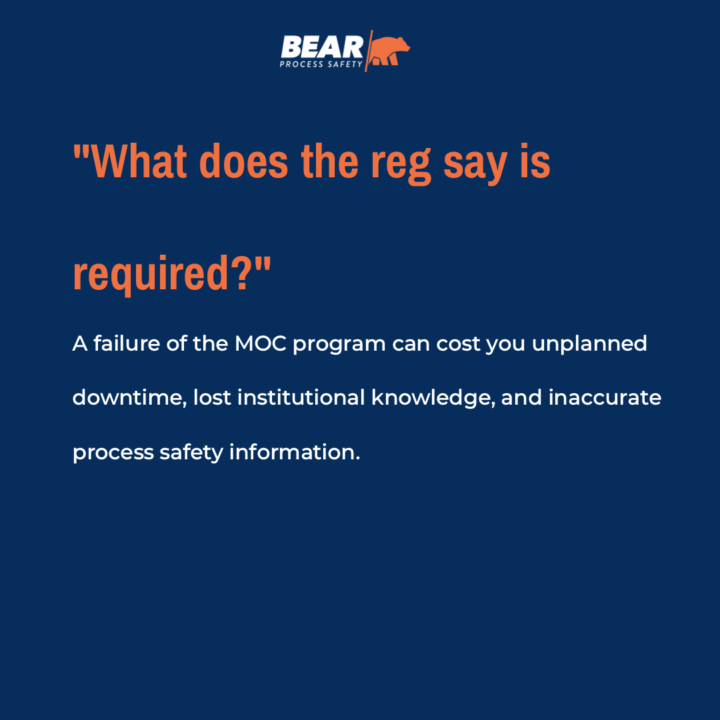
"What does the reg say is required?"
A failure of the MOC program can cost you unplanned downtime, lost institutional knowledge, and inaccurate process safety information. 1. Design your MOC to be multifaceted - Handle risk management, operational reliability, and knowledge preservation. 2.Use MOC to fight knowledge loss - When experienced operators retire, a strong MOC record turns individual memory into permanent records. 3.Track downtime caused by undocumented changes - Create budget solutions by efficient management
0
0
1-20 of 20
skool.com/bear-process-safety
Community for basic and advanced training.
Powered by