

Mar 1 •
AI Is a Multiplier - So What Is It Multiplying in Your Business?
AI does not fix businesses. It multiplies them. That sounds empowering - until you realize it multiplies whatever already exists. If your messaging is clear, AI amplifies clarity. If your offers are confusing, AI accelerates confusion. If your systems are tight, AI increases efficiency. If your operations are chaotic, AI scales chaos. That’s not a criticism. It’s leverage math. Before asking “How can I use AI more?” a better question is: “What is AI going to multiply?” Where Multiplication Shows Up AI tends to amplify: - Messaging clarity (or lack of it) - Decision frameworks - Repetition patterns - Operational structure - Emotional tone in communication If your thinking is structured, AI becomes structured. If your thinking is reactive, AI mirrors that too. This Is Why Early AI Adoption Feels Weird Some people experience huge gains quickly. Others feel like it’s adding noise. Often the difference isn’t intelligence or tech skill. It’s baseline clarity. AI cannot manufacture strategic clarity. It can only expand what’s already there. Prompts to Run a Multiplication Audit What parts of my business are already strong and consistent? What parts feel unstable or unclear? If AI amplified both of these, what would improve and what would get worse? Where am I trying to use AI to compensate for something I haven’t clarified yet? Key Takeaway AI is leverage. Leverage increases force - it doesn’t choose direction. Before expanding usage, strengthen the foundation. Reflection: What do you feel confident AI would multiply well in your business right now? AI Multiplication Audit: Prompts to Run Inside ChatGPT If AI is a multiplier, the smartest move isn’t “use it more.” It’s “understand what it would amplify.” Use the prompts below to run a clarity audit inside ChatGPT. Take 20–30 minutes and actually answer them fully. The depth of your input determines the quality of insight. 1. Identify What’s Already Strong Here’s a high-level overview of my business: [describe your offer, audience, and revenue model]
0
0
Feb 18 •
Custom GPT VS Project with AI
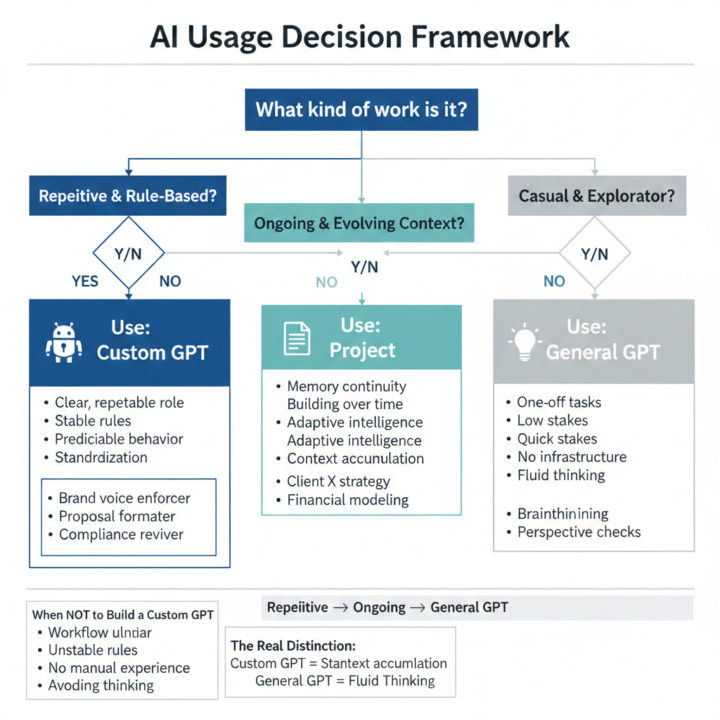
🧠 1️⃣ When a Custom GPT Makes Sense Use a Custom GPT when: - The role is clear and repeatable - The rules don’t change often - You want predictable behavior - You might let someone else use it - You don’t want to re-explain context every time Think of it like hiring a specialist with a job description. Examples of Good Custom GPT Use Cases - Brand voice enforcer - Proposal formatter - Client onboarding checklist guide - Sales page reviewer with fixed criteria - Compliance reviewer - SOP builder following your exact format - Content repurposer with specific output structure These are “same job, over and over” roles. When It’s Worth Programming One Ask yourself: - Will I use this at least 10+ times? - Does it need consistent formatting? - Would mistakes be costly or annoying? - Do I want to remove decision-making from this task? If yes → Custom GPT is usually worth it. What It’s NOT Great For - Open-ended brainstorming - Strategic ambiguity - Situations that change often - Early-stage thinking Because custom GPTs are structured by design. 📁 2️⃣ When Projects Make More Sense Projects are powerful when: - Work is ongoing - Context evolves - You’re building something over time - You need memory continuity Projects are less about roles and more about environment. Think: - A specific client - A specific product launch - A specific research initiative - A book you’re writing - A business model you’re refining Projects let ChatGPT remember: - Documents - Decisions - Preferences - Ongoing threads Without locking it into rigid behavior. Examples of Good Project Use Cases - Client X marketing strategy - Automated CEO content planning - Offer redesign - Course development - Monthly newsletter drafting - Long-term financial modeling These benefit from adaptive intelligence over time. 🌊 3️⃣ When the General GPT Is Actually Enough Sometimes people overcomplicate this. You don’t need a Custom GPT or a Project if:
Jan 25 •
The Difference Between AI That Feels Helpful and AI That Feels Useless
You’ve probably seen both sides. Some people say: “AI saves me hours.” Others say: “I tried it… didn’t really get the hype.” What’s interesting is that the tool is the same. The difference isn’t intelligence, tech skill, or creativity. It’s how AI is positioned in the business. Why AI Feels Useless for So Many People AI tends to disappoint when it’s used like this: ❌ Random & Reactive - Opening it only when stuck - Asking one-off questions - Expecting magic without context ❌ Treated Like Google - Searching instead of conversing - Asking for answers instead of clarity - Skimming outputs instead of refining them ❌ No Continuity - No memory - No patterns - No understanding of why something matters That kind of AI use will always feel shallow. Why AI Feels Genuinely Helpful for Others Helpful AI usually shows up in these ways: ✅ Consistent, Not Constant It’s not used all day - it’s used regularly for the same kinds of thinking. Examples: - Drafting similar responses - Reviewing decisions - Pressure-testing ideas ✅ Context-Rich Helpful AI knows: - What you’re working on - What you’ve already decided - What success looks like to you Not because it’s advanced - but because context was shared over time. ✅ Positioned as Support, Not Savior The most satisfied users don’t ask AI to “do everything.” They ask it to: - Reduce friction - Catch blind spots - Carry repetitive mental load That’s a huge distinction. Common Business Use Cases (No Setup Required) Here are ways people naturally experience AI as helpful - without deep training: 🧩 Clarity & Direction - Talking through messy ideas - Exploring options before committing - Sorting thoughts when everything feels tangled 🔁 Repetition Relief - Rewriting similar explanations - Creating consistency across messages - Reducing “starting from scratch” energy 🔍 Perspective Checks - Asking, “What might I be missing?” - Spotting assumptions - Stress-testing plans before execution
Feb 15 •
You Don’t Need More AI Tools - You Need Fewer Jobs
Most people approach AI asking: “What can this tool do?” A better question is: “What job am I tired of doing?” AI becomes useful when it has a role, not just access. Why Tools Aren’t the Answer More tools usually mean: - More decisions - More setup - More cognitive load That’s the opposite of leverage. Think in Roles, Not Features AI works best when it’s assigned jobs like: - Drafting - Reviewing - Organizing - Checking consistency - Exploring options Not “everything.” Just specific relief points. Everyday Roles AI Can Quietly Fill - Explaining things once so you don’t have to - Helping you think before you act - Making sure you didn’t forget something important - Reducing “starting from zero” energy These aren’t flashy - they’re freeing. Prompts to Assign Roles (Copy / Paste) 🧑💼 Role-Clarifying Prompts Here are tasks I’m tired of doing repeatedly: [list them] Which of these could AI reasonably support? I don’t want AI to replace me. I want it to support me in this role: [describe role] How could that look? 🧠 Delegation-Style Prompts If AI were my assistant, what would I *not* ask it to do — and why? Help me decide which tasks require my judgment vs support. Key Takeaway AI becomes powerful when it’s delegated responsibly. Not as a replacement. As relief. 💬 Reflection: If AI could take one job off your plate tomorrow, what would you choose?
Feb 8 •
AI Can’t Run Chaos - But It’s Incredible With Structure
AI is powerful - but it’s not magic. It doesn’t thrive in mess. It thrives in patterns, repetition, and clarity. This is why AI feels amazing in some businesses… …and totally useless in others. Why Chaos Breaks AI AI struggles when: - Every task is different - Decisions aren’t documented - Nothing repeats consistently Not because AI is limited - but because there’s nothing to anchor to. Why Structure Changes Everything Structure doesn’t mean rigid systems or complicated workflows. It can be as simple as: - Doing things in the same order - Naming decisions instead of rethinking them - Not reinventing the wheel every week AI loves that kind of predictability. Where Structure Shows Up (Even If You Don’t Call It That) - Weekly routines - Repeating client questions - Standard ways you explain your offer - Regular decisions you revisit over and over Anywhere something repeats = leverage potential. Prompts to Explore Structure (No Building Required) 🔁 Pattern-Spotting Prompts Help me identify patterns in my business that repeat weekly or monthly. Ask me questions if needed. Here’s a list of things I do over and over: [list them] Which of these would benefit most from consistency? 🧩 Decision-Clarity Prompts What decisions am I re-making that could be decided once and reused? Help me turn this recurring situation into a simple repeatable approach: [describe situation] Key Takeaway AI doesn’t replace structure. It amplifies it. If things feel messy, that’s not a failure - it’s a signal. 💬 Reflection: Where does your business feel most chaotic right now - and where does it already have quiet structure?
0
0
1-15 of 15

skool.com/automatedceo
Automate the hard shit, save hours, and run your business like a CEO with simple weekly AI workflows and no-BS training.
Powered by