
Write something

6d •
Something new for those who have followed the Pyramid project 👇
You already know the copper Sierpinski pyramid. Now the whole project is on one page, with a 4-minute video that explains it from start to finish. The pictures here are new renders from the 3D model. https://allistarcenter.com/great-pyramid-copper-fractal In the video you will see: • why the proportions of the Great Pyramid of Giza, and why each face folds into eight facets • how it is built, step by step: V-cradles, glass-fibre tubes, 133 printed joints, a black fractal layer and 108 copper panels • why the number nine keeps appearing, since 27, 108 and 324 all add up to nine • why copper and a fractal, as our working idea On the page you can also: 🔹 flip through every part, with labels that say what each one does 🔹 listen to C♯ in different octaves and see how it relates to the Schumann resonance, as a parallel to explore 🔹 read the Bashar session behind the design It is still a design, not a finished pyramid at full size. That is exactly why I would love to hear what you notice, and what questions the video leaves open.


9d •
Little mouth
Signal One is a recent prime movie that has a large merkaba called little mouth and is used to sent a message across quantum space where alians pick it up. Movie is ok but I think it’s interesting that they used the Sierpinski fractal antenna to send and receive messages.
8d •
🌍 New on Allistar Center: The Planetary Grid Vision, a living research page
Friends, I want to share one of the most surprising discoveries of my research, and a new living page where you can explore it yourself. 👉 https://allistarcenter.com/planetary-grid-vision Two pieces of guidance, years apart Years ago I had a vision: nine great circles divide the Earth into 48 identical triangles, with a Space-Time Antenna at the centre of each one. Together they create a standing wave around the whole planet that magnifies and amplifies the Earth’s own electromagnetic field, so that power becomes accessible everywhere. In a private session in 2020, I described it to Bashar and asked whether this was what Nikola Tesla had in mind when he wanted to power the entire planet wirelessly. Bashar answered: “Yes, exactly.” He confirmed that the grid and Tesla’s vision are the same idea, and then gave me the dimensions of each antenna. Separately, Bashar had described a sphere divided by 26 vectors, 45° apart: the structure of a tesseract, which taps into all other dimensions at once. I couldn’t build it from a sphere, so I built the closest solid shape in copper: a truncated cuboctahedron, with 26 rods ending in copper spheres, all joining at the centre. This shape grows out of Buckminster Fuller’s vector equilibrium, the cuboctahedron. It is the only form in which every vector from the centre is exactly as long as the edges around it: perfect balance. The vector equilibrium has 12 corners, 8 triangles and 6 squares: 26 parts in all. My 26 copper rods point at every one of them. 12 rods point to its corners, 8 to the centres of its triangles (the tips of the Merkaba), and 6 to the centres of its squares. My copper shape is the vector equilibrium with its corners cut off, so each corner becomes a new square face. The discovery Only now have I seen how the two connect. The nine great circles from my vision, which are part of Fuller’s vector-equilibrium system, create exactly my copper shape. When you link each of the 48 antennas to its nearest neighbours on the globe, the links form a truncated cuboctahedron wrapped around the Earth:

11d •
How to use Great Pyramid Proportions for Meditation
Here is a PDF of our private session where Bashar explained how we can use the Great Pyramid and what results we can expect. You can also see a miniature model with a 30 cm base, along with a top-view image showing the eight sides he mentioned. I'm also including a PDF with basic 3D renderings, a breakdown of all the parts, and a list of materials needed to build it, so you can calculate the cost. The request came from Alexandro, who is willing to build it in Bali but wasn't sure about the materials or the construction in general. I simply decided to organize the information a bit. We can iterate on this and improve it or explore different approaches. In my opinion, the fractal structures and conductive materials are what enhance the effect and allow us to make the structure smaller while potentially achieving a similar effect. I thought it would be good to share this here with you guys.

Feb 3 •
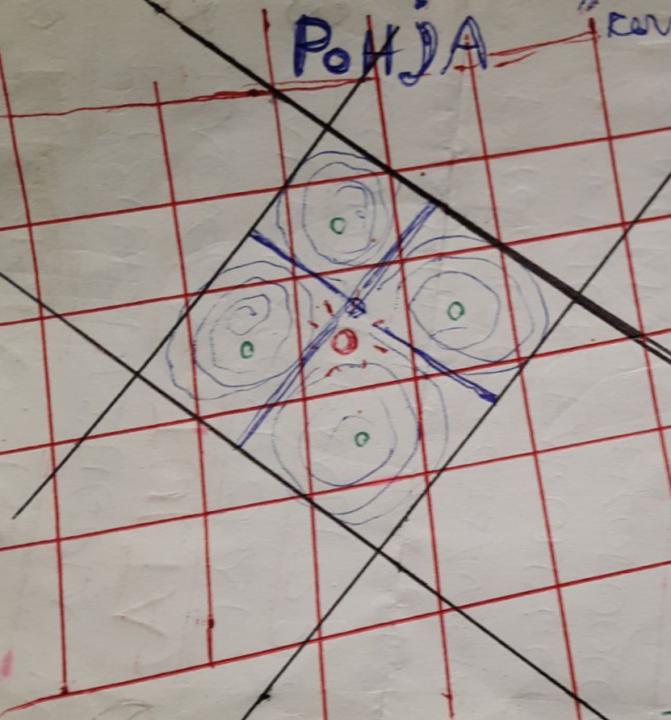
Energy-grid Layout
This is a very crudely done layout picture of the "checkerboard" energy-grid, but it will help to get the point. My father has been mapping them independently for over 20 years, along with trees and plant fields, crystals fields and all the conscious fields along that. Better sketches are coming later. The Black lines are downward going energy "walls", they have a big force in them, it feels bad to stand on them for a long period. Each side of the line is ~6m long. The corners point to cardinal points, north-south-west-east. We call them *Earth penetrating lines*. The Red lines are smaller and upward going energy walls they "overlap" the Earth penetrating lines. We call them *Ascending lines*. Each side of the line is 2m long. Also being on these lines for long period can make you restless, not as much as on the penetrating lines tho. Its corners point to half-cardinal points. At each of the energy-grid "arks" there is at the most middle point an beam or pillar of energy we call the *Middlepole*. (Its marked as red dot on the picture.) It shoots up to the northern sky, somewhere up to the "Polaris star". This middlepole feels very sacred and powerful. Same kind of energy pole is also on top of any fire. It can be felt by just watching the fire without any thoughts in mind. Then breathing inside and allowing eyes to travel upwards over the flame/candle. Very uplifting. Then about meter to north from the Middlepole is a *Spring* which "bubbles" almost water-like energy from underground. (Its marked as the blue dot on the picture.) At different times the Spring might shoot the "waters" with high pressure. Forth from it flows 4 small *Streams/Channels* which stop at the *Earth Penetrating walls* and goes down with them, thus dissecting the Ark into 4 sections. Now in each of these 4 sections there are the *Vortexes*. My english is not well enough to portray how the vortexes look like. (They are marked on the picture as the green dots and swirls.) In each section the vortexes are mirroring the opposite vortex.
1-30 of 153
powered by

skool.com/allistar-center-4289
This is the Metafusion community blending Technology with Consciousness, Science with Metaphysics. We connect what seems to be polarity into one idea.
Suggested communities
Powered by