

🔥
12d •
🌀 AI Quirks — The AI Attention Test Face-Plant
Researchers gave advanced AI models a version of the classic Stroop test, where the model has to ignore the obvious answer and follow the actual instruction. For example, imagine seeing the word BLUE printed in red ink. A human is supposed to say the ink color, not read the word. That sounds simple, but it tests whether you can slow down, ignore the automatic response, and stay focused on the task. The AI models did well when the test was short and simple. But as the task got longer and more demanding, performance dropped sharply. Some models reportedly fell from above 90% accuracy to near failure. 🌀 The Practical Point AI often fails when the job requires it to keep resisting the obvious answer over and over again. That is the face-plant. AI can look brilliant when the task is: “Answer this one question.” But it can struggle when the task becomes: “Follow this rule carefully, keep following it, ignore distractions, do not drift, and do that 100 times in a row.” That matters in real life because many business tasks are not one-shot answers. They are consistency tasks. Review every invoice the same way. Apply the same policy every time. Check every contract against the same rule. Follow the workflow without improvising. Stay inside the guardrails even when the next item looks familiar. 🌀 Short-Story Angle AI can explain the Stroop test. AI can probably write a college essay about the Stroop test. But when researchers asked AI to actually take the Stroop test, it eventually wandered off like a substitute teacher who lost the lesson plan. The lesson is simple: AI does not just need intelligence. It needs attention. And in business, attention is often where the money is. To read the full article, click here. A classic brain test exposed AI's biggest weakness Date: June 10, 2026 Source: PNAS Nexus
🔥
Feb 17 •
🌀 The Quick Quip — Small Daily AI Wins Add Up
🌀 You don’t need to binge AI — you need to practice it. ✨ Why This Quip Matters Many people treat AI like a crash diet or bootcamp — intense for a day or two, then gone. The real power of AI isn’t in the big sprint; it’s in consistent, daily use. Small experiments, brief daily reps, and intentional practice build fluency over time. One better prompt. One practical use case. One improvement a day. That’s what turns AI from a tool into a capability. Consistent habits beat frantic pushes every time. 📹 Real Story of the Week — Video Insight 👉 https://youtu.be/c7zp3w-QX9U Advice for Programming Beginners: How to Get Started with AI Agents — a video by Lex Freidman and Peter Steinberger (creator of OpenClaw) on YouTube. In this video, Peter breaks down how beginners should approach AI: not by trying to master everything fast, but by building foundational habits first — start small, learn a bit each day, and integrate AI agents gradually into your workflows. Rather than aiming for perfection, the video emphasizes experimentation, iteration, and practical application as the keys to progress. Pro Tip: Consistent daily practice matters more than occasional deep dives.
🔥
26d •
🌀 Quick Quip: Why Humanoid Robots Feel Like Form Over Function
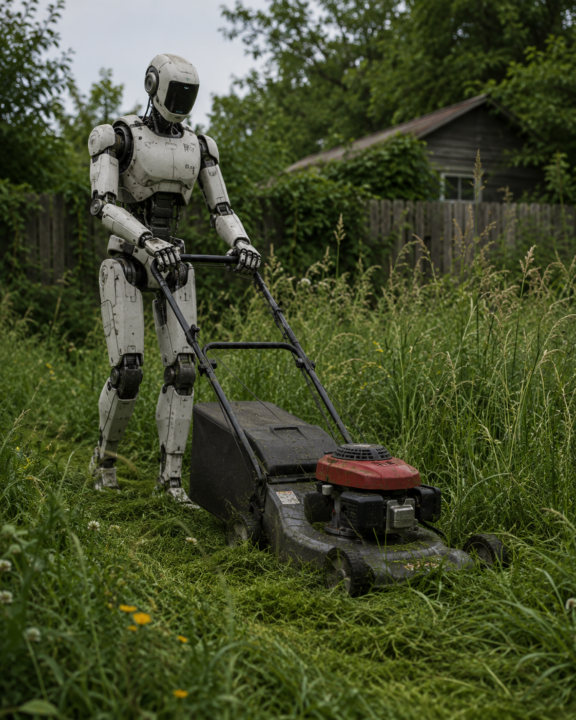
Okay, I am going to say something I may be completely alone in thinking. I keep coming back to the same question. Why are we so obsessed with making robots look like us? I understand the argument. The world was built for humans. Doors. Stairs. Tools. Handles. Factories. Warehouses. Kitchens. Vehicles. So the logic makes sense on the surface. Build a robot shaped like a human and it can operate inside the world humans already built. Fair point. But then I look at a humanoid robot pushing a lawn mower (illustrative) through tall grass, and I cannot help but ask: Is that really the best solution? A purpose-built mowing machine seems far more logical than a human-shaped machine using a human-designed tool to perform a machine-friendly job. A humanoid robot mowing the lawn looks futuristic. But the boring machine built specifically to cut grass may actually be the better answer. And that just makes me pause and shake my head. Because this is where humanoid robots start to feel more like form over function. They look impressive. They photograph well. They feel like the future we were promised in movies, cartoons, and science fiction. But impressive is not the same as useful. And familiar is not the same as optimal. Maybe humanoid robots are necessary because we are trying to automate environments that were designed around people. Maybe they are a bridge technology. A way to bring robotics into homes, businesses, factories, and job sites without rebuilding the world around the robot. That is possible. But I still wonder if we are making a deeper mistake. Maybe we are not just designing robots to solve problems. Maybe we are designing robots in our own image because we still struggle to imagine intelligence, labor, and usefulness without putting ourselves at the center. That is the tension. We say we want machines to do the work better. But then we keep making the machine look like the worker. That is a very human thing to do. And maybe that is exactly the problem.
🔥
Mar 22 •
🎉 AI in Real Life: Party Planning w/ ChatGPT (Not What You Think)
I had a conversation with a friend recently that stuck with me. “I asked ChatGPT how to keep a conversation going.” 💬 What? Why? “Small talk,” they said. They’re the kind of person who shows up, listens, and pays attention. But when there’s an opening to jump into a conversation, they don’t always take it. Not because they don’t have anything to say. More because they’re not always sure where to go next. So they tried something different. 🌱 A few years ago, that probably would have sounded unusual. Now it doesn’t. What stood out wasn’t the question itself. It was what it replaced. This is the kind of thing people used to: - Ask a friend about - Talk through with a mentor - Work out over time through trial and error Now they’re opening a phone or a laptop and starting there instead. 🔄 We talked through a simple example. Someone says: “I went golfing yesterday.” ⛳ Most people go here: - “What did you shoot?” Which is fine. But it often ends quickly. Instead, ChatGPT suggested shifting the direction: - “How did you get into golf?” - “Do you play regularly?” - “What do you enjoy most about it?” Same moment. More momentum. 🏌️♂️ They told me the difference wasn’t dramatic. They didn’t suddenly become outgoing. They just didn’t get stuck. They stayed in conversations a little longer. Asked a few better questions. Moved past that pause where things usually stop. And that points to something bigger. 💡 People are using AI for the kinds of personal conversations. Not to replace human input. To prepare for it. They’re using it to: - Think through problems logically - Remove emotion before responding - Practice conversations before they happen - Get quick advice It is not for final answers. It is to gain clarity - and confidence. And that’s the shift. 🎯 AI isn’t just helping people produce. It’s helping them process. ✨ That's AI in Real Life.

🔥
May 15 •
AI in Real Life: Down 32lbs & Counting with ChatGPT
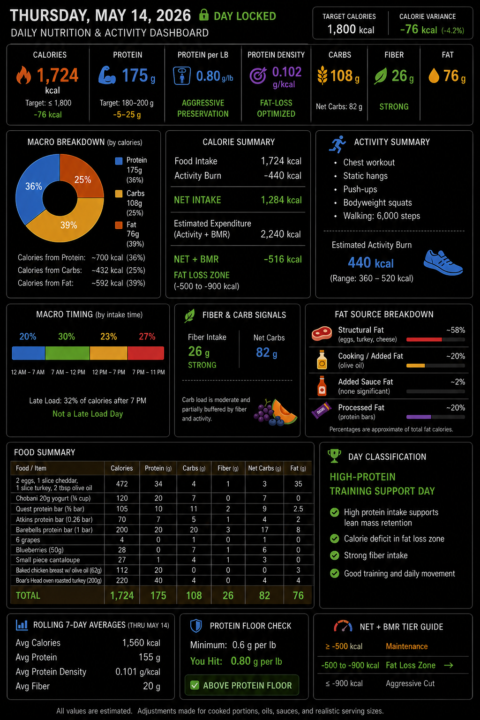
Back on my birthday, I stepped on the scale at 249.5 lbs alongside some pretty funky blood pressure and blood sugar readings. Today, I weighed in at 217.5 lbs Down 32 pounds! And more importantly… starting to feel like myself again. Since turning 60 on December 16th, I made a commitment to live my next best decade — physically, mentally, spiritually, professionally, and personally. God willing. People have asked me what changed this time. Honestly… two things. First, I hired a highly recommended nutrition and fitness coach, @Felix Urbanek who helped bring structure, accountability, and consistency to the process. Second, I tracked everything using ChatGPT. Every step. Every calorie. Every workout. Every small adjustment. Nothing extreme. Nothing glamorous. Just awareness and consistency stacked day after day. What surprised me most was how easy AI made the process feel. No spreadsheets. No complicated apps. No mental gymnastics trying to remember what I ate three days ago. Just simple conversations between ChatHPT and me that helped me stay engaged and accountable. And that matters. Because most people do not fail from lack of information.They fail from losing consistency. The interesting thing about AI is that it can quietly reduce friction in everyday life in ways people are only beginning to understand. Not by replacing effort. But by helping us sustain it. And that is a segue into the next series. I am going to show you how to do two things at the same time: Leverage ChatGPT as a nutrition and activity tracker… while also learning how LLMs actually work behind the scenes. Memory. Context. Projects. Drift. and more… Real-world AI learning… wrapped inside a real-world health journey. Now that’s AI in Real Life. Make it a ❤️ healthy day.
1-30 of 44
skool.com/ai-bits-and-pieces
AI lessons you can read in under 3 minutes and apply in everyday work and life.
Leaderboard (30-day)
1

+109
2

+45
3

🔥
+42
4

+23
5

+22
Powered by