
Pinned

💎
⭐
1d •
your 67% discount expires today
Quick heads up. Your 67% discount on One Person AI Agency expires today. This is the complete playbook from building an AI agency to $100K/month and selling it. The client acquisition system, the pricing, the delivery process. Everything. It normally runs $299. Right now it's $99. That changes tonight at midnight. -> your 67% discount expires today PS: If you are an AIS+ member, this is included in the Scale module after 90 days. No need to purchase separately. - Nate
Pinned
💎
⭐
2d •
🚀New Video: Build & Sell Claude Code Operating Systems (2+ Hour Course)
This is the full walkthrough of how I build my AI Operating System inside Claude Code, from the frameworks I use to think about it (the Three Ms and the Four Cs) to the actual setup, connections, skills, and routines that run while I sleep. By the end you'll know exactly how to set up your own AIOS, even if you've never opened Claude Code before. The full template, docs, and resources are free in my school community linked below. GITHUB REPO
Pinned

🔥
1d •
🏆 Community Wins Recap | Apr 25 – May 1
From AI roles and first clients to live receptionist systems and enterprise training deals - this week inside AIS+ showed what happens when builders stop watching and start executing. 🚀 Standout Wins of the Week inside AIS+ 👉 @Griffin Maklansky went from being laid off to landing an AI Workflow Builder role in just 1 month. 👉 @Ahmed Bin Faisal landed another $2,000 USD client — an interior design firm — and broke down exactly what led to the close 👉 @Narsis Amin built a working AI restaurant receptionist handling bookings, availability, and CRM logging end-to-end. 👉 @Josh Holladay closed a $4.5K (+$1K) client with half up front today — and dropped his top 10 lessons from the close 👉 @Dion Wang received his first official testimonial, validating real client impact and around 40 hours/month saved. 🎥 Super Win Spotlight | @Duy Nguyen Duy started as an engineer who was curious about AI — but unsure how to turn that curiosity into something real. After joining AIS+, he went from learning passively to building his own AI-operated business, Sharper Automations. Since then, he has: • Built a 24-agent AI business operating system • Landed 2 local paying clients through word-of-mouth • Created a system that improves itself weekly through feedback loops • Started moving toward his goal of leaving his corporate job His biggest shift? From “Can I really do this?” → to building a real business around AI automation.


8d •
Suggestion
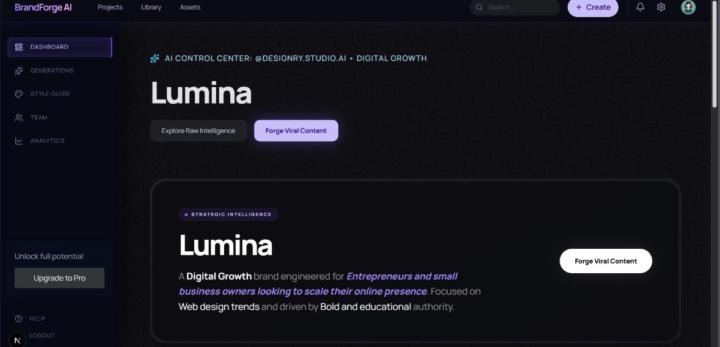
I turned 19 yesterday. And I realized something interesting… I’m running out of time. So instead of overthinking — I built. From 12 AM to 4 AM, and again 9 AM to 11 AM… I vibe-coded a custom AI branding analyst + carousel generation system. Here’s what it does: → Analyzes your Instagram brand → Fixes your positioning & visual identity → Generates premium, high-converting carousel posts → (Next step) Auto-posting + scheduling via Meta Graph API Before this? I was: Manually generating carousels Fixing designs myself Spending 5–6 hours per post Now it’s becoming a system. Not just content… A branding engine. Currently: Not hosted yet (testing internally) UI/UX still being refined Output quality being pushed to “premium” level But the direction is clear. We’re moving from: “Posting content” → to “Building systems that grow accounts automatically” Curious to hear your thoughts: Should I integrate Meta’s official API for auto-posting… or use third-party tools like Buffer/Hootsuite for faster execution?

🔥
42m •
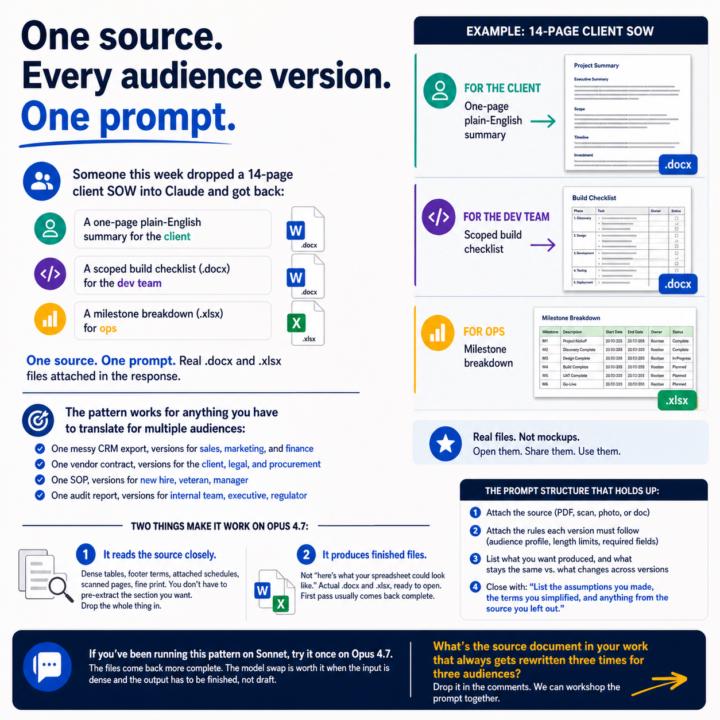
One source. Every audience version. One prompt.
Someone this week dropped a 14-page client SOW into Claude and got back: - A one-page plain-English summary for the client - A scoped build checklist (.docx) for the dev team - A milestone breakdown (.xlsx) for ops One source. One prompt. Real .docx and .xlsx files attached in the response. The pattern works for anything you have to translate for multiple audiences: - One messy CRM export, versions for sales, marketing, and finance - One vendor contract, versions for the client, legal, and procurement - One SOP, versions for new hire, veteran, manager - One audit report, versions for internal team, executive, regulator Two things make it work on Opus 4.7: 1. It reads the source closely. Dense tables, footer terms, attached schedules, scanned pages, fine print. You don't have to pre-extract the section you want. Drop the whole thing in. 2. It produces finished files. Not "here's what your spreadsheet could look like." Actual .docx and .xlsx, ready to open. First pass usually comes back complete. The prompt structure that holds up: - Attach the source (PDF, scan, photo, or doc) - Attach the rules each version must follow (audience profile, length limits, required fields) - List what you want produced, and what stays the same vs. what changes across versions - Close with: "List the assumptions you made, the terms you simplified, and anything from the source you left out." That last line is what lets you trust the output. You review the decisions Claude made instead of comparing every line against the source. If you've been running this pattern on Sonnet, try it once on Opus 4.7. The files come back more complete. The model swap is worth it when the input is dense and the output has to be finished, not draft. What's the source document in your work that always gets rewritten three times for three audiences? Drop it in the comments. We can workshop the prompt together.
2
0
1-30 of 16,247
skool.com/ai-automation-society
Learn to get paid for AI solutions, regardless of your background.
Leaderboard (30-day)
1

+5723
2

🔥
+4369
3

+3844
4

+2328
5

+885
Powered by