
Pinned

💎
⭐
8d •
🚀New Video: Claude Code for Non-Coders (6 Hour Course)
This is a complete beginner course on becoming AI native with Claude Code, no coding background required. I take you from your very first prompt all the way to building your own skills, sub-agents, a second brain, and automations that run on their own in the cloud. It's all real examples and step-by-step builds, so you can follow along and walk away with AI systems that actually do work for you. Feel free to skip around using the timestamps below to whatever piques your interest.
Pinned

🔥
2d •
🏆 Weekly Wins Recap | July 11 – July 17
From first clients and AI OS deals to app launches, time-saving systems, and members finally pressing publish - this week inside AIS+ showed what happens when opportunity meets preparation. AIS Live may have ended. The action didn’t. 🚀 Standout Wins of the Week inside AIS+ 👉 @Charles Cooper III turned one hour a day into 143 automations, 4 working AI voice agents, a full operations system, and his first real client engagement. 👉 @Michael Wacht turned a 25-minute AI talk for 125 business owners into 12 conversations, 5 leads, 2 appointments, and a 50-hour AI OS project. 👉 @Hearty Dave reduced a 120-hour quarterly reporting process to roughly one hour, saving his agency an estimated $18,000 in time every year. 👉 @Ameeth B. shipped his first n8n build: an HR agent that reads policies and prepares grounded Gmail draft replies for human review → First n8n HR agent 👉 @Tanya Maslach used the momentum from AIS Live to publish two polished LinkedIn videos and build a Chief of Staff agent that prepares useful context before meetings. ⸻ 🎥 Super Win Spotlight | @Wyatt Lyonsmith Wyatt joined AIS+, built his first project, landed his first client, and got paid while learning how to use the tools. That first delivery became proof he could show other business owners - leading to introductions, new conversations, and opportunities across different industries. His biggest lesson? You don’t need the whole journey figured out. Build one thing. Help one client. Take the next step.

Pinned
💎
⭐
Jun 3 •
What do you get if you upgrade to AIS+?
Some of you have never heard of the AIS+ community. Others have but the part that trips you up is the actual difference between the two. Either way, this post will give you clarity. This free group is a bundle of quick resources pulled from my YouTube videos, plus a massive open community that anyone can join. It's a great place to get your bearings and see what's possible. But it's open to everyone, it can be noisy and overwhelming, and there's no path through it. You can get help from other members, but I rarely answer questions here. AIS+ is the opposite: - A step by step roadmap with a clear order, so you're never guessing what to do next - A much smaller community of people who are seriously committed to building and selling AI agents - I answer questions every day and run a weekly Q&A call where you can get direct access to me For the course material: The roadmap takes you from zero to building and selling AI agents, and the whole thing is built on the latest tech like Claude Code and Codex. We update it constantly. The old n8n material has been archived. It's still there if you want it, but it's no longer the focus, because the way you build today has moved on and the courses moved with it. Here's the actual roadmap inside, in order, with when each piece opens up: 1. Start Here (opens the moment you join). Gets you oriented. How the community works, the path ahead, and how to get help when you need it. 2. Build Your Portfolio (opens the moment you join). Why a portfolio matters, beginner level tutorials, and what types of projects to focus on. You end up with real work you can show a client. 3. Claude Code (opens the moment you join). This is now its own dedicated course. Build faster, turn ideas into working automations, and go deep on the tool serious builders are using right now. This takes you from beginner to advanced, step-by-step. 4. Get Your First Clients (opens after 30 days). Getting your first clients is hard, because you don’t have any case studies yet. So, we analyzed all of the success stories from our members and found they get their initial clients with two different techniques: warm outreach and Upwork. So, we teach both techniques in detail with exactly what to say, exactly how to position yourself when you have no proof.
💎
⭐
11d •
🚀New Video: Fable 5 Just Built Me a Business With One Prompt
I gave Claude Fable a single goal prompt: build me a complete company from scratch, starting with nothing but the open internet. A few hours later I had a real product, a landing page, two launch videos, a founder video, a business plan, and market research, all built by hundreds of subagents that Fable planned, delegated, and reviewed. In this video I walk through everything it produced and break down the exact prompt that made it happen.

2m •
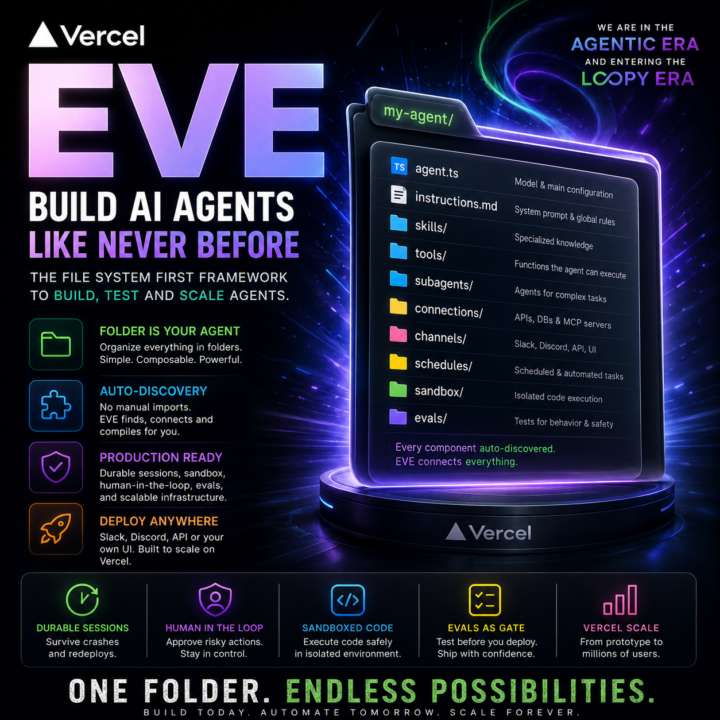
Vercel EVE Framework Agent
In the **AGENTIC ERA**, and already entering the **LOOPy ERA**, Vercel is launching a framework for creating agents from a folder-based structure. ## What Is Vercel EVE? **Vercel EVE** is an open-source framework for building and deploying AI agents using an architecture based on files and folders. In practice, the entire agent is organized inside a single folder: ```text agent/ ├── agent.ts ├── instructions.md ├── skills/ ├── tools/ ├── subagents/ ├── connections/ ├── channels/ ├── schedules/ ├── sandbox/ └── evals/ ``` Each directory represents one of the agent’s capabilities: * `agent.ts`: defines the model and the main configuration; * `instructions.md`: contains the system prompt and global rules; * `skills/`: specialized procedures and knowledge; * `tools/`: functions the agent can execute; * `subagents/`: specialized agents for more complex tasks; * `connections/`: APIs, databases, and MCP servers; * `channels/`: Slack, Discord, an API, or a custom interface; * `schedules/`: automated and scheduled tasks; * `sandbox/`: isolated code execution; * `evals/`: behavior and security tests. EVE’s main differentiator is automatic component discovery. You do not need to manually import every skill, tool, or subagent into the main file. The framework scans the folder structure, identifies the components, and generates a manifest with everything connected. This turns the file system into a kind of declarative configuration for the agent. Instead of writing one massive central file: ```ts import toolA from "./tools/toolA"; import toolB from "./tools/toolB"; import skillA from "./skills/skillA"; import investigator from "./subagents/investigator"; ``` You simply place each component in the correct folder, and EVE handles the integration during compilation. In addition to organization, EVE adds capabilities required for production: * durable sessions; * recovery after failures or redeployments; * sandboxed code execution; * human approval for risky actions; * testing before deployment;
1-30 of 21,721
skool.com/ai-automation-society
Learn to get paid for AI solutions, regardless of your background.
Leaderboard (30-day)
1

🔥
+7628
2

🔥
+7241
3

+6363
4

🔥
+4447
5

🔥
+3769
Powered by