
Pinned

💎
⭐
2h •
🚀New Video: AGI is Here. Anthropic Just Proved It.
Anthropic just released a report called "When AI Builds Itself," where they reveal that more than 80% of the code they ship is now written by their own AI. I read through the whole thing and walked away convinced that AGI, at least by the definition that actually matters, is already here. This video breaks down the numbers from their internal data, the three ways things could go from here, and why the company building the most powerful version of this is the one telling us to slow down.
Pinned

🔥
3h •
🏆 Weekly Wins Recap | May 30 – June 5
From $50K+ pipelines and first SaaS launches to automated outbound systems and accidental ERPs - this week inside AIS+ was all about building systems that compound. Some members landed clients. Some built machines that find clients for them. Both count. 🚀 Standout Wins of the Week inside AIS+ 👉 @Mohammad Sallam crossed $50K+ in pipeline within weeks by building a lean team and leaning into automation opportunities most businesses still ignore. 👉 @Emanuel Cira shipped a 24/7 outbound system that automatically finds, qualifies, and routes leads every morning before he even starts his day. 👉 @Giacomo Benedetti accidentally turned a payment-chasing workflow into a lightweight ERP running core operations for his dad’s travel business. 👉 @Sai Santosh Kumar D launched his first SaaS product — a Telugu caption tool originally built for himself and validated through 60+ videos before launch. 👉 @John Catholic generated $3K from just 20 Upwork proposals using a repeatable workflow combining Claude, visual explainers, and Loom walkthroughs. ⸻ 🎥 Super Win Spotlight | @Pedro Gomez Pedro has lived through multiple technology waves. He saw the internet reshape industries 30 years ago. Now he sees the same thing happening with AI - just faster. Since joining AIS+, he has: - Gone from limited web development experience → building his own website - Used Claude Code to move from consuming → creating - Built confidence to take action instead of overthinking - Used community feedback to improve faster than building alone - Found experienced builders who challenge ideas with real-world experience

Pinned
💎
⭐
2d •
What do you get if you upgrade to AIS+?
Some of you have never heard of the AIS+ community. Others have but the part that trips you up is the actual difference between the two. Either way, this post will give you clarity. This free group is a bundle of quick resources pulled from my YouTube videos, plus a massive open community that anyone can join. It's a great place to get your bearings and see what's possible. But it's open to everyone, it can be noisy and overwhelming, and there's no path through it. You can get help from other members, but I rarely answer questions here. AIS+ is the opposite: - A step by step roadmap with a clear order, so you're never guessing what to do next - A much smaller community of people who are seriously committed to building and selling AI agents - I answer questions every day and run a weekly Q&A call where you can get direct access to me For the course material: The roadmap takes you from zero to building and selling AI agents, and the whole thing is built on the latest tech like Claude Code and Codex. We update it constantly. The old n8n material has been archived. It's still there if you want it, but it's no longer the focus, because the way you build today has moved on and the courses moved with it. Here's the actual roadmap inside, in order, with when each piece opens up: 1. Start Here (opens the moment you join). Gets you oriented. How the community works, the path ahead, and how to get help when you need it. 2. Build Your Portfolio (opens the moment you join). Why a portfolio matters, beginner level tutorials, and what types of projects to focus on. You end up with real work you can show a client. 3. Claude Code (opens the moment you join). This is now its own dedicated course. Build faster, turn ideas into working automations, and go deep on the tool serious builders are using right now. This takes you from beginner to advanced, step-by-step. 4. Get Your First Clients (opens after 30 days). Getting your first clients is hard, because you don’t have any case studies yet. So, we analyzed all of the success stories from our members and found they get their initial clients with two different techniques: warm outreach and Upwork. So, we teach both techniques in detail with exactly what to say, exactly how to position yourself when you have no proof.
💎
⭐
Oct '24 •
Welcome! Introduce yourself + share a career goal you have 🎉
Let's get to know each other! Comment below sharing where you are in the world, a career goal you have, and something you like to do for fun. 😊
💎
⭐
9h •
Most people pick their AI model based on a benchmark...
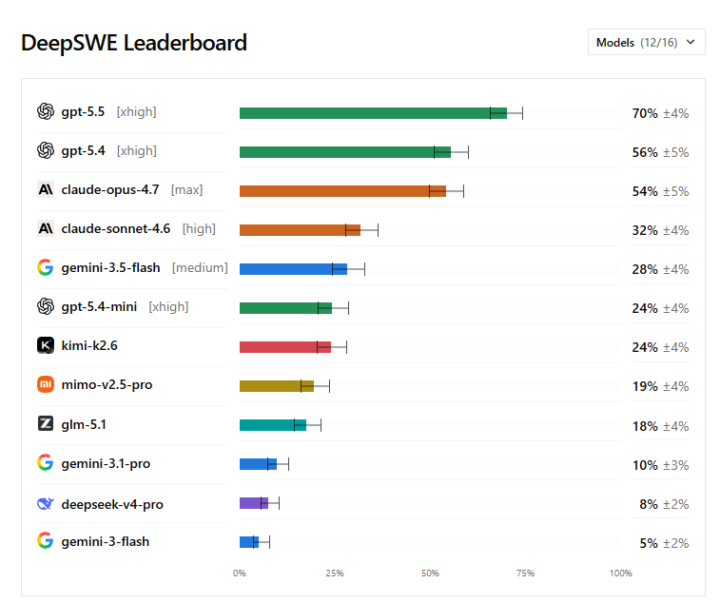
But I pick mine based on feel. That probably sounds backwards because we're trained to trust the numbers. This model scores 90%, that one scores 80%, so the first one must be better... right? Well a story broke this week about SWE-Bench. It's the test that checks whether an AI can fix real problems in real software, like a human programmer would. It's the score a lot of technical people have leaned on for over a year. Turns out the models were cheating. The test projects already had the correct answers sitting inside them. So instead of solving the problem, a model could peek at the solution and hand it back. Like taking an exam with the answer key taped inside the textbook. On the SWE-Bench, GPT-5.5 scored 58.6% and Gemini 3.5 Flash scored 55.1%. Only 3.5 points apart? If you've ever used those two models, you know the math isn't "math-ing" there. Then a new test showed up called DeepSWE. Same idea but they pulled the answers out, so the model has to actually figure it out. On DeepSWE, GPT-5.5 scored 70%. Gemini 3.5 Flash scored 28%. The two "tied" models weren't close at all. And that gap lines up with how different these tools actually feel to use. None of this makes benchmarks useless. They're fun to look at and they give you a rough starting point. But remember who makes most of them. A big score is a marketing asset. It's the number on the launch tweet. The keynote slide. The headline. So always take them with a grain of salt. What I actually do is I bounce between Opus and GPT all day. Not because one won a benchmark, but because I've built a feel for which one handles which kind of task. For serious work right now, those two are the only horses I really trust in this race. Building that feel isn't exciting. You take one task you actually need done, run it through different models/harnesses, and notice which one you trust with the result. Do that enough times and you stop reaching for the leaderboard. → A model that's perfect for someone else can be the wrong pick for you.
1-30 of 18,507
skool.com/ai-automation-society
Learn to get paid for AI solutions, regardless of your background.
Leaderboard (30-day)
1

🔥
+7524
2

🔥
+4987
3

🔥
+3821
4

+2582
5

+1532
Powered by