
Pinned

💎
⭐
3d •
🚀New Video: I Turned Claude Opus 4.8 Into My Entire AI Operating System
In this video I show you how I turned Claude Opus 4.8 into my full AI operating system that runs my businesses, holds all my context, and replaces the constant tab switching between apps. I walk through the Four C's I use to build it (context, connections, capabilities, cadence), the mindset shift of working out of Claude Code by default, how I organize files and skills, and the bike method for safely giving agents more autonomy. By the end you'll know exactly how to set up your own AI OS and the trap to avoid when you start handing it real keys. GITHUB REPO
Pinned
💎
⭐
20h •
"AI consultant" is one of the hottest titles in business right now.
But it also has an expiration date. Right now, sticking "AI" in front of "consultant" is a real edge. The search demand is there. The budgets are there. Companies are actively hunting for someone who can walk in, look at their operations, and tell them what to actually do with this stuff. So if you're trying to position yourself, take the label. It works. But the label is the temporary part and we've seen this cycle before. → When Excel showed up, people might've called themselves "Excel accountants." But how ridiculous would it be if someone introduced themselves like that today? → When the internet showed up, people spun up "internet marketing" agencies. Now that's just marketing. AI is doing the same thing to consulting because AI is going to seep into everything. In a few years, the qualifier drops. The consultants who aren't AI native won't be winning business. They'll just be bad consultants. The job under the hood doesn't change. A consultant walks into a business, finds the actual constraint, and prescribes a solution. The newest tech is the toolbox, not the job description. But people take the "AI consultant" title and assume the answer always has to be AI. Sometimes the right call is a database restructure. Sometimes it's a better SaaS tool. Sometimes it's a deterministic workflow with zero AI in it. I'm not saying AI is never the answer. It's the highest-impact tool we've had in a long time. But forcing it where it doesn't belong is how clients lose trust fast. I think about it as a pyramid. → Bottom: deterministic workflows. No AI. Cheap, fast, reliable. → Middle: AI workflows. More power, more cost, more failure modes. → Top: AI agents. Maximum capability, maximum risk, longest time to ship. The higher you climb, the more it costs, the longer it takes, and the more ways it breaks. More risk. Start at the bottom. Only move up when the problem actually demands it. The label "AI consultant" gets you in the door right now. The discipline of solving the real problem with the simplest possible solution is what keeps you there once everyone else catches up.
Pinned

🔥
3d •
🏆 Weekly Wins Recap | May 23 – May 29
From $64K+ in closed deals to first paid projects, first workflows, and first technical builds - this week inside AIS+ showed what happens when builders stop consuming and start moving. Some wins were big money. Some were first steps. Both matter. 🚀 Standout Wins of the Week inside AIS+ 👉 @Jacob West closed two deals in one week — a $22.5K custom software build for a local gym and a $42K AI OS rollout for a mid-market energy business. 👉 @Luca Giovinazzo delivered his first full client project live — 11 n8n workflows, CRM, Telegram bot, inventory alerts, booking system, KPI tracking, user guide, and Loom walkthrough. 👉 @Fadwa Naboulssi landed her first client three weeks into the community — a candidate sourcing workflow on a $150-per-successful-hire commission. 👉 @George Maitland completed his first technical build using Claude Code + n8n MCP — a local content engine with Telegram as the command center. 👉 @James O Neill built a free portfolio site for a friend-of-a-friend’s side hustle… and she insisted on paying anyway. First real money landed. ⸻ 🎥 Super Win Spotlight | @Josh Holladay Josh joined AIS+ because he wanted more than scattered learning. He wanted momentum. Focused content. Better access. And a room full of people actually moving. Since joining, he has: - Closed real client work - Built stronger confidence around pricing and value - Used the portfolio course to get clear on where he was and what needed to happen next - Learned how to turn client conversations into real business opportunities - Found a place to celebrate wins with people who actually understand the journey


2h •
The era of BYOK is ending.
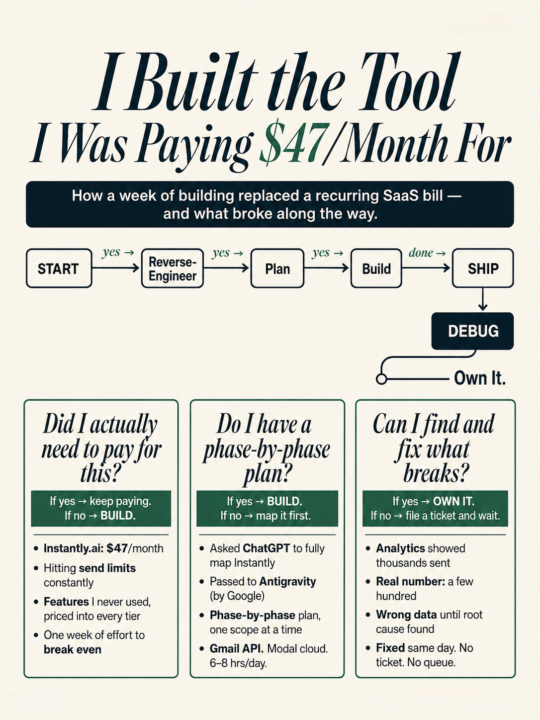
I asked ChatGPT to reverse-engineer a $99 tool. Then I built my own version for $2 a month. A year ago, the smart move was BYOK. Bring Your Own Key. Plug your API key into someone else's tool. Use their infrastructure, their limits, their roadmap. That era is ending. BYOS, Bring Your Own Software, is what comes next. Alex Hormozi coined the term. The premise: coding agents have reached the point where building your own tools is a founder's decision. You scope it, you run the agent, you own what comes out. I wanted to test whether this was real or just another thing people say on the internet. I was paying $47/month for Instantly.ai. Good tool. But their sending limits and built-in SOPs kept capping how far I could scale my outreach. I was paying for a ceiling. So I built Emailify in a week. Six to eight hours a day, treated it like a real project. This is what I do, so it doubled as a way to sharpen my skills with the new generation of coding agents. The process: I asked ChatGPT to fully reverse-engineer Instantly, every feature, every function, the complete picture of what the software does. Then I passed that to Antigravity (by Google), an IDE coding platform, and we built a phase-by-phase plan. Each phase had a clear scope. Each phase fed the next. By the end, I had fully functional outreach software. Multiple campaigns, hundreds of thousands of prospects, unlimited sends, Gmail API, cloud-hosted on Modal. Monthly cost: $2 to $4. A one-week build against $47/month recurring. One month to break even. After that, every month is margin. Now... the bugs. There were bugs. Plenty of them. The analytics kept breaking in a particular way that was genuinely painful to debug. It would report that I had sent thousands of emails when the real number was a few hundred. Completely wrong data, which meant I could not trust my own reports until I found and fixed the root cause. Every SaaS you subscribe to also has bugs. The difference is you cannot see them, cannot touch them, cannot fix them. You file a ticket. You wait. You work around the issue or you upgrade to the tier where it supposedly gets fixed.
💎
⭐
Jan 12 •
🚀New Video: I Built a Voice Agent That Calls Every New Lead (n8n + Vapi)
In this video, I walk you through how I built an outbound voice AI agent that instantly calls new leads after they submit a form, qualifies them, and collects key information before you ever reach out. I break down the full system using n8n for the automation and VAPI for the voice agent, so you can see exactly how the workflow is structured and how the agent actually works. The goal is to help you save time, get better lead context, and increase your conversion rates by showing up to every conversation already informed. If you’re interested in building real AI automations and voice agents that can be used in a business, this is a full step by step breakdown. VAPI SYSTEM PROMPT GOOGLE SHEET TEMPLATE
1-30 of 18,061
skool.com/ai-automation-society
Learn to get paid for AI solutions, regardless of your background.
Leaderboard (30-day)
1

🔥
+7211
2

🔥
+4745
3

+3308
4

🔥
+3304
5

+1307
Powered by