
Pinned

💎
⭐
2d •
🚀New Video: I Turned Claude Opus 4.8 Into My Entire AI Operating System
In this video I show you how I turned Claude Opus 4.8 into my full AI operating system that runs my businesses, holds all my context, and replaces the constant tab switching between apps. I walk through the Four C's I use to build it (context, connections, capabilities, cadence), the mindset shift of working out of Claude Code by default, how I organize files and skills, and the bike method for safely giving agents more autonomy. By the end you'll know exactly how to set up your own AI OS and the trap to avoid when you start handing it real keys. GITHUB REPO
Pinned
💎
⭐
12m •
"AI consultant" is one of the hottest titles in business right now.
But it also has an expiration date. Right now, sticking "AI" in front of "consultant" is a real edge. The search demand is there. The budgets are there. Companies are actively hunting for someone who can walk in, look at their operations, and tell them what to actually do with this stuff. So if you're trying to position yourself, take the label. It works. But the label is the temporary part and we've seen this cycle before. → When Excel showed up, people might've called themselves "Excel accountants." But how ridiculous would it be if someone introduced themselves like that today? → When the internet showed up, people spun up "internet marketing" agencies. Now that's just marketing. AI is doing the same thing to consulting because AI is going to seep into everything. In a few years, the qualifier drops. The consultants who aren't AI native won't be winning business. They'll just be bad consultants. The job under the hood doesn't change. A consultant walks into a business, finds the actual constraint, and prescribes a solution. The newest tech is the toolbox, not the job description. But people take the "AI consultant" title and assume the answer always has to be AI. Sometimes the right call is a database restructure. Sometimes it's a better SaaS tool. Sometimes it's a deterministic workflow with zero AI in it. I'm not saying AI is never the answer. It's the highest-impact tool we've had in a long time. But forcing it where it doesn't belong is how clients lose trust fast. I think about it as a pyramid. → Bottom: deterministic workflows. No AI. Cheap, fast, reliable. → Middle: AI workflows. More power, more cost, more failure modes. → Top: AI agents. Maximum capability, maximum risk, longest time to ship. The higher you climb, the more it costs, the longer it takes, and the more ways it breaks. More risk. Start at the bottom. Only move up when the problem actually demands it. The label "AI consultant" gets you in the door right now. The discipline of solving the real problem with the simplest possible solution is what keeps you there once everyone else catches up.
Pinned

🔥
2d •
🏆 Weekly Wins Recap | May 23 – May 29
From $64K+ in closed deals to first paid projects, first workflows, and first technical builds - this week inside AIS+ showed what happens when builders stop consuming and start moving. Some wins were big money. Some were first steps. Both matter. 🚀 Standout Wins of the Week inside AIS+ 👉 @Jacob West closed two deals in one week — a $22.5K custom software build for a local gym and a $42K AI OS rollout for a mid-market energy business. 👉 @Luca Giovinazzo delivered his first full client project live — 11 n8n workflows, CRM, Telegram bot, inventory alerts, booking system, KPI tracking, user guide, and Loom walkthrough. 👉 @Fadwa Naboulssi landed her first client three weeks into the community — a candidate sourcing workflow on a $150-per-successful-hire commission. 👉 @George Maitland completed his first technical build using Claude Code + n8n MCP — a local content engine with Telegram as the command center. 👉 @James O Neill built a free portfolio site for a friend-of-a-friend’s side hustle… and she insisted on paying anyway. First real money landed. ⸻ 🎥 Super Win Spotlight | @Josh Holladay Josh joined AIS+ because he wanted more than scattered learning. He wanted momentum. Focused content. Better access. And a room full of people actually moving. Since joining, he has: - Closed real client work - Built stronger confidence around pricing and value - Used the portfolio course to get clear on where he was and what needed to happen next - Learned how to turn client conversations into real business opportunities - Found a place to celebrate wins with people who actually understand the journey

💎
⭐
Oct '24 •
Welcome! Introduce yourself + share a career goal you have 🎉
Let's get to know each other! Comment below sharing where you are in the world, a career goal you have, and something you like to do for fun. 😊

15h •
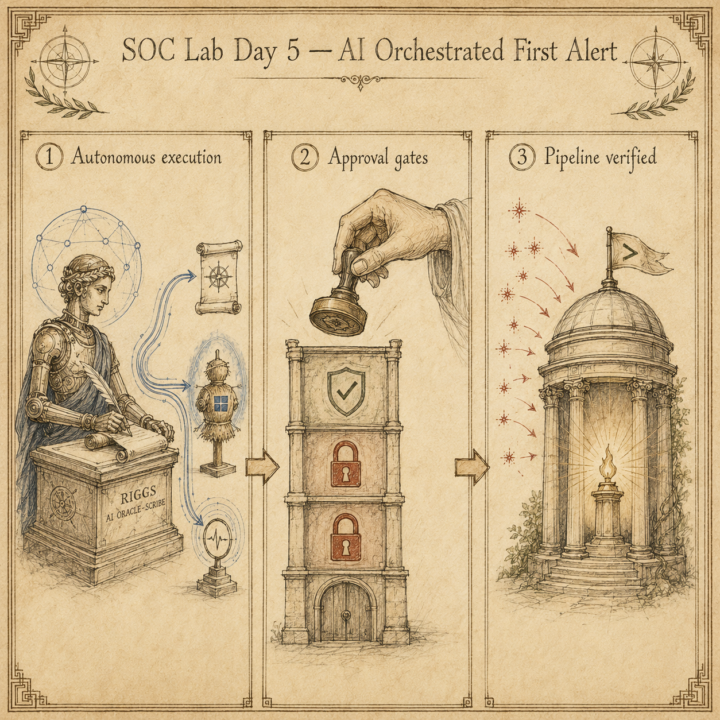
SOC Lab Day 5 - First Real Alert Landed!
I’ve been using RIGGS — a Claude-backed agent running in my terminal — as an orchestration layer, not just a coding assistant. For Phase 2 of the lab, it: provisioned a Windows VM over SSH installed Sysmon installed and configured the Splunk Universal Forwarder shipped telemetry to Splunk on my home server installed Atomic Red Team ran T1003.001 (LSASS credential dump via ProcDump) My role: physical access + final decisions. The most interesting part was watching it hit real-world blockers and work through them. Defender blocked the attack — and also blocked the usual paths used to disable it. RIGGS surfaced each blocker, explained why it failed, proposed the remediation, and executed when approved: execution policy Defender exclusions Tamper Protection LSASS PPL SSH filtered admin token / missing SeDebugPrivilege Once those were cleared, ProcDump dumped LSASS in 1.7 seconds. Then RIGGS checked Splunk and confirmed 19 events. Full kill chain visible. The split was clean: AI handles execution and verification. Human handles approvals, destructive actions, and judgment. That feels like the real opportunity with AI orchestration. Not “AI replaces the operator.” More like the operator stops doing the low-leverage work. Anyone else running AI this way — as an ops layer with human-in-the-loop checkpoints?
1-30 of 17,989
skool.com/ai-automation-society
Learn to get paid for AI solutions, regardless of your background.
Leaderboard (30-day)
1

🔥
+7143
2

🔥
+5029
3

+3574
4

🔥
+3173
5

+1284
Powered by