Activity
Mon
Wed
Fri
Sun
Jul
Aug
Sep
Oct
Nov
Dec
Jan
Feb
Mar
Apr
May
Jun
What is this?
Less
More
Memberships
Cloud Residents · US Credit
1k members • Free
55 contributions to Cloud Residents · US Credit

2d •
Does it constitute tax fraud?
I am a Non-Resident Alien (NRA) currently holding accounts with IBKR and Charles Schwab; I have submitted Form W-8 and received Form 1042-S. I plan to use an ITIN to open a bank account, but since almost all banks require a U.S. address, I intend to use a service like Anytime Mailbox to address this. Does this mean the bank will view me as a resident rather than an NRA? Will the tax forms I receive for income—such as bank interest—be the same as those issued to U.S. residents? Does this result in me having a "dual" tax status with the IRS? Wouldn't this be illegal?

0 likes • 2d
W-8BEN Form is for non-residents. W-9 for residents. So you should be good, you do have to file form 1042-S though, and if you have an active US business there's the FINCEN report too.

2d •
NY DMV-experience for Non-Driver ID application
Went to Manhattan Midtown DMV for the Standard Non-Driver ID. Was really smooth. Made an appointment a month before and already filled out the application online. When I went there my appointment barcode was scanned and I got a number. First I was called for taking the picture, second to go to the "real" counter. I had to give the application, the passport, I-94 admission number and my drivers license or two credit cards. After half an hour I was out of the building with an Interim Document in my hands. It really was as easy as it reads.
0 likes • 2d
Do they give you the paper copy or plastic? Or is plastic sent to your address?
0 likes • 2d
@Stefan S neat, when does that interim doc expire? The one I had was 3 months and plastic was 4 years

6d •
Equifax credit score & report with ITIN
If you struggle opening account with equifax.com or creditkarma for your equifax report & score. Here's an alternative that works - https://www.creditship.ai Got an email invite from firstcard to try it out and works with ITIN. With Creditship.ai, you can: - Get Free Equifax credit monitoring - Receive daily credit alerts and updates - Find the best credit cards or loans for bad credit - Ask AI Creditship anything, anytime
0 likes • 6d
I guess this is Vantage Score 3.0 then Nvm, just read it is. Great info! I couldn't login to credir karma at first. So this is a good alternative. What other info do they have? Like credit report info in detail?

7d •
Stop Chasing Business Credit Scores
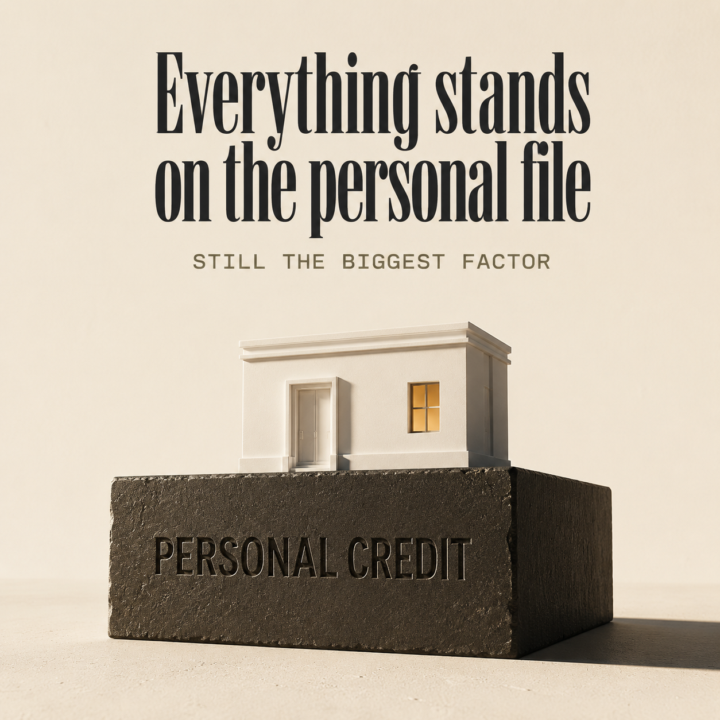
Most people are looking at business funding the wrong way. They obsess over the business credit score, the aged LLC, or some shortcut they saw online. But lenders are not just looking at a score. They are looking at whether your profile makes sense, whether your information is verifiable, and whether your credit history supports the amount you are asking for. Here are the five things that matter more than hype: 1. Personal credit still matters For almost all small business funding, your personal credit profile is still one of the biggest factors. If your personal file is thin, messy, or built mostly on shortcuts, secured tradelines, that can limit what banks are willing to approve. 2. Aged LLC is not magic Buying an aged corporation does not automatically make you fundable. In 2026, lenders care about verification, consistency, activity, banking relationship, revenue signals, and existing credit quality. If the business cannot be verified properly, the age alone does not save it. For most people, starting a clean LLC and building it correctly is better than paying hundreds for an aged entity that adds no real lending strength. 3. Authorized user history is not enough If your credit file is mostly authorized user accounts, lenders can see that. It may help with a score boost in some cases, but it does not prove you personally managed credit at a high level. Banks want to see your own primary accounts, your own positive payment history, and your own credit usage behavior. 4. Your public data has to match This is where many people get stuck without realizing it. Your name, address, business details, phone number, and public records need to be accurate and congruent across systems. LexisNexis, Dun & Bradstreet and other verification databases matter because banks use third-party data to confirm identity and business legitimacy. If your information is inconsistent, outdated, or hard to verify, the application can get slowed down, flagged, or denied.
Poll
13 members have voted
1 like • 6d
@Chrisdy Masson it's always income and personal credit. There's a family member I got with high income in his business but very bad personal credit. This family member got denied cause of this.
1 like • 6d
@Chrisdy Masson additionally, there has to be available income in the checking account. If it's all expenses the bank will definitely deny Though there are data points of credit cards being approved with business income of $5k-10k in the application So it still depends on personal credit
7d •
Underrated Banks and Cards
Hey I was wondering if anyone had suggestions for banks with products worth considering apart from the usual trio of Amex, Cap1, and Chase?
2 likes • 7d
The issue with every bank is customer service. With that said, there's cards like PNC's 2% with no foreign transaction fees. Bank of America has some decent cards. If you got enough money with them the cashback averages 2.5%-3% on every purchase Wells Fargo active cash is great too but idk about travel cards, theirs seem great but Idk about the transfer partners, maybe not worth it that way. Some credit unions have cards with very low interest rates that help during an emergency or high purchase. Like christmas shopping, new roof, new game console, or vacation expenses. So some credit unions' cards are awesome for long term purchases in case you can't use a 0% Intro APR offer card
0 likes • 6d
I haven't been approved for PNC's card, too many inquiries. I definitely have a checking account relationship with PNC
1-10 of 55

Active 7h ago
Joined Mar 29, 2026
Powered by