Activity
Mon
Wed
Fri
Sun
Aug
Sep
Oct
Nov
Dec
Jan
Feb
Mar
Apr
May
Jun
Jul
What is this?
Less
More
Owned by William J.
Our aim is to learn with functional understanding. We can interact in meaningful to daily life. Protect privacy https://incogni.cello.so/IzXO86TrV3D
Memberships
E-Luminating Strength
43 members • Free
Infinite Grit
1k members • Free
The Harshest Environment
81 members • Free
Indestructible Mind
13 members • Free
Contrary Wisdom (FREE)
54 members • Free
Practical Philosophy
708 members • Free
Aporia Academy | Philosophy
57 members • Free
The school of wisdom
19 members • Free
Wisdom and Spirituality
56 members • Free
8 contributions to The Reconnection Circle
Dec '25 •
Sometimes
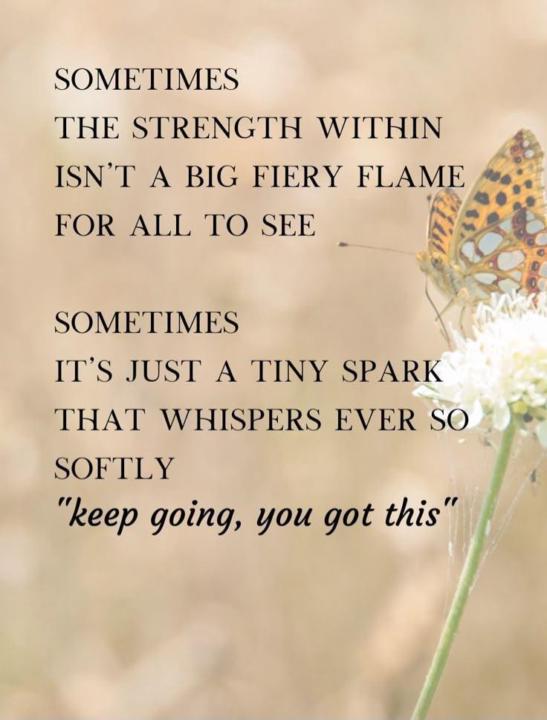
Sometimes we believe strength has to look dramatic. ⦿ Like confidence without doubt. ⦿ Like resilience without tears. ⦿ Like bold action that everyone can see. But the message in this image reminds us of something far more truthful — and far more compassionate. Real strength is often quiet. It’s not always a roaring fire or a powerful comeback story. Sometimes it’s a tiny spark that barely makes a sound. A whisper inside that says, “Keep going.” Not because everything feels okay — but because you chose not to stop. That quiet spark shows up when: ⦿ You get out of bed even though your heart feels heavy ⦿ You set one small boundary instead of fixing everything ⦿ You breathe through the wave instead of being pulled under it ⦿ You keep showing up for your healing, one imperfect step at a time This kind of strength doesn’t seek applause. It doesn’t announce itself. But it is profoundly brave. In emotional well-being, progress is rarely loud. Healing often looks like: ⦿ Choosing gentleness over self-criticism ⦿ Pausing instead of pushing ⦿ Resting instead of proving ⦿ Continuing even when motivation is gone If today all you can manage is listening to that soft inner whisper — that is enough. That whisper is resilience. That spark is hope. And hope doesn’t need to be big to be powerful. So if you’re waiting to feel “strong enough” before moving forward, let this be your reminder: You already are. Not because you feel fearless — but because you’re still here, still trying, still choosing not to give up. And sometimes… that is the strongest thing of all. 💛

0 likes • Jan 31
Your Life’s Work Starts Today: Finding the Courage for a New Beginning
Oct '25 •
“Honor Bound: Making Commitments That Create Success (Your word is your warranty) “
Commitment transforms promises into reality and potential into power. Commitment means staying loyal to what said you’d do long after the mood you said it in has left.
Oct '25 •
“The Fearless Life: How Your Success Journey Starts Now (First class ticket to awesome) “
Fearlessness isn’t about eliminating fear—it’s about not letting fear eliminate your dreams.
0
0
Sep '25 •
“The Crossroads: Every Quit Weakens You, Every Continue Strengthens You “
There is a stark, powerful binary choice. It frames each decision to continue as a deposit into your “bravery bank,” making you stronger, while each quit is a withdrawal that weakens your resolve for future challenges.
1
0
Sep '25 •
Scared to Start? Why You Should Do It Anyway(Fear is just excitement without breath)
The cave you fear to enter holds the treasure you seek—your greatest self awaits.
1-8 of 8

@william-j-stokes-2497
Inspiring the intellect with riddles and quizzes to enhance mindset aspects of life. We have more on “Trusites.online”
“Trusites.com”
Active 2h ago
Joined Aug 24, 2025