
Write something
Feb 15 •
A Comprehensive Guide to Maintaining Mental Health
Mental health is an integral component of overall health and well-being. It influences our thoughts, feelings, and behaviours, impacting how we handle stress, relate to others, and make choices. This guide provides a holistic overview of mental health, common challenges, and evidence-based strategies to cultivate and maintain it, with a specific focus on support and resources available in the United Kingdom
0
0
Dec '25 •
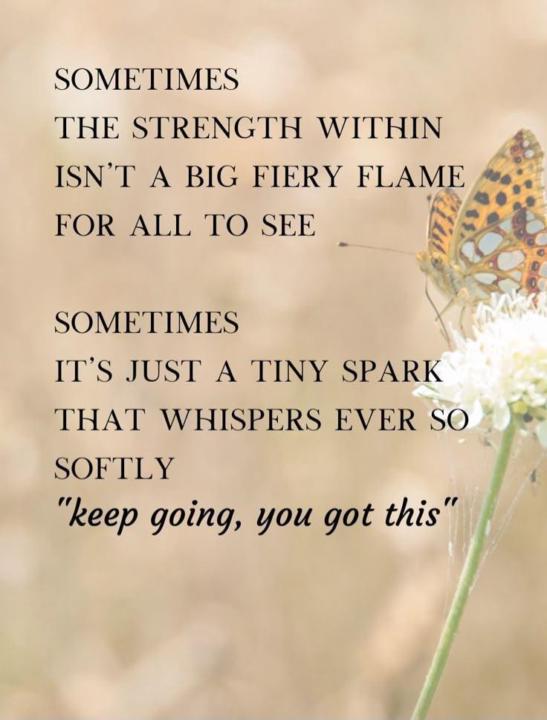
Sometimes
Sometimes we believe strength has to look dramatic. ⦿ Like confidence without doubt. ⦿ Like resilience without tears. ⦿ Like bold action that everyone can see. But the message in this image reminds us of something far more truthful — and far more compassionate. Real strength is often quiet. It’s not always a roaring fire or a powerful comeback story. Sometimes it’s a tiny spark that barely makes a sound. A whisper inside that says, “Keep going.” Not because everything feels okay — but because you chose not to stop. That quiet spark shows up when: ⦿ You get out of bed even though your heart feels heavy ⦿ You set one small boundary instead of fixing everything ⦿ You breathe through the wave instead of being pulled under it ⦿ You keep showing up for your healing, one imperfect step at a time This kind of strength doesn’t seek applause. It doesn’t announce itself. But it is profoundly brave. In emotional well-being, progress is rarely loud. Healing often looks like: ⦿ Choosing gentleness over self-criticism ⦿ Pausing instead of pushing ⦿ Resting instead of proving ⦿ Continuing even when motivation is gone If today all you can manage is listening to that soft inner whisper — that is enough. That whisper is resilience. That spark is hope. And hope doesn’t need to be big to be powerful. So if you’re waiting to feel “strong enough” before moving forward, let this be your reminder: You already are. Not because you feel fearless — but because you’re still here, still trying, still choosing not to give up. And sometimes… that is the strongest thing of all. 💛
Jan 13 •
Bach Flower Remedies
Over the next few days, I will be posting every Bach Flower Remedy and its uses and benefits. If you haven't come across them before, you will be amazed at how subtle yet powerful they are. Bach Flower Remedies: The Natural Way to Balance Your Emotions & Boost Wellbeing. Feeling stressed, anxious, or emotionally out of balance? Discover the power of Bach Flower Remedies – A gentle solution to restore emotional harmony. What Are Bach Flower Remedies? Developed in the 1930s by Dr. Edward Bach, a British physician and homeopath, Bach Flower Remedies are a series of 38 natural plant and flower-based essences designed to address emotional imbalances. Unlike conventional medicine, these remedies work on the mind-body connection, helping to ease stress, anxiety, fear, and other negative emotions. How Do They Work? Bach Flower Remedies are based on the idea that emotional well-being is key to physical health. Each remedy targets a specific emotional state, helping to: Reduce stress and anxiety Boost confidence and positivity Improve sleep and relaxation Enhance emotional resilience. Top 5 Most Popular Bach Flower Remedies 1. Rescue Remedy (The Emergency Formula) The most well-known blend, Rescue Remedy, combines five flower essences to help with acute stress, panic attacks, and emotional shocks. Perfect for exams, public speaking, or sudden crises. 2. Mimulus (For Known Fears) Struggling with specific fears (like fear of flying, spiders, or social situations)? Mimulus helps build courage and calmness. 3. White Chestnut (For Overthinking & Mental Chatter) Can’t stop replaying thoughts in your head? White Chestnut promotes mental peace and reduces repetitive, anxious thinking. 4. Impatiens (For Patience & Frustration) If you’re quick-tempered or easily frustrated, Impatiens helps restore calm and patience in stressful situations. 5. Cherry Plum (For Fear of Losing Control) Helps those who feel they’re on the edge—whether from anger, panic, or irrational thoughts—restoring emotional stability.
1
0
Dec '25 •
🌿 60-Second Calm
9 evidence-based ways to regulate your nervous system (save & share) If your body feels anxious, numb, overwhelmed, or “on edge” — nothing is wrong with you. Your nervous system is doing its best to protect you. These short somatic and grounding practices are designed to work with your body, not against it. Most take under 2 minutes. Pick one. Try it. Notice the shift. 👂 1) The 60-Second Anchor Breath ⏱ 1 minute • Breathe in 5 seconds • Breathe out 5 seconds • Repeat 6 times 💡 Why it works: This pace supports vagal tone and helps the body exit fight-or-flight. 🌬 2) The 4-4-8 Reset ⏱ 90 seconds • Inhale 4 • Hold 4 • Exhale 8 • Repeat 4 rounds 👉 Use when your heart is racing or thoughts feel loud. 👀 3) 5-4-3-2-1 Grounding ⏱ 2 minutesName: • 5 things you see • 4 things you touch 3 things you hear • 2 things you smell • 1 thing you taste 🧠 Brings attention out of panic and back into the present moment. 🦶 4) Muscle Mini-Scan ⏱ 3 minutes • Tense a muscle group for 5 seconds • Release and notice the drop • Move from feet → face ✨ Especially helpful for stored tension and emotional overwhelm. 🚶 5) Grounding Walk ⏱ 2–10 minutes • Walk slowly • Inhale for 3 steps • Exhale for 4 steps • Notice your feet touching the ground 🌱 Regulation through movement. 🤍 6) Hands-On Soothing ⏱ 1 minute • One hand on your heart • One hand on your belly • Gentle pressure + slow breathing Say quietly (or silently):“I am safe right now.” 🗣 7) Name It to Tame It ⏱ 1 minute Gently label what’s happening: “I notice my chest is tight.” “My thoughts are racing.” 🧠 Naming reduces emotional intensity. 🧭 8) Orienting (for dissociation or shutdown) ⏱ 1–2 minutes. Say: • “I am in ___” • “It is ___ time of day” • “I can hear ___” • “I can feel ___ under my body” 📍 Helps bring you back into the here-and-now. 🔄 9) Micro-Movement Reset ⏱ 30–60 seconds • Shake your hands • Roll your shoulders • Stretch• Take 3 slow breaths ⚡ Small movement = big nervous system shift. 💬 How to use these
0
0

Dec '25 •
Where attention goes, energy flows
This means that whatever you consistently focus on begins to shape your inner experience, your emotions, and ultimately your life. Attention is not neutral. It is a form of mental and emotional energy. When you place your attention on something—an idea, a fear, a goal, a memory—you are feeding it. You are giving it life. The mind and nervous system respond by organising thoughts, emotions, and behaviours around that focus. Attention is the steering wheel of the mind Imagine your attention as the steering wheel of a car. You may want to go somewhere new, but if your hands keep turning the wheel in the same old direction, you will end up in the same place again and again. - Focus on problems → the mind searches for more problems - Focus on fear → the body stays in survival mode - Focus on growth → the brain looks for opportunities - Focus on calm → the nervous system begins to settle The brain is designed to strengthen what you repeatedly attend to. Neural pathways grow where attention flows. This is why patterns—emotional, behavioural, and mental—can feel so deeply ingrained. This is not about blame This principle is often misunderstood as “think positive and everything will be fine." That’s not what it means. Many people focus on pain, worry, or threat because, at one point, that focus kept them safe. Hypervigilance, overthinking, and self-criticism were once survival strategies. So this isn’t about judging your focus. It's about becoming conscious of it. Energy follows attention emotionally Emotionally, what you attend to determines how you feel: - Replaying past hurt keeps emotional pain active - Anticipating danger keeps anxiety alive - Noticing small moments of safety builds regulation - Focusing on what is working builds resilience - You don’t need to deny reality. You simply don’t need to live inside the hardest parts of it all day. The power is in gentle redirection Real change happens not through force, but through repeated, compassionate redirection of attention.
0
0
1-22 of 22
powered by

skool.com/emotional-wellbeing-service-1635
Move from emotional instability to emotional resilience in 30 days — through simple daily steps, compassionate guidance, and a supportive community.
Suggested communities
Powered by