Activity
Mon
Wed
Fri
Sun
May
Jun
Jul
Aug
Sep
Oct
Nov
Dec
Jan
Feb
Mar
Apr
What is this?
Less
More
Memberships
Better Privacy
59 members • Free
The AI Advantage
100k members • Free
88 contributions to The AI Advantage

17d •
I’d like to come back
I’m going to attempt to resolve issue that has caused me to disappear! It’s important that there be flexibility and confirmation of what the chance is for my hose because I’ve always been about service before sales and I would like to stop seeing others get high with it and I get things, well I don’t know what’s going on with someone comments on something and I can’t see what it is so I don’t know what’s going on because it’s removed
0
0
Feb 19 •
Your Augmented Intel or Amplifies Intimidation
This is My takeaway from @AI Advantage Team’s post from Meta agenda! Own Mining Your Owned Mind MetaData Manfiested Monetarily!

Feb 18 •
How to avoid post deleted
How can this, "Derica" kind of post/what can of post was it, be avoided?
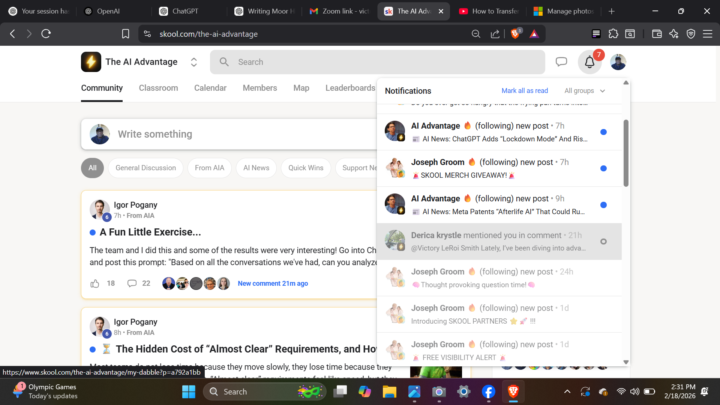
1 like • Feb 19
@Amanda Wilson springing but snowing soon
0 likes • Feb 19
@AI Advantage Team is it always what @Kimi NaAyutthaya is referring to, “spam or scam”?

🔥
Feb 18 •
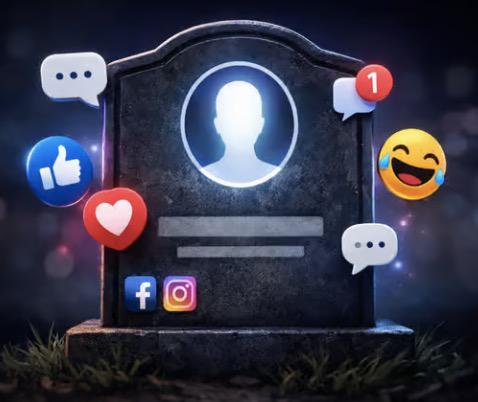
📰 AI News: Meta Patents “Afterlife AI” That Could Run Your Account After You Die
📝 TL;DR Meta has been granted a patent for AI that could simulate a user and keep posting, liking, commenting, and even chatting after they die. Meta says it has no current plans to ship this, but the fact it is patented tells you where the industry is looking next, digital “presence” that outlives the person. 🧠 Overview A newly surfaced Meta patent describes an AI system that can “simulate” a user on social platforms when they are absent, including if they are deceased. The system would learn from a person’s past activity and generate interactions that resemble how they used to communicate online. This lands in the middle of rising concern about deepfakes, identity control, and what happens when platforms can generate content in someone’s name, even after they are gone. 📜 The Announcement Meta has been granted a patent for an AI approach that could continue a user’s social activity through a large language model trained on that user’s history. The patent describes scenarios like long breaks from social media and posthumous activity, where an AI could keep a profile “active” by responding to messages or interacting with content. Meta has publicly downplayed it, saying patents do not necessarily reflect product plans. But the idea is now officially on the table, and people are reacting because it feels like a Black Mirror plot becoming a business option. ⚙️ How It Works • User simulation model - The system trains on your historical activity like posts, comments, likes, and messages to mimic your tone and typical behavior. • Activity continuation - It could generate new interactions such as liking, commenting, replying to DMs, and potentially creating posts as if you were still active. • Absence and death use cases - The patent explicitly frames the model as useful when someone is away for a long time, or cannot return. • Engagement preservation - The concept assumes that when a person stops posting, their followers experience a “gap,” and the platform loses engagement.
0 likes • Feb 18
Intellectual Property, as Inheritance? Seems Optimal to one day create My owned VirtualRealEstate, home of AI, as Intellectual Property?
Feb 2 •
UnIverse Won, Sow, CoreUs
UnIverse Won, People were all pixels, beam your nichency, YaPiXels! The script in your story, evokes life, changing tales. It’s not a time for supremacy, no time for complacency. It is a time to delete the plateau, diversity and come together, we are the Placebo, EnIn Unity. Sow, CoreUs, Shine Brighter than BRIGHT, any and everywhere you go, ignite thee muse fore many pixels, Enlighten their soul. Your spirits radiant beacon light, laser focus pierces sight, darkness pays tolls, resonate Difference making Grace as Thee Rock Your Younique Role.

0 likes • Feb 2
Oops, should be 741Hz, family of 417Hz & 174Hz:
0 likes • Feb 3
Brainstorm with ChatGPT regarding your experience that it will summarize as a niche!
1-10 of 88

@victory-leroi-smith-9406
I Am Certified to Life Coach. Denying negatives. I'm not online when negatively Impacted, Yet I create Courses as DysfunctionalLoveConsciousness
Active 17d ago
Joined Nov 6, 2025
Powered by