Activity
Mon
Wed
Fri
Sun
Aug
Sep
Oct
Nov
Dec
Jan
Feb
Mar
Apr
May
Jun
Jul
What is this?
Less
More
Memberships
AI Automation Society
423.8k members • Free
AI Automation Agency Hub
328.7k members • Free
16 contributions to AI Automation Society

3h •
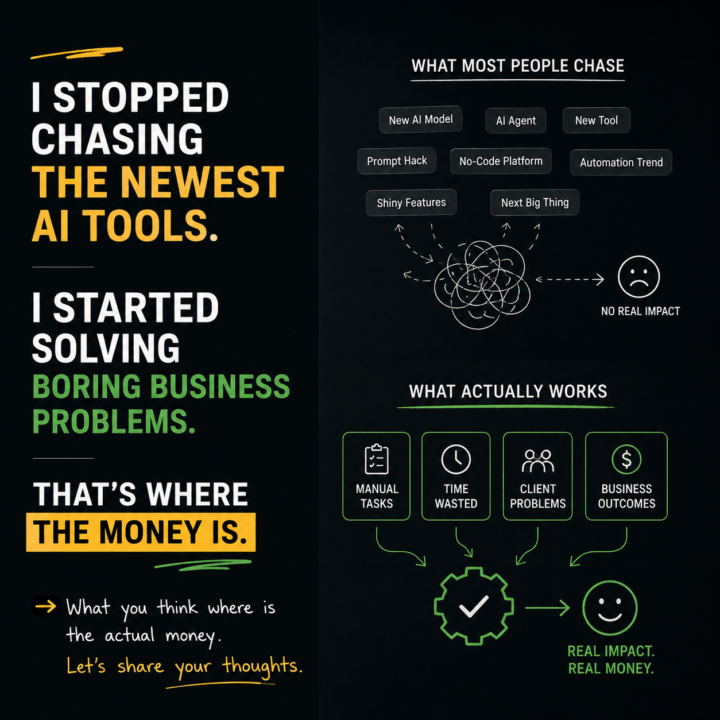
The biggest mistake AI builders are making right now?
I stopped chasing the newest AI tools. I started solving boring business problems. That's where the money is.
0 likes • 3h
What you thinks guys.

5d •
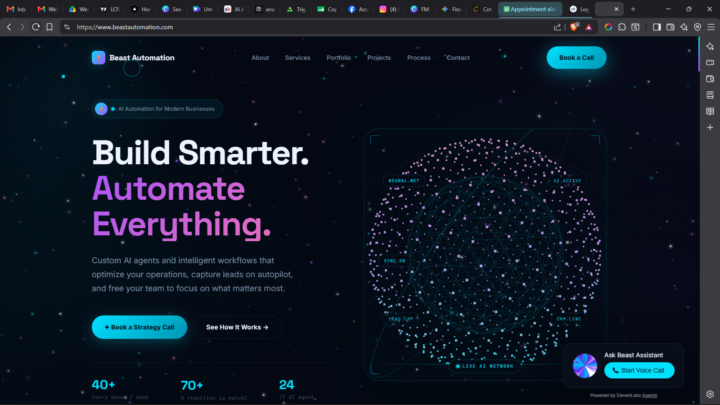
Honest question — does my website look too "AI-made"? 👀
Just launched beastautomation.com and I genuinely want your opinion. I built the whole site using AI — Claude helped me write the copy, design the layout, handle the animations, everything. Took about a week of back and forth. But here's what's been bugging me: When I look at it now, I wonder — can you tell? Does it have that sterile, "ChatGPT built this" energy that makes you trust it less? Because there's a real tension here. I teach people to use AI for business. My whole thing is "AI can do more than you think." So an AI-built site should be on-brand for me. But if a potential client lands on it and thinks "this looks fake" or "no human put thought into this" — that's a problem. So I'm asking the community straight up: 👉 Go check it out: beastautomation.com Then come back and tell me: 1. First impression — what did you feel in the first 3 seconds? 2. Does it look credible or does it look AI-slapped-together? 3. Is an AI-built website a red flag for an AI automation agency — or is it actually proof of concept? No sugar coating please. I'd rather hear it here than lose clients over it silently. 🙏
0 likes • 6h
An AI-built website isn't a red flag for an AI agency. In fact, it's proof of capability. The red flag is when it feels like AI generated it and no human refined it. Yours is much closer to the first than the second. Just add a bit more of you. @Prajwal Bista

1d •
🚨 URGENT — Need help ASAP: Meta Business Verification stuck on ID rejection (3rd attempt)
Hey everyone, running into a wall and could really use input from anyone who's dealt with this. I'm setting up WhatsApp Business API for a clinic client. Business verification has now failed twice — first attempt had a phone number cache issue (now resolved), but the identity confirmation step keeps rejecting the ID even after fixing lighting, framing, corners, dark background, and file size exactly per Meta's spec. I'm currently submitting a photographed printout of an e-Aadhaar PDF Has anyone here run into this specifically? - Did switching to a different ID type (Passport/PAN/DL) fix it? - Does it have to be the original physical card, not a printed e-Aadhaar? - Any luck getting Meta support to actually clarify the rejection reason beyond the generic message? This is time-sensitive — client onboarding is blocked until this clears, and I don't want to burn another attempt guessing. Really appreciate any first-hand experience here. 🙏
1 like • 1d
Meta's verification process can be frustrating because the rejection reasons are usually generic. If possible, I'd avoid the printed e-Aadhaar and try an original physical government-issued ID (passport or driver's license if available). Also, if the business name or personal details don't exactly match across Meta and the ID, even small differences can trigger a rejection. Hope you get it sorted—let us know what ends up working, it'll help a lot of others. 🙌 @Aashritha Reddy

1d •
Managing automations for potential clients
Ok maybe I’m over thinking and getting ahead of myself. I really want to set up an automation business, but I’m thinking how is this managed. I have Claude connected to make.com and it can obviously build automations. How does it work when you get actual clients? How do you manage others work flows? How do you manage passwords, APIs etc. This is where I’m stuck, easy to build for myself, it’s others I’m struggling with. Are there other systems? Any advice or videos that can point me in the right direction would be really appreciated. By the way I’m loving this community 😃😃
0 likes • 1d
You're not overthinking it this is the point where most people realize building automations is only 20% of the job. The other 80% is client onboarding, credentials, documentation, and maintenance. Once you build a repeatable onboarding process (shared accounts where possible, API keys, password manager, SOPs, staging vs. production), it becomes much less intimidating. Keep asking these questions now it'll save you a lot of headaches later. 🚀 @ Craig Sawyers

💎
⭐
2d •
Who's pumped??
Last day to buy your AIS Live tickets! We brought together real AI business owners to show you guys what they actually sell and how they do it. July 11th and 12th (this weekend) and completely virtual. Get your ticket HERE

0 likes • 1d
seems cool 😊
1-10 of 16

Active 3h ago
Joined Apr 23, 2026
Powered by