Activity
Mon
Wed
Fri
Sun
Nov
Dec
Jan
Feb
Mar
Apr
May
Jun
Jul
Aug
Sep
What is this?
Less
More
Rebel Economist (Free)
1.4k
Free
Rebel Economist Challenge
1.1k
$49/m
62 contributions to Rebel Economist (Free)

Sep '25 •
Combining MMT and Real Capital thinking in one table
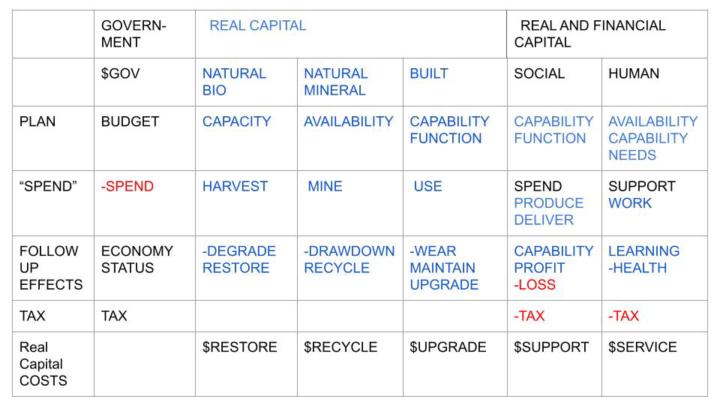
I'm going to run through my thinking here and it will be rough, so please excuse that. I have a hunch (Nordhaus) that this may be a productive edge to explore, and welcome your thoughts. If follows on from @Steve Keen s presentation to Jeremy Corbyn, where it opens up for spending on that which is important and needed, this gives a framework to do it (rough I know but small beginnings). The table runs left to right. Black is money, Red is liability, blue is real capital, increasing or decreasing (with a - sign). It represents the government budget. You will need to know the basics of real or multi-capital to get this. https://stephenhinton.org/2024/01/28/real-capital-an-explainer/ The first column is the national budget, planning to spend first and then get back all or some via tax (MMT), The last two are mixed real and financial - social capital is organisations, and these all have financial identities that pay tax on their operations, as well as get gov, benefits/contracts, Human capital is people with social identity numbers who get benefits and pay tax and are employed in social organisations. So we have represented the money side of things. However, the national budget expects a use of real capital - biological like wood, food etc and mineral. This is processed in the built capital. You can see already that national accounts do not take into the real capital capacity available, or the drawing down effects of the operations of the social capital, the organisations. At the end of the year (effects) there will be an economic status of the government account, but also the social capital (GDP). However, there will also be status of real capital - soils and forests degraded by harvesting, mineral reserves down, by mining, and of importance, the effects of economic stress on the human capital. This is where MMT comes in. It would be better to, when producing national budgets, to include a real capital focus. You could demand of firms that they declare their real capital impacts per dollar of operation. You could factor in economic stress and budget to minimise it. There are a lot of things you can do if you see it this way,

1 like • Oct '25
@Max McKalliste Sorry for my late reply (holiday). No it is not a metaphor. The idea is to model CO2 uptake when you "manage" a forest, using not only the stocks and flows but using a dynamic model that shows how trees age and the impact on the CO2 levels. But my knowledge is too limited wrt CO2 and biological processes. I need to find the right background (literature) and or people to help me out with this. Building the model itself is not hard to do in Minsky/Ravel.
Jan '24 •
Philips Curve
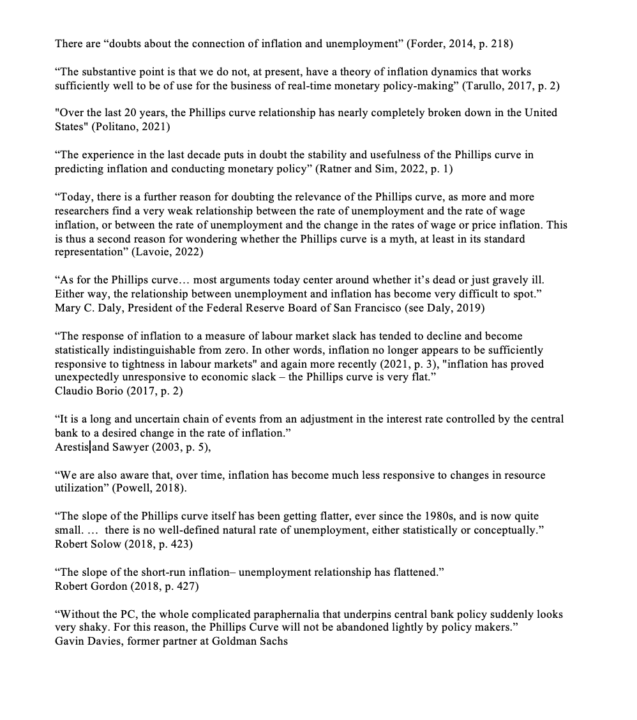
I recently noticed that Louis-Philippe Rochon mentions a lot of discussion about the death of the Philips curve on @MonetaryBlog on X (Twitter). He even included a list of references (attachment). I haven't the time to look into this right now, but my impression in the past was that Philips work was very impressive, whereas most economists reduce it (and often think about it in terms like political business cycles). For dynamical systems a Philips like relationship is essential. So is it alive, or isn't it?
0
0

Aug '23 •
Still stuck with Covid/No class today
I did a RAT this morning and got a very emphatic result back. So though I’m feeling better, I still have the damn thing, and I will continue taking it easy to aid my recovery. There will be no class today, and I’m tossing up whether I should skip next week as well, since I have the long-awaited meeting with the Bank of England next Tuesday, which of course involves a substantial workload for me. This isn’t exactly how I envisaged starting my six months in Budapest! So sorry everyone, but it’s better that I delay classes until I am at least close to 100% recovered

0 likes • Aug '23
Take good care of yourself!
Apr '23 •
Should I expand the number of lectures?
Rebecca Gorman's comment (are you still in the group, Rebecca) highlighted something I'm conscious of myself: that I'm cramming too much information into too few lectures. I expanded the number from 7 to 10 just to (a) enable me to separate Ravel from Minsky, and add lectures (b) on what microeconomics should be and (c) the flaws in Neoclassical economics. Should I go further, for the sake of people's comfort in absorbing my material?
Poll
36 members have voted
0 likes • May '23
@Alwyn Lewis True. But mount pelerin were mostly economists that had been sidetracked by Keynes or rather Keynesian policies, which were tested to the extreme by WW-II. A bunch of frustrated people do not constitute a powerful elite (or we would have taken over the world already 🫢😉). Some elites make sure these economists are taking up important places e.g. central bankers so that the game is and remains rigged.
1 like • May '23
@Alwyn Lewis “What astonishes me is the extent to which this 'slippery rhetotic' came to deceive even those involved in manufacturing it.” Indeed! Economics could be described as AAI too.
Dec '22 •
Welcome to Rebel Economists!
Congratulations on your decision to become a Rebel Economist, and thank you for fighting this war with me -- to bring real economics to the mainstream. The goal of this early 'test group' is to get feedback to fine-tune this Mastermind for the official launch. So feel free to let me @Steve Keen or @Jordan Schwann (my Skool partner) know if there's any feedback you have. This is my first official 'online course & community', and it definitely isn't perfect yet.A few things to know before we start: 1. Skool will be our community platform to discuss, watch lectures, view upcoming LIVE mastermind meetings, and more. Feel free to click around on this platform. It's been designed to be easy to use. 2. Our LIVE Rebel Economist Masterclasses/Mastermind Meetings will happen on Thursdays at 1pm New York Time (EST). That's 10am Los Angeles Time (PST), and 6pm London Time (GMT). Sorry Aussies, but that's 5am Sydney time (but you can watch the recordings). To make sure you don't miss them, click on the 'Calendar' tab, then click on any event to add to your personal calendar. We're having hassles setting up a permanent link. Here's the link for today, December 29: https://us06web.zoom.us/j/82392045499?pwd=cjBxU1IvUmZOM2J0bXZaN05FZTlVUT09 3. Go to "Classroom" for all lectures, courses, and free downloads. You will also find all your free bonuses here. Like 'How To Minsky', Curated Debunkers Files, and my team's $500 Ravel Software for free. You can access all of them instantly now. Enjoy!
0 likes • Apr '23
Hi Martin, you could try the following link https://sourceforge.net/projects/minsky/files/beta%20builds/
1-10 of 62
@tom-schatteman-1020
Economist (heterodox type).
MMT and anti-austerity.
Freedom above all.
Active 30d ago
Joined Jan 7, 2023
Belgium
Powered by