Activity
Mon
Wed
Fri
Sun
Mar
Apr
May
Jun
Jul
Aug
Sep
Oct
Nov
Dec
Jan
Feb
What is this?
Less
More
Memberships
CO-LAB
635 members • Free
ME Meridian Yin Yoga TTC 2026
33 members • Free
ME Healing Hub
1.2k members • Free
4 contributions to ME Healing Hub

Nov '25 •
🌿 A question for all the teachers & space-holders here
I’m in the middle of preparing the training manual for the upcoming Meridian Yin Yoga Teacher Training, and before I finalize anything,I want to hear from you. I know many of you inside this community are teachers, coaches, bodyworkers, or guides in your own ways — working with movement, breath, emotions, or healing. Lately I’ve been reflecting on how many different modalities we all come from… and also how often we hit the same walls. So I’m curious (and genuinely want to hear this from you): 1️⃣ In your own practice or teaching, where do you feel the biggest gap in understanding the body? — fascia?— emotions?— organs & visceral patterns?— meridians & energy flow?— nervous system regulation?— or something you can’t quite name? 2️⃣ What is one thing you often sense in your students/clients… but don’t yet have the language or tools to fully support? 3️⃣ And if you could deepen your skillset in one direction next year, what would you choose? I’m asking because whenever people share these answers, a very clear pattern always appears: Most practitioners are highly trained in techniques…but rarely taught how the internal landscape actually works —how fascia, organs, emotions, meridians, and the mind interlink. I’m simply curious…and I think this conversation will open a lot of clarity for everyone here. 🌿


3 likes • Nov '25
Hi Mai, Here are my reflections: 1. The biggest gap in my understanding of the body: For me it’s the interweaving rather than the parts. I understand fascia, emotions, nervous system, and meridians in isolation but the gap is in how they influence each other moment to moment. Especially how emotional patterns map into the fascia, and how organ/meridian imbalances subtly shape someone’s posture, breath, or emotional tone before they ever speak. It’s like I can feel the “story” in someone’s body, but I don’t always have a clean internal map to explain why it shows up where it shows up. 1. Something I often sense in clients but can’t fully put a to language yet: I frequently sense when someone’s holding a protective bracing pattern, eg. around the ribs, diaphragm, hips, or the left side of the body and I can feel it’s not just physical. It’s a mix of emotional guarding, past overwhelm, and sometimes organ level tension… but finding the language that’s trauma informed, non-pathologising, and still empowering is tricky. I think I can name the pattern, but not always the internal mechanics behind it. If that makes sense?! 1. What I’d love to deepen next year: Understanding the meridian–organ–emotion–fascia relationship in a way that I can actually apply in real time: Eg. A) why a client collapses on the left but over-compensates on the right B) why grief shows up as tight quads or digestive anxiety as jaw tension C) how to sequence yin not just for poses, but for energetic/emotional repair D) and how to guide people into “safe surrender” rather than collapse or freeze. Essentially: I want my language, touch, and cueing to match what I intuitively feel and to be able to support people more confidently when their body starts revealing its layers. Really grateful you asked these questions as it’s made me really think. I already feel the training is going to land deeply. 🍀
Nov '25 •
🌊 Returning to Water & Earth
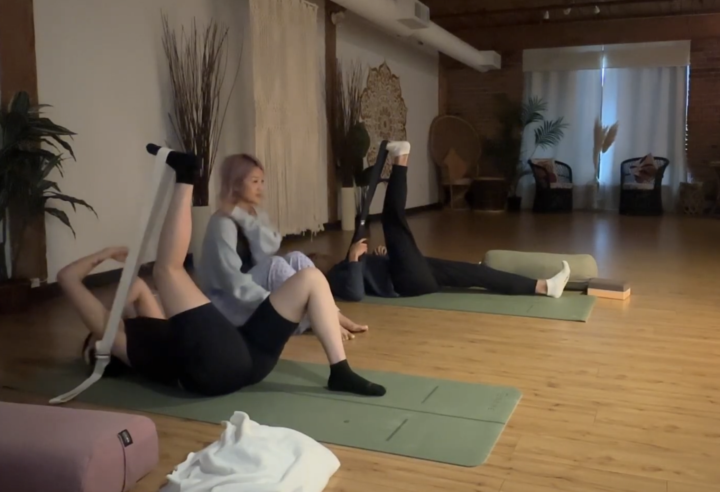
A Meridian Yin Yoga Practice As the seasons shift, nature teaches us how to descend — how to slow, soften, and gather our energy inward.This class is an invitation to do the same. We’ll explore the Water and Earth elements through Meridian Yin Yoga — harmonizing the Kidney–Bladder and Spleen–Stomach meridians to restore flow, nourishment, and inner quiet. You’ll experience what it feels like when stillness becomes medicine — when fascia, breath, and energy begin to communicate beneath the surface of movement. 🌿 In 90 mins You’ll Experience: - How meridians move through fascia and how Yin postures guide Qi along these pathways - The energetic anatomy of organs — how the Kidneys store fear and willpower, how the Spleen grounds us through care and digestion - The art of sequencing by element, aligning practice themes with natural and emotional cycles - The science of surrender — how fascia rehydrates and the nervous system resets through long-held postures - The bridge between Eastern and Western anatomy — from meridian flow to bone variation and visceral connections - How to practice in a way that is somatic, sensory, and alive — so students feel seen, not corrected ----------------------------------------------------------------------------------------------------------------------------------------- If you’re a movement coach/energy facilitator or a devoted learner ready to deepen your Yin path — not only with techniques, but with understanding and energetic presence — this journey is for you. 🧭 Meridian Yin Yoga Teacher Training (60 Hours)with Mai Li — Jan 5–Feb 6, 2026Live online + full replays 🌟 Early bird: $1200 until Dec 1st ($1600 onward) Includes printed manual + meridian doll shipped globally This training is for that part of you. The part that wants to learn the TCM theory, meridian system, feel the Five Elements, and teach from soul and science.
1 like • Nov '25
I just did this practice and it was brilliant. I feel super open throughout my body and especially my hips. My mower back is slightly tender but I think I just need to warm it up now....runs to get water bottle !
Nov '25 •
Meridian Camp Closing Session
Hey loves, Quick heads-up about our coming live session — this will be the closing practice space of Meridian Camp, and you’re absolutely invited to join us live. 🌿 🏙 What tomorrow is about We’re gathering for a practice-focused session where we’ll: - Revisit the mountain, ocean, and sky of the meridian map in real, simple body language - Turn it into doable daily rituals for your actual life in the city/home (not just theory from camp) - Work with the feet, pelvis, tongue, eyes, scalp & breath so you feel the chains in your body, not just in your notes - Leave with 2–3 anchor practices you can keep repeating when life gets loud again It’ll be a 90 minute space, mostly practice, some Q&A. 📅 Tomorrow (Saturday) 🕙 10:00 (please check your local time) 🔗 Important: New link to join I’ve updated the live call link, so please use the new link in your MSA/Healing Hub calendar. 🎥 Replay access: - MSA Members: included in your portal. - Healing Hub Members: replay available for $37, uploaded after the live session. Come as you are: tired, curious, wobbly, regulated, dysregulated… all of you is welcome.Let’s close the camp by landing this work deeply into your everyday body. 🧭✨
0 likes • Nov '25
@Gwen Rahardja me too! I really wanted to attend.
Aug '25 •
The Emotion Release Everyone is asking about.
Visceral Fascia Release - This is the gentle self-massage for internal freedom. Your organs aren’t floating freely inside you — they’re wrapped, supported, and suspended by fascia, which connects to your spine, ribs, pelvis, and diaphragm. When that fascia becomes tight from stress, inflammation, surgery, posture, or emotional holding, it can pull your rib cage, restrict breathing, affect digestion, and even limit your range of motion in unexpected areas. By gently releasing tension around your belly and diaphragm, you not only help your organs “breathe” better, but you also improve blood and lymph flow, calm your nervous system, and create space for emotional release. Enjoy your practice! 💡 Before you start — take your “before” test! You’ll be surprised. 1. Sit on the edge of a sofa, bench, or bed. 2. Bring the soles of your feet together (or adapt if that’s not comfortable). 3. Sit tall, then fold forward without forcing. Notice how far you can go — this is your starting point. After practice — Re-Test Sit back up and repeat your forward fold.Notice if you have more space without touching anything in your groin or hamstrings — this is your visceral fascia letting go. 📸 Share your progress and tag @maielements! Extra Notes: - Avoid practice on a full stomach (wait at least 2 hours after eating). - Avoid deep abdominal work during menstruation or with certain medical conditions — listen to your body. - This can be a beautiful pre-bedtime ritual to calm the mind and support deep sleep. - Emotional releases are normal — breathe through them, extend your exhale, and allow your system to settle. ✨ This practice is part of Week 2 in our MSA monthly challenge. We began with external breathing and have now prepared the nervous system enough to go deeper into internal release.If you’d like to join our daily step-by-step practices and learn small but deeply meaningful holistic healing tools each day — you’re welcome to join us!
0 likes • Nov '25
Just done this for the first time as I’m wide awake and want to calm my body to rest state and then hopefully deep sleep. So starting this as a bed time practice.
1-4 of 4
@suze-todd-8961
Psychotherapist, breath work facilitator, single mum and creative.
Active 7h ago
Joined Nov 5, 2025