Activity
Mon
Wed
Fri
Sun
Jan
Feb
Mar
Apr
May
Jun
Jul
Aug
Sep
Oct
Nov
Dec
What is this?
Less
More
Memberships
Gamify SAT
9.6k members • Free
SAT Prep
14.9k members • Free
High Achievers
17.6k members • Free
Driven Minds
3.8k members • Free
6 contributions to Gamify SAT

⭐
4d •
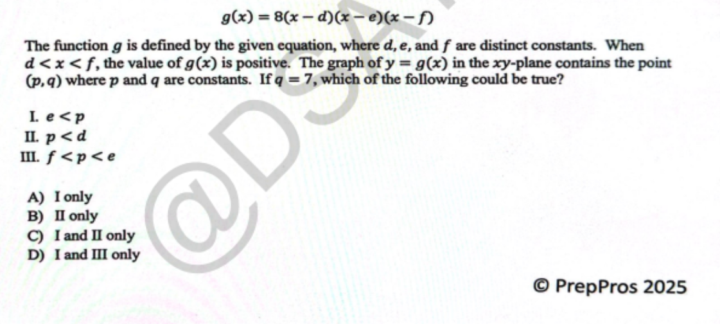
Daily SAT Question 12/3
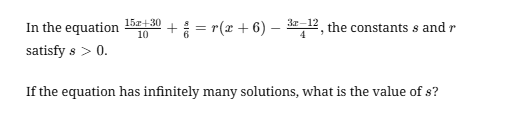
Shoutout to @Devansh Tan for this REALLY hard SAT Math question. I lowkey want to see if any of you even KNOW how to solve it. Original problem by PrepPros.

0 likes • 4d
A:

1 like • 5d
Here's how to do it with regression: - We know that two lines must be parallel (and pass through the same points) for there to be infinite solutions, which is why we can set them "equal to" each other. - r is part of the gradient which can change to be parallel and equal to each other.
1 like • 5d
If you want a more intuitive way to do it: - r + 3/4 is the gradient of the line which is variable to change, it only has to be parallel to the other line, which has a gradient of 1.5. - The lines have to be parallel and equal to each other for there to be infinite solutions, which is why they are situated on top of each other:
6d •
How to do these types of RC questions?
All the answer options are so similar, I'm not sure what to look for smh

0 likes • 6d
@Hamy Mv Thanks so much :)

6d •
My brain hurts when I get to module 2
My intention span is definitely not long enough, what can I do to improve my concentration? I think I'm not the only one here...
2 likes • 6d
Hey W W, good question, here are some things I do: - Before each module, I like to close my eyes and take some deep, slow breaths. - During practice I like to listen to brown noise, so I don't get distracted, it also mimics the background noise. - Set timers and frequent breaks during your study, so you don't feel like you are constantly studying.
7d •
Should I watch the YouTube Videos or do the courses first?
Basically the title: wondering what order I should do them. Thanks guys :)
2 likes • 7d
@Manthan Kadam Thank you!
2 likes • 6d
@Jason Parton Thanks man, will do 🫡
1-6 of 6