Activity
Mon
Wed
Fri
Sun
Jul
Aug
Sep
Oct
Nov
Dec
Jan
Feb
Mar
Apr
May
What is this?
Less
More
Memberships
AI Automation (A-Z)
154.8k members • Free
Chase AI Community
66.2k members • Free
Context Engineers
209 members • Free
Clief Notes
35.3k members • Free
AI Accelerator
18.8k members • Free
AI Consultant Incubator
2.8k members • Free
AI Workshop Lite
24.4k members • Free
Imperium Academy™
65.5k members • Free
Content Academy
14k members • Free
5 contributions to Content Academy

🚀
Apr 6 •
Multi Coding Agent System (Claude Code, Codex, Gemini & More)
Hey Academy, Most coding agents lock you to your desk but this one works on your phone too. In this video I'll show you a single open-source system that lets you run any coding agent—Claude Code, Codex, Gemini, Kimi, and more—from your desktop, your phone, or headlessly in the background while you sleep. I built this from scratch with 30 years of coding experience, and it already has 1,400 GitHub stars. You'll see a full demo where I create a Next.js SaaS project entirely from my phone using voice dictation, switch seamlessly between devices, and manage multiple projects at once through one unified browser interface. I'll walk you through every feature including plan mode, code mode, the built-in editor, git controls, and how to install everything for free. By the end, you'll have coding agents running for you 24/7.

0 likes • Apr 6
I rerun the npm setup command and got it working, but now I'm getting the 404 not found error :😂
0 likes • Apr 7
@Ramzi Zahra Did you get it working in the end? I couldn't 😐
🚀
Mar 30 •
How to Use Claude Code for FREE
Hey Academy, For support join the AI Architects. The $200 subscriptions and API fees make it hard to get started with AI coding—so I built a solution that runs Claude Code 100% free on your computer using local models. In this video I'll walk you through a live demo of the full setup: free local models through Ollama, budget-friendly alternatives like DeepSeek and MiniMax, and a flexible interface that supports multiple coding agents including Claude Code, Gemini CLI, and OpenAI Codex. You'll see how to switch between chat mode and interactive mode, configure any LLM provider you want, and use the complete development environment with a built-in editor and shell. I'll also walk through the entire installation step by step so you can get up and running today—whether you're a complete beginner or an experienced developer looking to cut costs.
6 likes • Mar 30
The link to popebot in video description is missing. https://github.com/stephengpope/thepopebot

Mar 22 •
I Run 10 YouTube Channels. I Don't Make a Single Video. Here's what that actually looks like
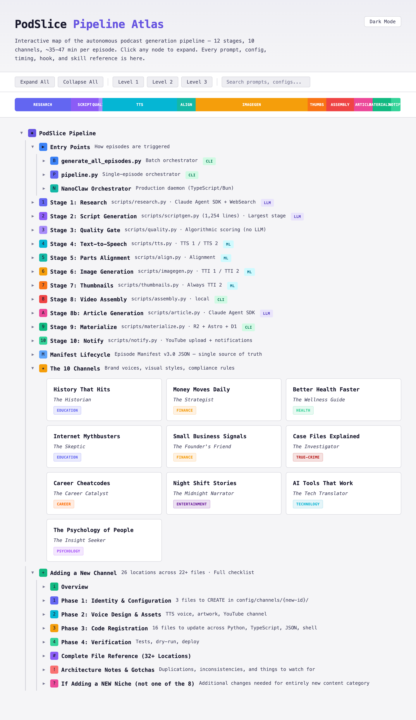
I woke up this morning to 10 fresh podcast episodes. Fully researched. Scripted. Narrated. Visuals timed to every beat. Published to YouTube, RSS, and my own website. I didn't make any of them. A machine on my desk did. While I slept. I launched these channels at the end of February. It hasn't been a month yet. Some channels are pulling 1,000+ views and gaining subscribers - with zero ads, zero promotion, zero outreach. But here's what I need you to understand: this is not a prompt. When people hear "automated content," they picture someone typing a topic into a chatbox and hitting publish. That's not what this is. That's not even close. What I built is a multi-stage production pipeline. Not a single generation step - a sequence of independent systems, each with its own job, its own rules, and its own quality bar. Every stage has to pass before the next one starts. If something isn't good enough, it gets caught, flagged, and redone automatically. Here's what that actually means in practice: Every episode starts with real research. Not "summarise this topic." Actual source-finding, fact-checking, angle evaluation. The kind of editorial groundwork a good producer would do before writing a single word. Most automated content skips this entirely. Mine can't - the pipeline won't let it move forward without it. Then there's the writing. And this is where I spent most of my 45 days. I didn't just generate scripts - I built an entire set of rules around how spoken language works differently from written language. How rhythm changes when someone is listening instead of reading. How a pause lands. How a transition should feel. Early versions sounded like a textbook. Now they sound like someone talking to you. After the writing comes the part most people don't think about: quality control. Every script gets evaluated across multiple dimensions before it moves on. There's a hard pass/fail threshold. I've watched the system reject its own output dozens of times and come back with something genuinely better. Nothing mediocre gets through. That's not a nice-to-have - it's the reason the content performs.
0 likes • Mar 25
Could you share a link to one of your videos/channels made this way?
0 likes • Mar 25
can you share a video that got a lot of views?

Jul '25 •
Vibe Coded a Chatbot for my Website!
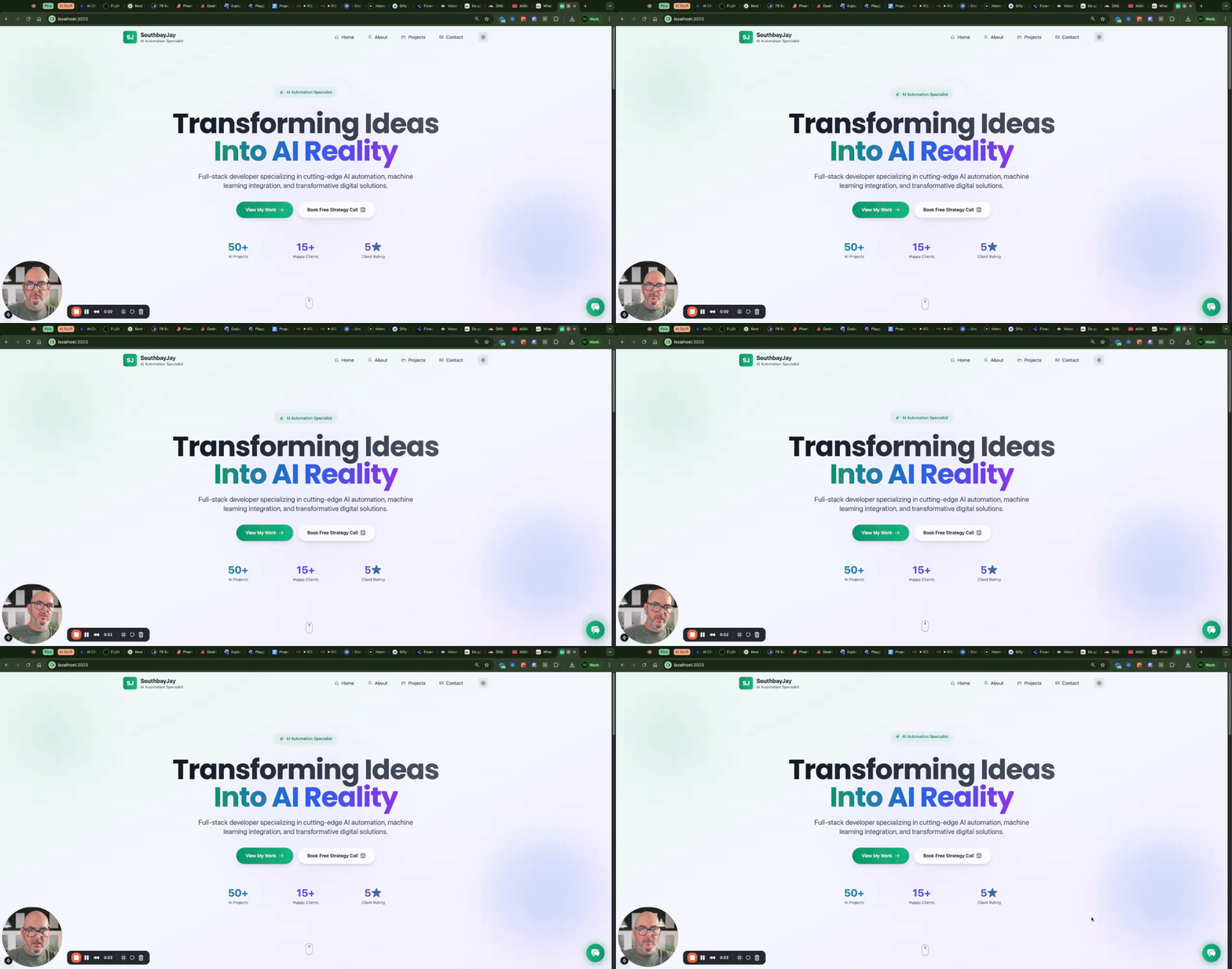
I wanted to share this quick video of a chatbot that I'm working on for my website using Windsurf to create it. Just getting started with the functionality and still need to dig into the system prompt for the ai agent. It needs to have some guardrails put into place so it doesn't answer random questions. If you really want to build web projects then the Vibin' Coders community is for you! Jump in now before the price goes up again!! The website and the chatbot were both Vibe Coded! Simple conversation with Windsurf, or the coding app of your preference, and some basic knowledge that @Stephen G. Pope teaches us and you can build cool apps just limited by your imagination. It's on a sales pitch, I was super excited about this chatbot!! @Stephen G. Pope's Vibin' Coders community is where it's at!
1 like • Jul '25
Nice
1 like • Jul '25
You didn't record the process from start did you? Would be good to see the prompts you used and how you built the backend too.
🚀
Dec '22 •
Welcome! Introduce Yourself HERE 🔥
Hi! Welcome to the Content Academy. This community is designed to help you build a profitable content strategy, efficient team & automated content process. Step 1: Introduce yourself in THIS THREAD below! (✄ copy/paste template 👇) Where are you from? What are you working on? What immediate help do you need? Step 2: Read the rules and checkout our free courses and paid programs
Poll
2494 members have voted

1 like • Jul '25
Hey everyone! My name is Sheroz. I am a vibe coder. I would like to learn how to build and launch an online business with AI. I hope I can meet and connect with like minded people who are more experienced than me to learn from them! I am determined to learn everything that I can in order to build and launch my own products/websites fast. Speaking to people who have already launched a successful product/business and learning from them is the experience I am looking to get. Launching a successful business is probably a lengthy process, but I am willing learn, try things and fail and learn until I succeed. Glad to join this community and looking forward seeing what other people are building. Thank you for the opportunity! All the best!
1-5 of 5

@sheroz-samatov-6085
Hey! I'm 39, passionate about programming, writing, and online business. Excited to connect with fascinating communities and meet fellow enthusiasts!
Active 7d ago
Joined Jun 21, 2025
Powered by