Activity
Mon
Wed
Fri
Sun
May
Jun
Jul
Aug
Sep
Oct
Nov
Dec
Jan
Feb
Mar
What is this?
Less
More
Memberships
Book Design Like a Pro
257 members • Free
Publisher Sea - KDP & ADS
512 members • Free
Driven Publishers
4.1k members • Free
The Book Club
432 members • Free
Royalty Guild. Amazon KDP
264 members • Free
Profitable Publisher 3.0
336 members • Free
Spotify Challenge
772 members • Free
Publish & Profit Challenge
4.1k members • Free
8 contributions to Royalty Guild. Amazon KDP

Feb 27 •
Problems logging on to Amazon ads
I’ve been trying all day, but I haven’t been able to see my Amazon ads dashboard. It doesn’t load. Have you been having problems as well?

1 like • Mar 1
Sorry for the late response here but it sounds like it might be a cache problem. Did you get the issue resolved and what was the problem? If you did not try restarting your computer and or updating your browser. I use Google Chrome and sometimes when I restart the computer, it’ll update the browser as well.

Feb 22 •
The Uncomfortable Truth About KDP's Future (And What To Do About It)
I've been sitting on this post for a while because I wanted to make sure I wasn't just being dramatic. After months of watching the space closely, I'm convinced this isn't fear-mongering — it's pattern recognition. Here's my honest breakdown of where Amazon KDP is headed — for all of us. The Ground is Already Shifting Under Our Feet KDP is currently the frontline of AI disruption. The market isn't just "getting competitive" — it's being flooded with synthetic content at a scale we've never seen before. Amazon knows it. That's why they're actively rewriting the rules: algorithm changes, royalty structure tweaks, review policy updates. The A10 algorithm shift wasn't accidental. They're trying to manage a glut they didn't anticipate, and they're doing it in real time. If we've noticed our organic rankings slipping over the past year, we're not imagining it. The playbook that worked in 2022 is now actively working against us. The Next 1–2 Years: We're No Longer Authors. We're Media Buyers. Here's the hard pill: writing a well-structured, 30,000-word book is no longer a differentiator. We can produce it in a day. Execution — the thing we used to compete on — has been commoditized overnight. And before anyone says, "just write better, more human content," readers can't actually tell the difference anymore. That ship has sailed. Competing on the quality of the text itself is a losing game, regardless of how it's produced. So what actually wins now? External attention. Amazon's new algorithm heavily rewards books that arrive with an audience already attached. That means the winners over the next two years won't be the best writers. They'll be the best digital marketers — the ones building newsletters, growing YouTube followings, nurturing Skool communities, and then pointing that audience toward their books. Our identity in this business has to evolve. We need to think of ourselves less as authors and more as media brands that happen to publish books. The second piece of this is what I'm calling the trust premium. Readers are already experiencing AI fatigue, even if they can't name it. They can feel when a person is behind something — not because the writing is better, but because the marketing is authentic, the niche is specific, and the face behind the brand is real and present. Verifiable human presence and transparent, specific marketing will convert dramatically better than anonymous, optimized content. Our humanity isn't in the text anymore. It's in how we show up off the page.

3 likes • Feb 22
Yes, I can agree with that. We will just have to roll with it and transition more toward social media platforms as some of us have already been doing. That’s been on my monumental list of things to do, but yes, we now need a following, and that was made crystal clear a couple of months ago when Amazon started neutering all of the fake book club reviews. I’ve been dragging my feet about creating a newsletter and while I do have a social media presence, their minuscule and I need to start focusing on that soon
Feb 5 •
$500 Test or Phases Campaigns
Yesterday was an interesting day: @Matt Radkiewicz and @Barry Georgiou published videos on how to structure Amazon Ads campaigns. Matt and Barry are accomplished publishers, and clearly, we can extract a lot of value from both videos. But on the surface, they seem to contradict each other in some areas. For example, using an auto campaign at the start. I would like to give my perspective on the topic, and we could continue in the comments. Barry provided a clear, simple structure: Phase 1, Phase 2, and Phase 3, with exact goals for each phase. And it's great if we assume the promoted book is great, the niche has potential, and the promotion timeline is infinite. Matt, on the other hand, provided the structure for a publisher that cannot make a long-term commitment to the book yet due to insufficient data. His $500 campaign provides a framework for gathering initial data to determine whether the promotion should continue. As for me, Matt and Barry described frameworks for completely different scenarios, and we should not compare them; rather, we should consider them for different use cases. What is your opinion on the topic? @Robert Enochs does it make sense for you?
1 like • Feb 6
@Igor O ok. That makes perfect sense, thank you. So then I had the wrong impression about lottery ads. I was trying to rush it with more aggressive bids around $0.60 CPC. But what you stated makes sense that all we need to do is have a low bid to fill the gap when a competing book runs out of budget or there is a missing ad spot - makes sense, thanks
2 likes • Feb 6
@Igor O do you run your lottery ads globally or in a specific country? My global lottery ads are not doing well, but it could be because my CPC is set too high. I’ll check on that. My lottery ads for the USA with a $.40 CPC seem to be doing pretty good but I’m wondering if maybe I should lower that one there also?

🔥
Feb 4 •
$500 Amazon KDP Ads Strategy in 5 Steps
I published a new video breaking down my 5-step Amazon KDP Ads strategy for promoting a book with a $500 budget. For most books, spending $500 wisely on ads is enough to increase sales, collect meaningful data for optimization and scaling, and identify potential bottlenecks holding the book back. The amount of data you gather depends on the cost per click (CPC) in your niche. What are your average CPC levels?
4 likes • Feb 4
@Pamela Henkels if by “Guru Ads” you’re referring to Barry’s ad strategy- yes I can relate, but Barry’s strategy the first month or two is all about “discovery” and trusting the process - not about ROI I am in his program and trying to trust the process. I am just past 30 days of P1 campaigns with broad and phrase match campaigns to discover new KWs and train Amazon for CTR and CVR - BUT YES it’s expensive. Before Barry’s strategy, I was averaging about $300-$400 / month from organic sales (no ads spend whatsoever). Over the last 30 days of Barry’s strategy, I have doubled and tripled my monthly sales to $1k-$1200 for the last 35 days, BUT I have spent $2800 in ad spend to get there lol So obviously that’s not great to spend $3k to make $1k, but first, we know the first month or two is all about discovering new KWs and training Amazon on what works and what doesn’t. However, a large part of my ad spend was do to the fact that I’m running multiple campaigns for multiple books (about 8 books with 6 or so campaigns per book) Additionally, some of my initial KWs in those discovery campaigns were not highly targeted and a bit broad themselves - so running broad campaigns for those was even more costly. And lastly, many of my books have very low review counts (only 2-3 of them have 25-30 reviews). The rest of them are like 0-5 reviews per book and running ads to low confidence/ low social proof books is extremely costly because it causes a very low CVR in my experience. With all that in mind, it is my opinion (and I have to agree with Barry) that running auto ads to a brand new book is a mistake because Amazon doesn’t know what the book is about yet and so it’s going to be expensive while it learns. Now in all fairness, I think that’s basically what I’ve been doing with broad and phrase match campaigns as well - I just think that relying completely on Amazon with auto ads is an even bigger mistake / expense (until Amazon has been trained on your book properly first).
3 likes • Feb 4
@Matt Radkiewicz ok. Thank you, I will be starting auto ads very soon. My books are not new, but I am very curious to see what would happen with a new book. Perhaps I’ll publish one, test the strategy and found out - it would be interesting to compare how that performs with no background sales data
Jan 14 •
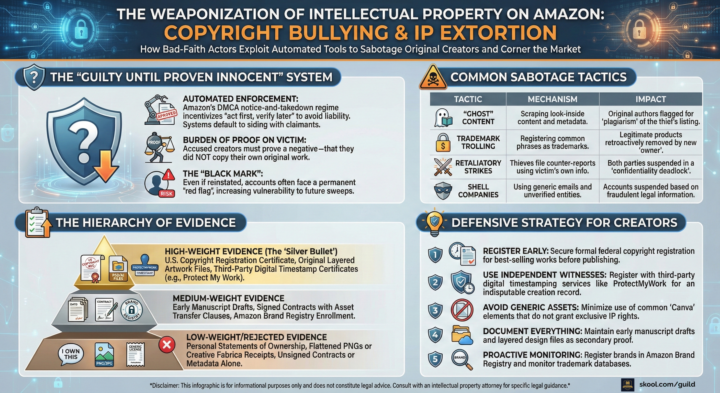
🔴 Why Your Book Could Be a Target (and It’s not Piracy)
Most authors worry about piracy. But there's a much more dangerous threat: Copyright Weaponization. On Amazon, your original content isn't just an asset - it's a vulnerability. Bad-faith actors are now using Amazon's own "Safe Harbor" tools to sabotage legitimate creators. Here is how the "Strategic Sabotage" loop works and how to protect your account. The Trap: "Guilty Until Proven Innocent" Amazon operates under a "notice-and-takedown" regime. Because they want to avoid legal liability, their systems are hard-wired to: - Act First, Verify Later: They remove content immediately upon a claim, favoring the claimant by default. - Shift the Burden: You are forced to "prove a negative" (that you didn’t steal your own work), usually within a 5-7 day window. - Automated Bias: AI bots handle these claims. If a bot sees a similarity, you get the "strike" - even if the other person stole from you. Tactics to Watch For - "Ghost" Content: Thieves using your manuscripts or scrape your "Look Inside" preview, publish it themselves, and then report you for plagiarism. - Retaliatory Strikes: If you report a copycat, they file a false counterclaim against you, resulting in a "confidentiality deadlock" where both accounts are suspended. - Trademark Trolling: Bad actors trademark common phrases used in titles (e.g., "Mamma Bear" or specific niche keywords) to retroactively wipe out top-selling competitors. Your Defensive Checklist To survive the "copycat era," you need a defense-first workflow. Don't wait for a strike to happen: 1. Register with the USCO: A formal Federal Copyright Registration is your "Silver Bullet." 2. Use Independent Witnesses: Services that provide digital timestamps are available. This creates an indisputable record that your work existed before the thief's version. 3. Keep the "Paper" Trail: Always save your original layered files (PSD, AI) and early manuscript drafts. Flattened PDFs or Canva receipts are often rejected as "low-weight" evidence.
5 likes • Jan 14
I published a book 2 years ago in the spring of 2024 and then recently I noticed that someone published a book in September 2025 with the exact same title and subtitle that I published. Their book cover is terrible and the interior content seems very similar, but their book is not selling well and what little bit of looking into it I did, it seems that it’s totally legitimate to publish a title even though it’s the exact same title is already published book. In other words, according to Amazon‘s terms of service having a book published with the exact same title as another book is not a problem as crazy as that sounds
6 likes • Jan 14
@Igor O lol, yeah exactly. Instead of reporting it I think I’ll just run my book as an ad on their ASIN and take all their sales lol And that can be there penalty for being stupid
1-8 of 8
@robert-enochs-8875
Writer and publisher: Learning and Helping Others
Active 3h ago
Joined Jan 2, 2026
Michigan, USA
Powered by