Activity
Mon
Wed
Fri
Sun
Sep
Oct
Nov
Dec
Jan
Feb
Mar
Apr
May
Jun
Jul
Aug
What is this?
Less
More
AI Automation Society
438.5k members • Free
Clief Notes
45.1k members • Free
Agentic Foundations
9.3k members • Free
5 contributions to Clief Notes

1d •
ICM for second brain
Hi, anyone building a "second brain" / LLM wiki using ICM? I understand ICM is very good for defined tasks and workflows but what about using AI for researching and keeping general information? Currently I run a second brain with the following folder structure: - Inbox / | | Convert to markdown file with MarkItDown (deleted afterwards) V - Sources/ | | Using custom Wiki-ingest skill to extract important content and group by relevant topic | according to Google's OKF system | V - Wiki/ - Flat directory with derived knowledge from Sources/ An AI agent can navigate Wiki/ easily and efficiently using a separate Routing/ folder containing a INDEX.md file, which described which topics exists and a brief description. Each existing topic gets a <topic>.md file in Routing/ with links to actual pages in Wiki/ with a brief description. Anybody who has a similar or different system? I am curious to learn from all of you!
0 likes • 24h
@Nicolas Patron Uriburu Thank you for answering. I have changed it so a copy of the original format is also stored in Sources/ and a derived file has a backlink to it in case it is needed I am struggling to understand the problem with routing. I understand that routing may send the agent into the wrong direction but I don't understand how you fix it exactly. Could you elaborate on this? In my Wiki/ I store summaries + a possible personal insight about the content
1 like • 24h
@Jim Tyndall On the topic list: it's fixed on my end. The ingestion skill can suggest a new topic, but only after checking there's nothing similar already, and even then I have to approve it before it gets added. So the list can't quietly grow on its own, which should help with the kind of drift you described. The lookup skill is read-only, at least in theory (as far as that actually holds up in practice), so just looking something up shouldn't be able to change a topic. As for what checks Routing/ against Wiki/, honestly, nothing right now. It's the same agent doing both the ingestion and the routing updates. I'm still pretty new to this so I haven't run into it getting out of sync yet, but I can see why it might happen. I'm using git plus a log file where the agent writes out a short description of every action it takes. So even if things did drift apart, I'd at least have a trail to go back and see what actually happened between two points. Thank you!

5d •
Calling all local builders - drop your stack y'all!
This is the only place I can talk local ai without getting blank stares, so let's actually see what everyone is running. I'll go first. here's the whole stack: HARDWARE ▸ Alita - personal dual-3090 rig at home. 48gb total vram, 128gb ram. kept totally separate from anything work related. MODELS ▸ primary: qwen3.6-35b-a3b on gpu0, served by llama.cpp. mixture-of-experts, ~3b params fire per token. q8 kv cache, 256k context. ▸ router: a ~9b qwen on ollama out front, deciding what's actually worth waking the big model for. ▸ embeddings: qwen3-embedding 0.6b and nomic-embed-text, same ollama instance. AGENT LAYER ▸ hermes, running as Alita here. three daily jobs: morning brief, work email summary, personal email summary. all land in discord. ▸ weekly maintenance runs on a different scheduler with hermes as the watchdog, on purpose. runner dies, watcher yells. watcher dies, the daily jobs go quiet and I notice. two failure domains instead of one. MEMORY ▸ obsidian vault as the source of truth. ▸ hybrid search over it - bm25 plus local embeddings, running in-process. no extra service to babysit. ▸ qdrant for the vector-store work that actually needs one. INTERFACE ▸ the observatory - a front end I built over the vault. not a dashboard. a command center I actually work from: projects as boards, sessions as a timeline, drafts moving through a publishing pipeline, all of it reading and writing the same markdown files. The one piece I would not give up is the vault. the models change every few months. the notes are forever. The thing that taught me the most had nothing to do with hardware. I did kill a pile of containers nothing was consuming - n8n, a web ui, a couple databases - but that was housekeeping. the real one was giving up on folders. I spent a long time sorting notes into the right directory and it was wrong again six months later. Now every note carries its own frontmatter and the folders are just a cache I regenerate from it. Type isn't a folder. Status isn't a folder. The structure lives in the file.

2 likes • 1d
Where do I start when I want to run local AI?

2d •
Something is coming 👀
Been heads down on something the past month plus. Not a lesson, nor a Tea round but more like the layer under all of it. Kept seeing the same thing in comments and onboarding calls: People not knowing where to even start or if something’s already been covered somewhere in here. We're working on fixing that. Not ready to put it in your hands yet.
2 likes • 1d
Interested!

👑
Apr 6 •
60/30/10 Applied Series Launch
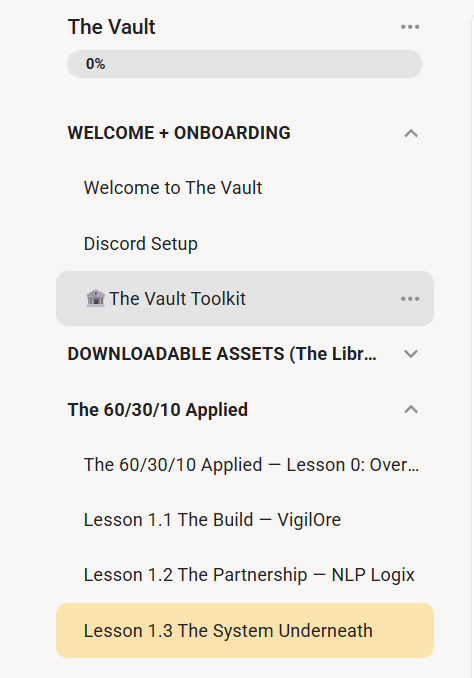
The 60/30/10 Applied series is up. Three lessons. The 60/30/10 Applied — Lesson 0: Overview - The Vault · Clief Notes I want to explain why this one's behind the paywall because most of my stuff isn't. The free course teaches the framework. These lessons open up my actual consulting business out side of skool, Less about AI Fundamentals and more a deep dive into my past and current Enterprise Projects. Real contracts. Real pricing. Real revenue share clauses. The engagements I run through Eduba, my technical consultancy. I'm showing you how I scope, price, and protect builds that generate six figures from single partnerships. That's not something I put on YouTube or else where. You being here as a premium or VIP member is what keeps the free stuff free. This is me giving back to you specifically with the things I'd normally only share across a table with a client. Three lessons, each one a different angle on the same ratio. Lesson 1: The Build. A compliance platform in the DRC. Five agents, 160 hours to 5 minutes, and how the ratio determined every contract decision. Lesson 2: The Partnership. A $31M ARR consulting firm. Cold LinkedIn DM to $300K+ partnership. The ratio applied to the deal, not the code. Lesson 3: The System. The training funnel underneath both. 95% adoption. The flywheel. My own business broken down layer by layer. Each lesson has a course companion with exercises you run in Claude on your own work. Start wherever fits you. More coming. Edits rolling out over the next couple months. Tell me what landed and what needs to go deeper.
1 like • 1d
Intereseting!
👑
Jul 1 •
Welcome to Clief Notes. Here's where to start.
1. Go check out 📚Navigating The Course to see how to get around and what's here. 2. Start with The Foundation. Concepts, folder architecture, prompting framework. Everything else builds on this. 3. Check in at the bottom of each lesson. Polls, discussion posts, other members working through the same stuff. Use them. 4. When you're ready to build real things join in on our Biweekly competitions and win some real cash. ⭐ Competitions Mega Thread 5. If you are wanting to dive into the masterminds, grab all the past templates, artifacts and resources. Upgrade and head into the The Vault for Premium and The Drawing Room (VIP) for VIP 6. Post your work. Ask questions. Help others when you can. What are you here to build?
2 likes • 2d
Looking forward to learn your system!
2 likes • 1d
Hi, anyone building a "second brain" / LLM wiki using ICM? I understand ICM is very good for defined tasks and workflows but what about using AI for researching and keeping general information? Currently I run a second brain with the following folder structure: - Inbox / | | Convert to markdown file with MarkItDown (deleted afterwards) V - Sources/ | | Using custom Wiki-ingest skill to extract important content and group by relevant | topic according to Google's OKF system | V - Wiki/ - Flat directory with derived knowledge from Sources/ An AI agent can navigate Wiki/ easily and efficiently using a separate Routing/ folder containing a INDEX.md file, which described which topics exists and a brief description. Each existing topic gets a <topic>.md file in Routing/ with links to actual pages in Wiki/ with a brief description. Anybody who has a similar or different system? I am curious to learn from all of you!
1-5 of 5

Active 6h ago
Joined Jul 12, 2026
Powered by