Activity
Mon
Wed
Fri
Sun
Jun
Jul
Aug
Sep
Oct
Nov
Dec
Jan
Feb
Mar
Apr
What is this?
Less
More
Memberships
Finanzas e Inversiones México
456 members • Free
Skool of Personal Finance
105 members • Free
Total Goalkeeping
7.5k members • Free
EJ
Education, Jobs & Money
2.3k members • Free
The Energy Data Scientist
686 members • Free
23 contributions to The Energy Data Scientist

7h •
PDF on Costs for building and operating power plants
This attached PDF report is from the U.S. Energy Information Administration (EIA) , showing a cost comparison of different ways to generate electricity in the United States. The cost estimates are specifically for power plants entering service in 2030. EIA picked 2030 because it's the earliest year by which all the technologies considered (including slow-to-build ones like nuclear) could realistically come online. So it's a single snapshot year, not a multi-year projection. That said, the costs are levelized over a 30-year cost recovery period, meaning they spread the plant's lifetime costs across 30 years of operation , but the plant itself starts in 2030. The main idea is the Levelized Cost of Electricity (LCOE) . It's a single number (in dollars per megawatt-hour) that represents the total cost of building and running a power plant over its lifetime. This reports this way compares very different technologies like nuclear, natural gas, wind, and solar . The LCOE is the headline metric, but the report actually compares 3 things : 1. LCOE : the cost to build and run the plant 2. LACE : the value the plant provides to the grid (revenue potential) 3. Value-Cost Ratio (LACE / LCOE) : whether the plant is worth building Very useful report for my work, and was shared with many energy professionals . Have a download.
0 likes • 7h
@Dr. Spyros Giannelos thank you . Yes , LACE is also a lifetime, levelized number, just like LCOE. Both metrics share the same structure. Interestingly the "L" in both stands for "Levelized" , meaning future costs (or revenues) are converted into a single average $/MWh .

20d •
Energy Report
I'd like to share a short report I wrote some time ago. It's a brief overview of the Turkish energy market and its key players. I'd be happy to hear your thoughts and comments.
0 likes • 20d
Thank you sir for sharing this . I went through it . In my view , the report also rightly shows that Türkiye’s energy transition is not simply about replacing one fuel with another. It is about building a system that is more secure, flexible, and more attractive for investment over time. The issue is energy efficiency, especially in industry and buildings, since this can ease import dependence and reduce the need for costly new supply. Another useful extension could be the role of local manufacturing capacity in solar, wind, equipment, and related services, which could strengthen both jobs and supply-chain resilience. Jobs are strong ? how is your experience sir ? would you recommend people looking at the energy market ?

Mar 9 •
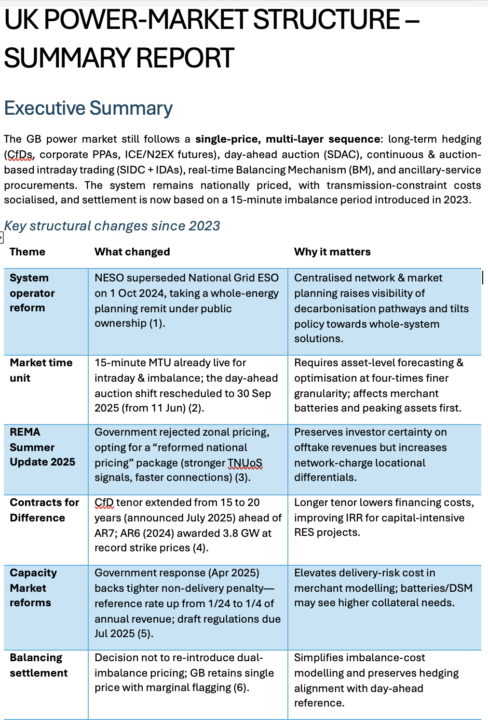
New Report: UK Power Market Structure (2026)
I’ve uploaded a new report on the UK Power Market. It gives a practical overview of how the market works across each layer, from long-term contracts and day-ahead trading to intraday markets, balancing, and ancillary services. It also highlights the most important recent reforms, pricing trends, and the structural features shaping the market today. It is like a cheat sheet, concisely giving an overview of a complex market . The UK market is often seen as a model market because it is one of the most mature, transparent, and actively reformed power markets in the world. So, understanding how it operates helps bring much more clarity to power markets globally. The UK markett is moving fast on market reform, which makes it a very useful case study for where global power markets may be heading. You can find and download the report in the Classroom, under Energy Industry Support ( a special section focused on analysing trends and key topics in the energy industry using simple language). Attached is a screenshot from the report.
0 likes • Mar 9
Very useful to have this high-level summary.
Mar 5 •
New Online Course: Reinforcement Learning for Energy
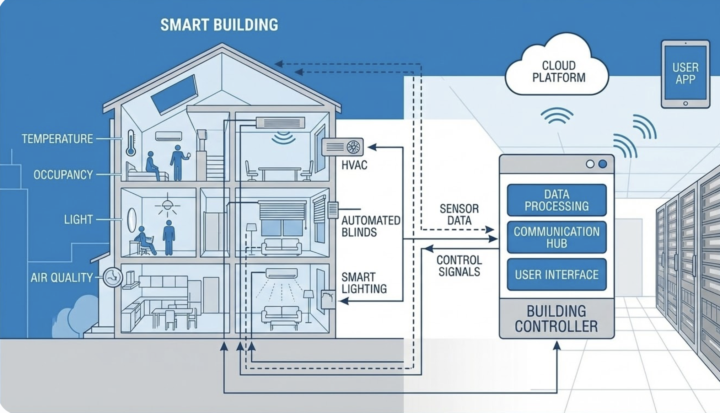
In this course, we are developing a model in Python that uses Reinforcement Learning to minimize the operating costs of a Smart Building (also known as an 'energy hub'). The course is In the 'Classroom' at the very end (numbered 117). The full Python code is available for download. Definitely watch the videos as they explain all details necessary. Below is an explanation (using simple language with all jargon explained). Also you can download a slide in PDF (the slides in PowerPoint format are inside the course). I believe the best way to truly understand Machine Learning and Reinforcement Learning is by diving straight into the code. The code in these videos is based on a real-world application where I tested various methodologies to determine the most cost-effective way to operate a smart building. This building is 'smart' because of how it manages energy. It is equipped with its own energy storage unit (a battery), a solar photovoltaic (PV) unit, and a central computer system. Using advanced algorithms, this system autonomously decides: - When and how much to charge or discharge the battery. - Whether to curtail (reject) excess energy output from the solar PV unit. - When and how much electricity to purchase from the main grid. Over time, we have explored different algorithms for this central computer system. We covered Monte Carlo methods in Course 115 and Stochastic Optimization in Course 116. This new course (Course 117) focuses specifically on Reinforcement Learning. Reinforcement Learning is a subfield of Machine Learning. While traditional Machine Learning models learn by studying historical datasets, Reinforcement Learning trains an algorithm to learn through trial and error—interacting with an environment to figure out the best sequence of actions to achieve a goal. Machine Learning is a subfield of AI, and Reinforcement Learning is a specific branch of Machine Learning. Machine Learning models learn by studying datasets. It's called Reinforcement Learning similar to behavioral psycholog which says that we are learning through rewards and penalties. When the AI (the "agent") takes an action that gets it closer to its goal (in our case: saving money in the smart building) it receives a mathematical "reward." This positive feedback reinforces that specific behavior of the algorithm. Reinforcement Learning trains an algorithm (which is known as Agent) to learn through trial and error.
0 likes • Mar 6
thanks a lot, needed this . I can implement it and add on my cv
Feb 2 •
New Report on Small Nuclear Reactors
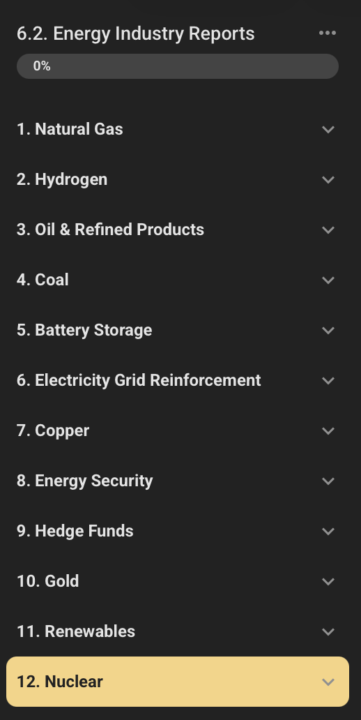
A new report on energy trends has been published and can be found by clicking on 'Classroom' and navigating to Section 6.2 (See the attached screenshot). You can use this report and the visualisations it includes, in your own projects, work, or studies, without limits. This report is about Small Nuclear Reactors and current trends by February 2026. Big technology companies like Amazon and Google are racing to find reliable electricity to meet the massive energy demands of new AI data centers. Their primary long-term solution is investing in Small Modular Reactors (SMRs) which are smaller nuclear plants that provide steady "zero-emission" electricity. However, because SMRs take about 8 years to build, these companies are also restarting and upgrading existing nuclear plants to bridge the gap. The report includes lots of diagrams and flowcharts that provide context, and also a list of relevant sources that were used to complete this report. These sources are from the Financial Times, Wall Street Journal, the Economist and Investors Chronicle (all sources are available inside the report). Your subscription in this Skool community gives you access to paywalled energy-economics articles from these publications (Financial Times etc) indirectly through these reports. I have also included some explanations and additional text that explains some details. The text is written in beginner-friendly, easy-to-understand language. Reading these reports is helpful for interviews, panel discussions , presentations, networking, and public speaking. Strongly recommended.
0 likes • Feb 2
@Arben Kola , PhD I hadn't realized the gap between SMR supply and data center demand was so large.
1-10 of 23

Active 7h ago
Joined Nov 2, 2025
INFJ
Jordan - Texas