Activity
Mon
Wed
Fri
Sun
Dec
Jan
Feb
Mar
Apr
May
Jun
Jul
Aug
Sep
Oct
Nov
What is this?
Less
More
Build Market Close
800
5.0
Free
Clief Notes
55.8k
5.0
Free
27 contributions to Clief Notes

29d •
The architecture of complexity
A paper in 1962 already started talking about the main ideias of ICM, and the most interesting part is that it was trying to understand the architecture of complex systems and how they tend to hierarchical architectures. An awesome read that will allow you to understand ICM even better. A quote from that paper : "Perhaps the simplest possibility is for the complex system to serve as a description of itself"

2 likes • 28d
Thanks!

Sep 21 •
Jev is a Gamechanger!
What is Jev? A newly released decision model: you give it text and a set of options, and it tells you which option fits and how sure it is. And it does so extremely fast and cheaply. I did several tests. This is what I saw. In my own test it labelled 14,007 emails in 4 minutes for about $0.50. Running the same job through Sonnet would have cost about $42 and taken a lot longer. On a smaller run the answers were as good while being 80 times cheaper and fast enough you could use it practically in real time. Why does any of this matter? Let me explain in an example of a workflow that would crank on this: You have incoming email. Send it through a decision tree: - Is the email for support or finance? - Jev - If support, what product is it for? - Jev - If for a TV, is it about the recall, or which of 3 TVs? - Jev - If recall, send canned message - code - Depending on which TV, assign to X person - code - Search documents based on the question and draft a first response - LLM The expensive LLM no longer does all the decision tree work it would have in the past. Jev does that for about 1/80th of the cost. The LLM (Or Human) is at the end of the tree not spending time pointing it in the right direction. The recall is an example of adding a new or temporary category. With Jev that means writing one more sentence describing it. No retraining, no labelled examples. If it's a recall, send them where to go for it and no LLM is called at all. It's cheaper than it looks. Questions about the same email can all go in one call: support or finance, which product, recall or not. The whole top of the tree comes back in one round trip. Only the LLM step at the bottom has to wait. Where it needs care There will always be ambiguity in text. LLMs and Jev are susceptible to this. Jev returns a confidence score that you can choose how to interpret. Is 70% good enough to move to sending a response before a human looks at it? It's cheap enough to run on every email even when a human still reads them all. It sorts the pile and flags the unsure ones first.
1 like • Sep 26
Thanks!
Aug 29 •
Anthropic's blog
I feel like Anthropic's engineering blog is not receiving enough attention. So I wanted to bring it up again for those of you who missed it. The blog contains compressed, straight-forward knowledge that is a result of many customer interactions. Topics include: - Evaluating agents - Making your code environment transition to having longer sessions - Writing skills - What is it like to enable Claude Code for customers And many others... It is pure gold. If you haven't checked it out, put it in your To-Do list Link: https://www.anthropic.com/engineering
0 likes • Aug 30
@Leo Saraiva yes, indeed they assume you have worked at some point with Claude-enabled workflow. But they include numerous general statements, even how to structure your team to deliver better product.
Jul 16 •
I Just Sold my first ICM Folder system!
Last month I was speaking with a friend who works for an engineering firm in Australia about ai, and all the cool things we can do with it these days, and he mentioned that he was trying to push to get a monthly newsletter out to their team to inform them of upcoming professional development courses and workshops. Of course it takes a lot of time to manually search the relevant websites, and put together a newsletter, etc. so no one has done it. I asked a few more questions about the tools they use, and then went and built out a small, structured ICM folder system, with the exact same blueprint that we have been learning in here and using for the competition building. I then made a loom video showing how it worked, and then emailed it to him along with the fully company branded email that it output. It was near the end of financial year at the time, so they were a bit busy, and he said he'd get back to me. Today, 1 month later, he came back and accepted my quote of $600, which includes 2 rounds of revision. To get the draft up and tested, it took me probably about 4 hours, and then there will be another few hrs in finalising it (with the revisions). In reality I probably undersold myself, but this is a side project at the moment (I run a cafe, not an ai consulting business...yet!), and I was excited to have the opportunity at a real client to test against. Let me be clear, I'm not selling a fancy Ai loaded website or app or anything... It is literally 5 folders, with a top level claude.md file, instructing claude co-work (or claude ai or code - or any other Ai tool that can follow structured instructions with a renaming of the claude.md file) on exactly what to do. This is exactly what Jake has been teaching here, and it will stand the test of time. As Anthropic updates their interface, and Open Ai starts to take over claude or another better tool comes along, this ICM folder system will continue to do its thing. It may need some tweaks along the way, but it's not going to need it's whole codebase updated or anything, because it's all plain language, english instructions.
3 likes • Jul 16
Excellent, keep it up!

Jun 24 •
How I measure my Session Health
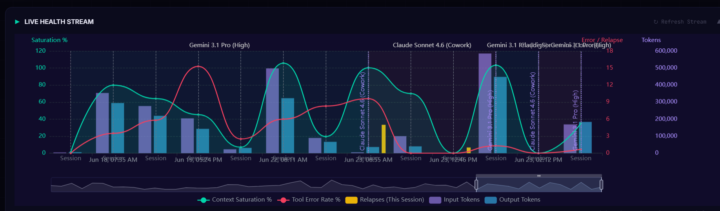
my Live Health Stream is a real-time telemetry dashboard designed to monitor the "cognitive load" and operational stability of autonomous AI agents across different sessions and models (e.g., Gemini 3.1 Pro, Claude Sonnet 4.6). I am using both AntiGravity and Claude Code. They write to my obsidian vault, and my dashboard is a HTML/CSS version of that data along with python scripts that aggregate my json data for metrics I want to measure. Tool Error Rate % (Red Line) - What it is: The frequency at which the agent is failing to execute its tools properly (e.g., syntax errors, bad file paths). - How it’s calculated: (Failed Tool Calls / Total Tool Calls in the session) * 100. Notice on the graph how the red line spikes almost immediately after the green saturation line peaks. Context Saturation % (Green Line) - What it is: A measure of how "full" the agent's brain is getting. - How it’s calculated: (Total Input Tokens / Model's Maximum Context Window) * 100. If this hits 100%, the agent starts forgetting earlier instructions (context eviction). Lessons Learned (Yellow Bars) - What it is: The number of times an agent gets caught in a recursive failure loop (trying the exact same failed action over and over). - How it’s calculated: Programmatically tracked by analyzing the execution log for identical, sequential failed tool calls within a single session. I have a "Lessons Learned" log that I have my agents read on boot, and then if they **** up they have to record a lesson there, and update the .json file for that session where i build this graph from. Input/Output Tokens (Blue/Purple bars) Since this is not exposed I have to do an estimate: "input_tokens": input_bytes // 4, "output_tokens": output_bytes // 4, One of my core philosophies is No Vanity Metrics, and another is Things that are Measured Improve, and Ultimately, The Most Important Things Cannot Be Measured.
0 likes • Jun 25
Hi @Peder Halseide , so you make an agent update the session .json file to keep track of the current context and the error rate?
1 like • Jun 25
@Peder Halseide got it, thank you!
1-10 of 27

Active 7h ago
Joined Mar 19, 2026
Powered by