Activity
Mon
Wed
Fri
Sun
Sep
Oct
Nov
Dec
Jan
Feb
Mar
Apr
May
Jun
Jul
What is this?
Less
More
Memberships
ContractorOS: Construction AI
490 members • $97/month
Construction Contractors Hub
4.3k members • Free
7 contributions to Construction Contractors Hub

Apr 8 •
Does your project use dashboards?
How can you get a quick summary of project performance in under 60 seconds? Dashboards should instantly tell you how your project is tracking in terms of cost, schedule, quality, design, risk and other domains: Here is a video doing a deep-dive on dashboards Does your company use them? Are they good? Here is the Excel dahsboard: https://www.skool.com/construction-contractors/classroom/c3d0bb3b?md=9420ef01f7b54d38aec13f967e87622d

1 like • Apr 9
Tim, would love to see a dashboard for Estimating
Mar 17 •
Operum & Claude/ChatGPT Connection
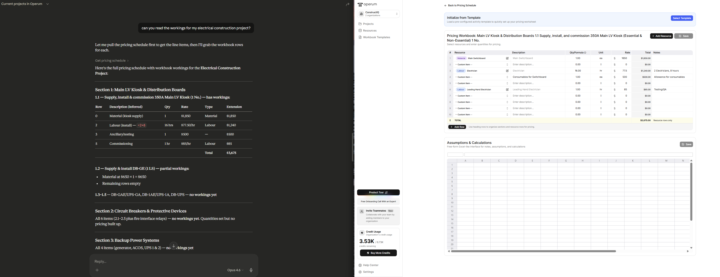
Just finalizing something I am pretty excitied about But very soon you will be able to connect Operum to Claude/ChatGPT so you can fully customize your own estimating workflows with AI Operum stores all your assemblies/data, you get the flexibility of building estimates with ChatGPT Claude. Operum is your editable/structured UI that stores your estimates. Some examples of use cases: - Update your cost library by uploading a quote with 100 line items and AI extracts - Conceptual estimates from scratch using AI and your data - Build detailed estimate workings with prompts - Upload your drawings/specs into Operum, use them as context in Claude And 100 other ones, depending what you want to do https://www.operum.io/
2 likes • Mar 17
That's a game changer!
Mar 12 •
What do you find sucks about estimating?
Last week I did my first bid in ages. I had taken some time off to build the software, so it was good to be back at doing actual estimating. It was an electrical project but the scope was unbelievably confusing. It instantly reminds me what I hate most about estimating. Spending hours going through the drawings, trying to make sense of the scope of works and put it all together. It feels like when bidding, you spend 90% of your time trying to work out what the client actually wants you to price. If you were going to spend $5m+ on a contract, surely you should spend a few hours trying to clearly articulate what you want them to price? But clients never seem to do it properly.... What do you hate most about estimating?
5 likes • Mar 12
The quality of drawings is just downright unacceptable 90% of the time. Owners want you to put together a GMP proposal, and the documents are at 60%. It's just getting worse and worse.
2 likes • Mar 12
@Kartik Patil They're such a pain in the ass. And 90% of the time, those subs are a pass-through anyway. They sit back and collect their 3% for doing nothing

Feb 25 •
Am I Stuck
I am Estimator at one of best company (Top 40) in Canada as General Contractor. Its been a year and half in this company and total 2 1/2 years of experience overall in field. I feel like I have stopped improving at the pace I was expecting and I am doing some mistakes which I could have watched it easily while submitting the hard bid. I am trying different things while being off work as structures, scheduling, learning process as they were my subject in masters education, but I feel what should be my growth look like. Why I am being slow at learning and I am 25 year old, and what should be my next step. I feel being pre-construction manager will be actually worth it as I gain more knowledge and experience. Need some help as you guys have definitely gone through such period.
5 likes • Feb 27
You need to give yourself some grace, man. This industry is extremely challenging and knowledge-dense, especially for people like us who are general contractors and have to understand every single trade. You only have 2.5 years of experience. I barely knew what an RFI was two and a half years in, but you're doing all the right steps. It's incredible to see that you're taking it upon yourself to gain more knowledge outside of work. I applaud you on that. You need to keep that up; however, don't burn yourself out. Experience in this industry really does hold a lot of weight. Once you see something for the second time, you will almost instantly flash back to the first time that you saw that type of system or detail when you had no idea what it was. That only comes with time and experience. If you are at a top company, I'm going to go on a limb and say that there's training for younger employees like yourself. I could be completely wrong, regardless of whether there is or isn't specific training given to younger employees. Make it a point to seek out the top people in your company who enjoy teaching people. Go to them with questions and ask if they've seen something before that might be stumping you. You're not only going to get good responses from the people who like to help, but it's also going to show a massive initiative in you and position you for career growth within that organization. I have pretty severe ADD, and I would say that I am definitely a slower learner as well; however, that doesn't mean we can't learn. We just have to work harder than most people. It's okay if it takes you a little longer to pick something up compared to everyone else. That's just the natural race that we have to run in life. You're working harder than 99% of people your age and experience right now. Pick your fucking head up, man. That's something to really be proud of! If I can offer any guidance or assistance, shoot me a DM. Just let me know.

Feb 14 •
Why MOST Architecture Firms hit Plateau (And Don’t Know WHY).
You Don’t Have a Lead Problem, You Have a Conversion Problem. You didn’t start your firm to chase clients. You didn’t survive studio all-nighters, crit reviews, and years of licensure exams just to negotiate your own fees down on a Zoom call. But if we’re being honest… A lot of firms are still operating like this: * Waiting on referrals * Hoping a broker sends something over * Sending a proposal and praying it doesn’t get ghosted * Hearing “we’re talking to a few other firms” and instantly feeling pressure That’s not strategy. That’s survival. And survival mode is expensive. If your average project is $80k–$120k and you’re closing 2 out of 10 qualified inquiries, that’s not a design issue. That’s a structure issue. Because the firms that quietly dominate their local market? They’re not always more talented. They just: * Control the discovery call * Pre-frame budget before presenting design * Anchor value before fees ever come up * Filter out bad-fit clients early * Have a defined sales process their team understands Most architects were never taught how to: * Handle “your fee is higher than the others” * Prevent scope creep before it starts * Upsell additional services without feeling awkward * Build brand authority so clients come in pre-sold So what happens? You take projects you don’t even love just to keep cash flow steady. You discount when you shouldn’t. You tolerate red flags because pipeline isn’t predictable. And the worst part? You think it’s normal. It’s not. The moment you add structure to how projects are won, everything changes: * Higher close rates * Better clients * Cleaner margins * A team that feels stable instead of reactive * The ability to say “no” without anxiety Architecture school taught you how to design. Nobody taught you how to win. The good news? This is a skill gap, not a talent gap. And once you see the framework behind it, you’ll wonder how you ever operated without it.
5 likes • Feb 15
@Jaspreet Singh Bro, it’s 100% a copy and paste post from an LLM 😂.
3 likes • Feb 15
@Jaspreet Singh This isn't the place to argue. Create good drawings, network, and the business will come.
1-7 of 7

Active 13d ago
Joined Jan 25, 2026
Powered by