Activity
Mon
Wed
Fri
Sun
Aug
Sep
Oct
Nov
Dec
Jan
Feb
Mar
Apr
May
Jun
What is this?
Less
More
Memberships
Clief Notes
40.7k members • Free
Real Estate BFF
307 members • Free
Our Deal Partner CRE Community
631 members • Free
Land League
531 members • Free
AI Automation Society
417k members • Free
104 contributions to Clief Notes

19d •
Chinese models US hosted & Private
There is a method of using Chinese models like: Qwen, MiniMax, Zai, Moonshot, etc. That are hosted in the US on the latest NVIDIA B300 datacenter GPUs, where your data stays private and is never trained on. This is where Ollama, the self hosted go to source for local models comes in. Ollama offers a selection of cloud based models. Simply append your model call with :cloud https://ollama.com/search?c=cloud&o=newest What's your favorite model?
Poll
10 members have voted

4 likes • 19d
@Curtis Hays economies of scale. Geopolitics aside. Asia has been automating manufacturing for decades. People assume cost savings come from the wage difference alone (not always the case) but it actually comes from the fact that Asia has invested heavily in production automation to such an extent it has commoditized the world. Palmer Lucky, founder of Oculus and now of Anduril, talked about this recently in an interview. Engineering in the US has become essentially boutique design shops, then its sent to Asia where their engineers actually design the process/infrastructure to produce the thing. And they are incredibly good at it. I am currently in the manufacturing space and I can tell you that the quality control/quality assurance is so tight in Asia, our American factories of the same product simply can't compete. I have far more QC issues from American manufacturing than Asia. The difference? Automation. Pure and simple. Now jumping back to AI, I would imagine the same is in tech. They do things at such immense scale, it drives the cost down. Which is exactly what Jake talks about with building features rather than infrastructure. Asia has mastered infrastructure.
1 like • 19d
@Mark Gubuan not sure. with the heavy investment and on going cost to maintain all of these data centers, not sure how these frontier companies can capitalize on something that already only costs $20/month. I can only see the costs going up. But, that's just my fairly uninformed gut talking.

🔥
20d •
SkillOpt — Has Anyone Looked at This?
A CEO of an MSP that I've been one on one consulting on ICM sent this article to me this morning. Microsoft's SkillOpt automatically upgrades AI agent skills without touching model weights Repo: https://github.com/microsoft/SkillOpt The short version: instead of fine-tuning model weights, it treats your markdown skill files as the trainable parameter. It runs your agent against benchmark tasks, analyzes what went wrong, proposes bounded edits to the skill doc, and only accepts changes if held-out validation strictly improves. The deployed artifact is a single best_skill.md file — no extra model calls at inference. They're reporting +19.1 points on Claude Code benchmarks. That's output quality — the agent getting the right answer more often — not token savings. When I first started building skills in my ICM, they were bloated. Long, unstructured, burning tokens. If you're letting Claude build your skills for you (which is the natural thing to do), you're not necessarily getting an optimized artifact — you're getting whatever Claude thought was thorough at the time. The question SkillOpt is trying to answer: is the skill actually performing, or is it just big? Where I'm less sure it translates: most of the benchmarks are coding tasks, where "correct" is binary. I have three copywriters — Cash, Clyde, and Wradley. Scoring whether a piece of copy is better is a different problem. Harder to define, harder to gate automatically. Is this a layer worth putting on top of nuanced specialist work? Has anyone here dug into it?
4 likes • 20d
@David Vogel it’s almost as if the universe keeps sending you to tell me to get on the Hermes train. 😝 I keep talking myself out of it because I don’t feel like I’m enough of a “power user” to need it.
🔥
24d •
Turns out the academics are a lap behind us.
Had a call today with researchers from Stanford's Autonomous Agents Lab. They're studying AI adoption at marketing agencies. Found me via Google. I asked them how much research they did on me first, none; they were embarrassed to say they just filled out my contact form. I warned them it might not be the conversation they expect. At the end, they said I was the most advanced agency owner they'd spoken with. They'd never heard of ICM. These are smart people doing real research. They've talked to a lot of agencies. And the most common thing they see is: people using ChatGPT chat, maybe dabbling with agents, struggling to get them to do things reliably end-to-end. You all know what I've been running for the past 2 months and I showed them. Then the researchers showed me their own tool — an autonomous browser agent that can log into Google Ads and act. I told them: I don't write to external platforms without a human reviewing it first. That's a policy, not a technical limitation. My clients' $20K/month runs through my judgment, not an AI's. Human in the LOOP! Their reaction: "that makes sense." But they were clearly used to hearing "I'm trying to get the AI to do more." I'm not. I'm trying to get the AI to help me reason better. That's a different goal. My takeaway: if you're in this group and you're here honestly learning, you're way ahead, don't stop! Keep building! Ronnie Coleman once said: "Everybody wants to be a bodybuilder, but nobody wants to lift no heavy-ass weights."
5 likes • 24d
@Curtis Hays This is such an epic story.

24d •
I'm in London for Tech Week, community meetup on the 11th
I'm in London all week for London Tech Week. If you're here too and you want to meet face to face, I'd love that. Find me, say hello, talk shop. The whole point of a week like this is the people, not the panels. On the night of the 11th I'm hosting a meetup for this community. No stage, no slides. Just people from Clief Notes in one room, in person, for once. Time and location aren't locked yet. I want the room to fit the turnout, so here's the plan: drop your name and email on the sign-up page below, and once it's confirmed I'll send everyone the where and when in a single email. Sign up here: https://aris-space.com/london-tech-week If you've only ever been a name in a thread to me, this is where that changes. //A<3

2 likes • 24d
I hope y'all have an amazing time! Can't wait to hear a debrief!
0 likes • 24d
@Ari Evergreen
30d •
I open-sourced the setup I use to ship while I sleep
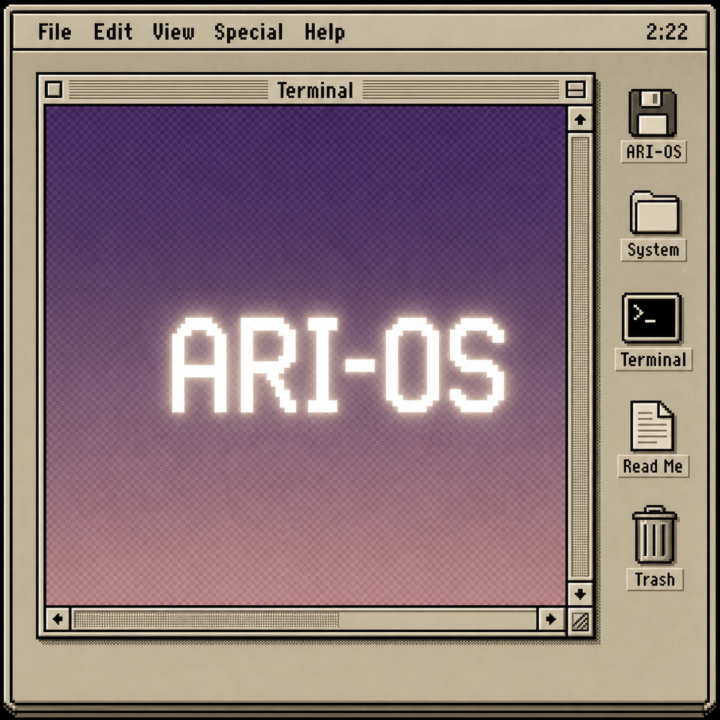
For a long time I was the slowest part of my own work. Everything ran through one chat. One conversation, one me. Good ideas queued up behind whatever I happened to be typing. The model in front of me was fast. I was the line it had to wait in. So I changed the job. Instead of doing the work, I direct it. I stay in one seat and advise, and the building happens in the background, in workers I hand tasks to and check on later. It runs whether I am at the desk or asleep. That last part is the honest claim, so let me be careful with it. This is not ten times faster, and nothing builds itself. I still decide what gets made, and I review every result. What changed is that I stopped being the single point everything has to pass through. The proof: I built part of the setup using the setup. I wrote a short spec for a tool I wanted, handed it to a background worker, and went to bed. In the morning the tool existed, its tests passed, and one question was waiting for me about a naming choice. I answered it. That was my whole night shift. I packaged it and open-sourced it. It is called ARI-OS. Repo: github.com/PUSHINGSQUARES/ARI-OS Install page: aris-space.com/applications/ari-os It is one loop, six steps, and you can learn it in an afternoon: 1. Brainstorm. Talk the idea out until it is a clear outcome, not a vague wish. 2. Plan. Turn that outcome into ordered steps. 3. Dispatch. Hand a step to a background worker and let it run on its own. 4. Watch. Glance at a small dashboard. See what is running and what is stuck. 5. Review. Read what came back. Keep it, or send it back with notes. 6. Ship. Merge the work that passed. You live on steps one, five and six, the judgement steps. The worker takes three and four. Step two is shared. The parts that need your taste keep you. The parts that do not stop waiting for you. If you are just getting started with Claude Code: it is pure Python, it installs with one command, it sits on top of your existing setup, and it is reversible. It distils four habits I lean on every day. A handoff layer, so a fresh session picks up cold without losing the thread. Background-first dispatch, so focused work runs while you stay free to steer. Spec-first thinking, so the work has a target before any code exists. And a memory, so the setup recalls what past sessions decided instead of guessing every time.
0 likes • 29d
@Ari Evergreen
1-10 of 104

@nathan-smith-5543
Hi there! My name is Nathan and I’m here to learn new skills, reinforce current ones, and grow as a leader in business and in life.
Active 1d ago
Joined Jun 1, 2026
Powered by