Activity
Mon
Wed
Fri
Sun
Jun
Jul
Aug
Sep
Oct
Nov
Dec
Jan
Feb
Mar
Apr
May
What is this?
Less
More
Memberships
Follow The Way
85 members • Free
26 contributions to Follow The Way

Feb 4 •
What do i do Today?
Was watching an interview of Bassem Youssef on Candace, i cued the video for 2 minutes of your time to point out "nothing will change" i reflected on my activities, and believe i've switched my focus away from 'cursing the darkness' to trying to touch the lives of those closest to me. While i don't believe 'true' altruism exists, i've seen how a little attention spent in ministering (in my own unique and imperfect way) helps my general attitude and outlook. i feel no compulsion to explain or document online what i do from day to day, but i trust if i am properly focused, it is God working through me. the video segment maybe nihilistic, but should encourage you to make your small part of the world just better. the entire point is "what's MY responsibility?" in perspective. yes, i look for these things, because the oppression is real.
0 likes • Feb 5
I was watching an unrelated clip where the ending stated "all groups (religions) suffer some sort of superiority complex, 'i'm going to heaven and they aren't'.." This reminded me immediately of the parable of the wedding feast of Matthew 22, which gives the conclusion “For many are called, but few are chosen”. This ties back to my wry point of me telling God my plans. HE sits back and says "we shall see" I personally believe it is absolute hubris to think i've "put on the wedding garb" of accepting Jesus Christ and "am good". i can say this with confidence, only for myself, because of the continuous barrage of sin and failure i contend with every day. for me, it's not 'the right mindset' but my active participation in a secular world in the way that pleases God. this is meant to be a gentle reminder to ask yourself "what if i'm wrong?" which is not a lack of faith, but an affirmation. Thine will, not mine.
0 likes • Mar 29
just want to throw some words by Charlie Kirk up for others. Very simple message about Focus on God. https://www.youtube.com/shorts/5HdsQ-UeSp8
Dec '25 •
Source?
i have to start somewhere, so here goes... On the topic of Truth tellers, i'm interested to hear where others spend their time gathering information. While i understand this is topical and subjective, i've noticed a trend i'm experiencing that i abandon a source i trusted when they step across my lines. i spent an hour a day watching The Bongino show for years during Russiagate, but quit when he stopped Ukraine coverage. it seemed to me he was avoiding the topic of the massive money laundering in favor of lesser importance stories. you see where he is now? I use Viva Frei for legal analysis, but crickets from him on the Tyler Robinson Gag order? red flags for my "pro Israel" radar. "cat up a tree" coverage is overt avoidance. My 23 y/o son says he watches Fuentes, who i had audited and understood the 'shock jock' aspect coupled with the appeal of taboo topics. disproportional Black crime, Racism is natural, etc. i told my son "they" would "get to" Fuentes and he would sell out, after my experience with Trump's reversal on campaign promises. and now Nick's acceptance of the Tyler shooter narrative on Crowder has many convinced. (i've only watched 1/4 of his 2 hour interview on Piers Morgan) Tucker was amazing in his interview with Qatar’s Prime Minister. consistent values on display. i'm also using maybe 3 or 5 channels for the TPUSA questions being asked. I'm more political than Religion focused, but look for any references as a springboard to Scripture. i have to say, after 8 years on a "conservative bubble" politics forum, i had to walk away when faced with lockstep Zionism there. two admin announced criticism of Israel was "chumming" and bannable. echos of Pam Bondi censoring? and literal posts in a "RIP Charlie Kirk" thread stating 'Second amendment comes BEFORE the first'. epitome of a dog whistle, by multiple members. To which i learned: Titus 3:9-15 https://becomingcloser.org/titus_long/never_teach_a_pig_to_sing.html
0 likes • Mar 4
Was watching Kim Iversen when she brought on Prof. Jiang (Xueqin) to discuss his predictions on Iran. 23 minute clip i had audited his channel half a year ago, first on "problems of the official story of the moon landing" which i found compelling enough (strange, because i don't subscribe to those sorts of perspectives) to look at his other videos, "the real reason Jesus was too dangerous for the church" (which ties back to my 'First Sermon' post) possibly it's because i don't really understand the points he presents of a Theology nature, but often i cross reference points made for clarity. let me restate that in English: "Jiang may be talking a load of trash propaganda and i wouldn't know he was lying, BUT it prompts me to do further research from other sources, which is a positive thing" If anyone watches his classroom sessions on religion and finds conflicting evidence, i'd like to hear why he's off the Narrow path. https://www.youtube.com/@profjiangclips https://www.youtube.com/@ProfJiangMedia https://www.youtube.com/@PredictiveHistory Edit: digging more brought me to his "three reasons the US attacked Iran" cued to the last 3 minutes 30 seconds.
0 likes • Mar 10
Today's guest speaker is Reinhold Niebuhr. maybe best known for his "serenity prayer" he spoke about the accountability of power to Justice. From a Christianity Today article written 2017: "Niebuhr said to American leaders, go ahead and throw your weight around, but don’t pretend that your motives are pure, and don’t be shocked if you achieve something less than justice." i contrast that with "Religion News Service" written March 2026. "he rejected naïve pacifism — the belief that goodwill and diplomacy can eliminate violence from history. He argued that the refusal to confront evil can itself become immoral." I hope you can see how these two 'takes' of what he preached are from opposite sides. another take from the 2017 CT article warns against political prejudice: "politicians who claim fealty to Niebuhr aren’t so much admiring a prophetic outsider as heaping laurels on a hero of their own tribe." lastly, from assorted quotes of his: “Nothing worth doing is completed in our lifetime; therefore we must be saved by hope. Nothing true or beautiful makes complete sense in any immediate context of history; therefore we must be saved by faith. Nothing we do, however virtuous, can be accomplished alone; therefore, we are saved by love.” This took me back to Jacob Marley's chains and "more than can be accomplished in a lifetime" which stayed with me.

Mar 1 •
So so much growth in the past two months!
I know it has been a long time since I’ve contributed here, and for that I apologize. What started off as enthusiasm for a great 2026 has been tested in difficulty after difficulty after difficulty. Purified by fire. Adversity. Grief. Clarity. Courage. Wash. Rinse. Repeat. How do people live life without Jesus? Time spent in the Word. Time spent in prayer. Interceding. Listening. And what I recognized just today is that the adversities (and they are soul-crushing sometimes) will continue, and so will the Holy Spirit. We are alternately being strengthened and purified. Empty me. Fill me. Use me. Hold on to Jesus, brothers and sisters. Life is not fair. It was never meant to be. And God still wins. Hang on!
0 likes • Mar 2
I admit i come here for a break from the insanity. a brief respite to refill. to refocus. While struggling for over a week with a "God save me from being angry" issue (a prayer asking for strength) i read the words "Adversity, Grief, Clarity, Courage" God is asking me to apply these to my situation, to stop being stubborn and apply wisdom. i even had gone to Got Questions and was rewarded with Romans 12:19. "Do not take revenge, my dear friends, but leave room for God’s wrath, for it is written: “It is mine to avenge; I will repay,” says the Lord." NIV. i won't begin to outline, suffice to say i need to rest with a clear conscience, nothing else is vital. let's leave it at that. This was just a venting, not a prayer request, maybe a hard look forced from a "Follow THE way" perspective was what i was seeking. Adversity, Grief, Clarity, Courage. so i'm about 75% there.
0 likes • Mar 9
Just an update, here seemed as good a place as any. a comment under a video short took me to the parable of the good Samaritan, specifically Luke 10:27 He answered, “’Love the Lord your God with all your heart and with all your soul and with all your strength and with all your mind’ and, ‘Love your neighbor as yourself.’” Sunday was a good day, caught 2819 church message, broke winter's hold with outside time, meditating and giving thanks. i had texted the person i was "angry at" a message (Friday) negating their incidental debt to me with Luke 10:35 : (because God directed me to that passage) "The next day he took out two denarii and gave them to the innkeeper. ‘Look after him,’ he said, ‘and when I return, I will reimburse you for any extra expense you may have.’" Sunday night (the next text) from them was about some random comment i had made that "showed them..." i was a terrible person. i'm thinking to myself "bite the hand that feeds you", "you knew it was a snake..." because the simple fact was, i was angry at myself for helping them in the first place. that's what the prior post was ALL about. I texted them back with "Thank you, i am sorry" and nothing more. i feel i did the right thing, kept my word, and pleased God with obedience. i'm not sure where i (just) heard: "Victory isn't always defeating your enemies, it's victory over yourself"
Jan 8 •
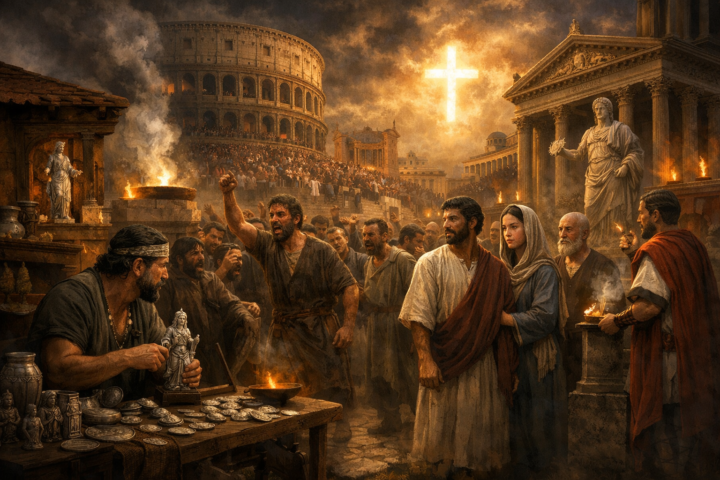
Bread, Spectacle, and Allegiance: Why Rome Feared the Early Church
Most people think Rome persecuted early Christians because Rome hated religion. That's not really what was going on. Rome had room for religion. Rome was drowning in gods. Temples, shrines, festivals, sacrifices, household idols. The issue was not that Christians had beliefs. The issue was allegiance. Rome could tolerate private faith. What it could not tolerate for long was a public people whose highest loyalty did not belong to the state. Now, to feel why that mattered, you have to picture how Rome held the crowd together. They used a rhythm. A system. Keep people fed, and not just fed, but fed for free. Grain distributions meant survival was tied to the system. Life stayed smoother if you stayed compliant. It quieted unrest without needing soldiers on every corner. Then keep people entertained. Games, festivals, spectacle. Loud enough to drown out reflection. Then keep desire active. Always something to crave next. Status, pleasure, comfort, approval. Keep people chasing. Keep them busy. Busy people do not ask big questions. And wrap all of it in ritual so participation feels normal, not forced. Altars. Processions. Public sacrifices. Honor the emperor. Not because everyone believed deeply, but because participation was the signal. It told the empire, I belong. I'm safe. I'm one of us. That's how you manage millions. Not by persuading every individual, but by shaping the crowd. Then Christ broke the rhythm. The gospel did not just give people new opinions. It moved the center. It rewired loyalty. And once loyalty shifts, it shows up in public. It changes what you do. What you refuse. What you will not say just to keep life easy. Because Rome's religion was not just spiritual. It was an economy. Temples moved money. Festivals moved commerce. Idols had supply chains. Craftsmen made statues. Vendors sold offerings. Trade groups often had ritual meals and offerings tied to the gods, and participation could affect your reputation and your ability to work. So when Christians stopped bowing, they also stopped buying.
0 likes • Jan 13
I wanted to cite from what was going on behind the scenes why i was questioning my ability to properly speak with someone in a one to one setting: this is quoting from a discussion on Theosis: "In my real life it meant things I used to like or tolerate became unpleasant to me. Other things drew me that I'd not been interested in. Without being too specific, things we'd call sinful, weren't something I stopped by force of will to please God, I just didn't want to. I was more patient, and I didn't try to do that, either. I realized the great value to others of simply listening to them, by doing that. I found myself doing it, I didn't decide to. Just giving time and attention can be a huge gift. That's not me. It was the knowing, the feeling of grace that .... like... who is this person doing these thoughtful things?.... It would have been an identity crisis except the answer was always right there, this Father God who always felt like He was smiling at a small child He never disapproved of and it was me and He was showing me a new toy and keeping me from running out into the street. I'm immensely far from perfection, but I'm also pretty far from where I was. I didn't do any of it. I just - once given the experience of the Presence of God, it's like the most addictive drug in the Universe. I just wanted to be with Him. The rest happened to me, it wasn't done by me." "i realized the great value TO others of simply listening" hit me in a way i needed. The irony here is, as my Children grow farther apart from me, i'd learned to accept what time they are willing to give, to not give judgement or offer advice, but to share my experience and give encouragement.
0 likes • Feb 13
With the buzz about SuperBowl sunday, the Olympics and TP halftime show, i just wanted to post how i considered all of them "bread and circuses" meant to placate the Hoi Polloi. i wasted little to no time besides posting this much on it. Over reporting how many viewed the TP show made me make the observation i consider Erika Kirk with the same merit as Jill Biden. (Jill sat in on cabinet meetings in lieu of Joe) If TP backs Kamala after their petition to recall Julie Spilsbury, Mesa Az councilwoman, removed for supporting Harris? (Harris is an unsubstantiated hear-say, but i respect who i heard it from).

Jan 26 •
Time is Flying By...Jesus is About to Return!
Please watch and let me know your thoughts. https://youtu.be/pp6hAahJkJU?si=Bd3kXHIc2CWNb4DO
0 likes • Jan 28
posted 8 hours ago in my video routine, under 2 minutes into the (3H) clip. i started the video right after my 2 lamps post.
0 likes • Feb 4
i didn't fail totally but immediately saw how different readings led to different interpretation. but at least i got a chance to use that new to me web site on StackExchange. to put it in context, it reminded me of the difference between "implied" and "inferred" with one response stating "a fairly clear answer is implied in the text itself" (not 'inferred from') Three different disputed readings to two witnesses was my understanding. (1) Moses and Elijah (2) Enoch and Elijah (3) Two unknowns, yet to be appointed and revealed, i'm sticking to that answer personally as the one i'm most comfortable with. instead, i was directed by a different imperfect messenger to read the book of Mark, chapter 4, so i obeyed.
1-10 of 26