Activity
Mon
Wed
Fri
Sun
Jul
Aug
Sep
Oct
Nov
Dec
Jan
Feb
Mar
Apr
May
Jun
What is this?
Less
More
Memberships
BUILT Investor Network
295 members • Free
Commercial Real Estate Mastery
1.3k members • Free
Preforeclosure Real Estate
3.3k members • Free
Construction Contractors Hub
3.4k members • Free
Auction Property Academy
578 members • Free
Multifamily Wealth Skool
19.2k members • Free
Passive Income Club
456 members • $297/m
5 contributions to Construction Contractors Hub

2d •
Google Created This Lead Generation Tool Almost 10 Years Ago For Small Local Businesses—Yet Most Of Them Still Don't Know It Exists
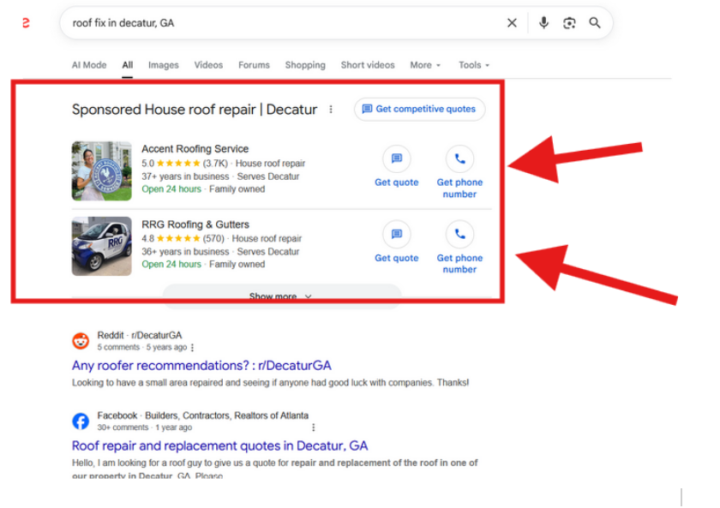
Many contracting businesses don't know about this, and they really—REALLY should. Google first introduced this feature back in 2017, nearly a decade ago, after spending roughly two years testing and refining it. The rollout was a success, and today it has become one of the most powerful lead-generation channels available to small and medium-sized local service businesses. This one is especially relevant for local service professionals. Traditional Google Ads can be incredibly powerful, but they're also competitive. You need to write good ad copy, set up your campaigns correctly, monitor performance, optimize keywords, and continuously refine the account. On top of that, you're usually paying per click—not per lead. That means if your landing page isn't converting, you can easily spend a significant amount of money on clicks without generating many actual leads. And unfortunately, that's a reality many businesses experience. But what if I told you there's a way for small and medium-sized local businesses to bypass a lot of that complexity? What if you could appear at the very top of Google, pay for leads instead of clicks, and let Google handle much of the heavy lifting for you? Have a look at the picture attached. This is an example search I performed in Decatur, GA. Take a look at the top two results. You'll notice something interesting right away. These businesses aren't appearing through traditional Google Ads. They're showing through Google's Local Services Ads (LSA) platform, which sits above the regular search ads and organic results. This is what's called LSA (Local Services Ads). It's connected to your Google Business Profile (formerly Google My Business), which you're probably already familiar with through Google Maps. LSAs are displayed in a way that allows searchers to either call the business directly or send a message with just a few clicks. One of the major advantages is that you don't need a dedicated landing page to generate leads.

0 likes • 4h
Thanks for sharing this, I wasn’t aware that they were actually different, yet parallel services offered; I just learned something 😂 . I think many businesses aren’t aware of this updated, extended, more precise version, because most individuals probably think they’re the same thing/ service 😂 . Chances are, we probably have heard about it prior, but due to the way Google advertises the service, our brains more than likely filtered out the common verbiage and thought, “SCROLLLL I already have that”. Too many hype words that are parallel to the original method, rather than, Targeted pointers and phrases, illuminating the difference and explaining why we need it. ..

11h •
What is the biggest obstacle to maintaining accurate and timely estimates, contractors?
Hi everyone! Joining the Construction Contractors Hub and interacting with other industry professionals excites us. Here's a question for contractors, builders: What is the most difficult aspect of estimating that you now deal with? Tight deadlines, varying labor prices, material costs, or bid accuracy? Although every company has different needs, many expanding businesses are looking into construction estimating services for busy contractors to save time and concentrate more on project execution. We would be delighted to hear your opinions: 1. Do you do your own estimation or do you contract it out? 2. What has made your bids more successful? 3. Which methods or instruments do you suggest for estimating? eager to share knowledge with everyone and learn from the community.
0 likes • 7h
From my experience, it isn’t often the estimates at all that cause the most ruckus, it’s the scheduling/ rescheduling (In a climate like Michigan that can experience all 4 seasons in a single day, despite what the meteorologist had initially forecasted 😂) That consequently, directly impacts the initial estimate’s legitimacy. .. I’ve found that adding a broader contingency cost into the final bid to account for that potential, to be of best practice for our company as, we offer the majority of the unused funds back to the client to build further rapport. As for estimating tools, we’re currently shopping around; transitioning from a traditional style, in order to meet innovation where it stands rather than complaining about the flaws of the contrary “old school” ways 😂. I’m happy to be apart of the community and super eager to learn & bounce ideas and experiences off of other members in the group!

5d •
Contracts Management is Pattern Recognition + Admin
Based on a study I found, the average contractor loses 9% of their revenue to bad contract management. Which is absolutely insane when you think about how easy it actually is Contract management is patent recognition and administration Sure when you get into a dispute with your clients or are making complicated claims, there is a lot more to it than that. But the day-to-day discipline of maintaining a site diary, making claims on time, and all together keeping good records and following contract processes is just not that hard. A lot of it is repetitive manual tasks that are perfect for AI Here is my outline of how to apply AI to construction and contract management
2 likes • 5d
Thanks for sharing; also, this may be a silly or rhetorical question but, is there a general area where these videos you post on the feed are generally stored?
0 likes • 3d
@Tim Fairley oh, very cool. Thanks!
15d •
Understanding Construction Risk Management
Construction companies are like insurance companies. We take a fixed fee and deliver a scope — regardless of whether it rains, suppliers go bankrupt, or we hit ground conditions nobody expected. We carry the risk. We guarantee the result. The difference is how insurers survive it. They pool thousands of similar policies, so any single bad payout is absorbed by the spread. The law of large numbers does the work. We don't get that. Every project is one-off. There's no spread to hide in — each job is a single bet. It's the opposite of manufacturing, where you run the same process over and over until it's perfect. We can't perfect what we've never built before. So uncertainty is unavoidable. We manage it one project at a time. Risk management is how we deal with the uncertainty that matters. What risk management actually is A project plan tells you what should happen. It's built on assumptions. Risk management prepares you for what might happen when those assumptions break — the storm, the supplier that folds, the ground that isn't what the report said it was. That's the whole job: take uncertainty and turn it into manageable action. Done well, it protects your margin, keeps the programme honest, heads off disputes, and keeps people safe. A few concepts worth getting right Risk vs. uncertainty. Uncertainty is everywhere. A risk is the uncertainty that matters — the kind that hits cost, time, quality, or safety. Don't drown the register in things that don't move the project. Threats and opportunities. Risk isn't only bad. A threat has a negative impact; an opportunity has a positive one (i.e. an unusually dry spell that lets you finish early and pull cost out). The goal is to kill threats and chase opportunities — most people only do the first half. Cause, event, consequence. A risk worth recording has all three: the condition that triggers it (cause), the uncertain thing that happens (event), and what it does to the project (consequence). "Bad weather" isn't a risk. "Heavy rain in Q2 (cause) floods the excavation (event) and pushes the programme two weeks (consequence)" is.
1 like • 12d
Great insert! Whether we employ this concept functionally already or not; keeping this framework prioritized at the forefront of thought, will cause this process to be habit, ultimately generating more income, managing/ accurately predicting timelines and trade capabilities and so on. Love it!
22d •
Construction Take-Offs - The Complete Guide
Take-offs drive everything on construction projects. The cost, schedule, contracts and methodology. I wanted to do a big re-boot of a previous video I've done on construction take-offs. Much more in depth and covering some new and important concepts I've learned. Hope you find it valuable You can find all the notes and the assemblies in the classroom https://www.skool.com/construction-contractors/classroom/d7547c66?md=342669a8812248bfbcf94b161268d625 I use ZZtakeoff in the video (thanks to @Sam Romeo and @Derek DelQuadro)
0 likes • 18d
Wow, excited to check it out; thanks for sharing with us!
1-5 of 5
Active 52m ago
Joined May 29, 2026
Michigan
Powered by