Activity
Mon
Wed
Fri
Sun
Jun
Jul
Aug
Sep
Oct
Nov
Dec
Jan
Feb
Mar
Apr
May
What is this?
Less
More
Memberships
Clief Notes
29.1k members • Free
20 contributions to Clief Notes

Mar 15 •
🏁 Foundations 3.3 Check-In
Everyone gets something wrong the first time. Vote below, then drop your mistake in the comments so others can learn from it.
Poll
303 members have voted

0 likes • 15h
So let's say I want to have a helper that helps me with technical help for different applications I have. At the top level I have a short description of what the purpose is and a routing table, etc. Is it better then to have subfolders for each application wherein there is context and reference documents for that application (which is what I have in my first attempt) or should I have one subfolder for the particular activity (technical resource lookup and advice) and then a context file with routing and naming for files relevant to the particular application? In the former case It gets into perhaps too many subfolders as there will be one per application but on the latter I could have a whole lot of files as reference in one subfolder, but would also allow me to add other acivities.

1d •
From 5 days to 1hr!!!
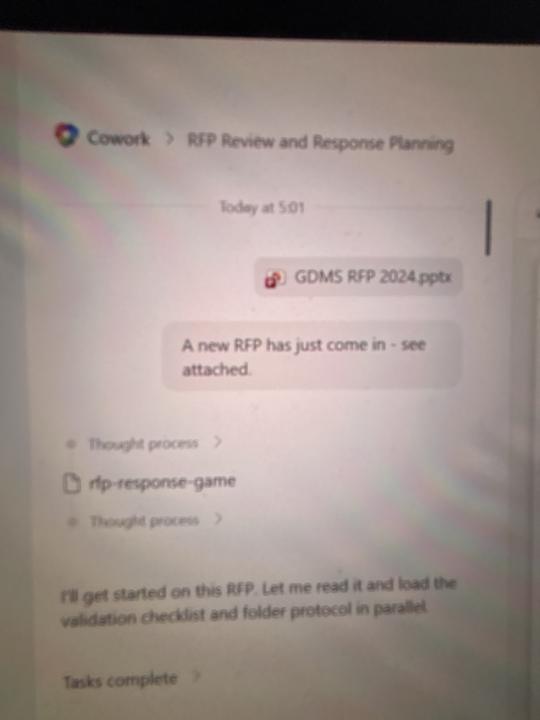
Hi all. Quick background - The organisation I work for recently signed an agreement with Anthropic and last week we got access to their most recent models (Haiku, Sonnet and Opus). We’re predominantly a Microsoft house so have been using OpenAI this whole time and I have a Copilot licence. With everything I’ve learnt in this community, it’s been the biggest frustration not having access to tools that I can leverage to build ICM structure. I was trying to build my own if I’m honest. This week that changed as getting the Anthropic models also gives me access to the Copilot Cowork ‘Agent’ (frontier, and not just an agent 🤦). I now have something that can interact with my folder structure and today I completed testing of a workflow for creating proposals off the back of receiving an RFP - a process that usually takes 2-4 people a working week (5 days) of collaboration, research, meetings, etc, but took me just over 1 hour to have a fully branded working draft, off of the prompt “A new RFP has just come in - see attached”!!! (Screenshot for proof) We have a pretty rigorous process when we receive RFPs, so to be clear exactly what’s going on: 1. Validate the RFP against a number of criteria first to establish its something worth our time responding and bidding for. 2. Go through a research stage to gather information about the client, the industry, competitors (known or potential), case studies etc. 3. Analyse all research with additional context of our relationships and previous opportunities or projects if they exist. This additional data is all store in a CRM that has limited access to only senior people. Artefacts are created here with matrices of competitor comparison analysis, value wedges and our approach based on the case studies. 4. Map out our value proposition comparatively to potential competitors and develop the story we want to tell. (All this before we start building out the proposal and embed this information into it) 5. Build out the proposal. There is a template but it’s extensive and requires shaving down quite often. This is also done by junior members more often who are just pulling information in without understanding what it all means. 6. Check that branding guidelines are in place throughout and consistent. 7. First draft is now ready for senior review and changes
1 like • 18h
That's great, I can see how this would be a boon. Your process is already well scripted and was amenable to this path once you had access to the tools. One thing I've seen used often when writing proposals is a verification matrix. When reviewers work through proposals that are received, one of the quickest things they may do is look to see if the proposal is compliant with the RFP. If it isn't compliant, they won't waste any more of their time on it. That may already be in your workflow/system, but if not, it would probably be straightforward to implement based on what you already have. The agent builds a matrix from the RFP then uses it in creation of the proposal. It can show you all along the way and at conclusion. If you see something there that doesn't make sense to you or is weak, it may point out areas you need to shore up. You can even put the matrix into your proposal to show you really read through and understood what the customer wanted and that your proposal is compliant. It will already be an advantage over competitors who don't put one in as the reviewer has to hunt and confirm whether or not its compliant. With your matrix, you'll even have been able to show them "why" its compliant and help convince them if they misunderstand the linkage. Should help you pass that test at least.
1 like • 17h
@Ben Bruce It's best to stick as closely as possible to the wording of what is listed as required in the RFP. Don't make them "hunt" or "guess". With big proposals, customers may break it up among many reviewers for certain sections. Everyone will have their own interpretation so if the words are the same it makes it easy for them to check the box you are compliant and also any experts in those areas will see the validity of what you offer in reponse to that requirement (which may have actually come from that particular customer expert as a requirement in the first place in which case you are speaking directly to someone who influenced the RFP). It also helps keep it clear with any internal reviewers that you have while the proposal is going through your own process before submission. Their time is limited too and you want them focused on what really matters. If its compliant they are basically your experts who are making sure the response is what you want to say to the customers experts. They'll read the RFP and maybe focus on a particular section of their expertise. If you use the same nomenclature as the RFP, when they read their section they'll be able to correlate to it and the proposal section. Those experts will know best how your offering can be compliant and they can probably help make sure the value proposition relative to those requirements is clear. When included in your proposal, if you are allowed to include it, you could just title it RFP Compliance Requirements Verification Matrix or similar. Again you are trying to make it a no-brainer that you fully understood the RFP and are complianct completely -- and point the people most highly concerned with a particular requirement at the sections you want to speak directly to them about your offering relative to their concerns. That you "get what they need" and have the answer. Many probably fought hard on their side to make sure that requirement made it into the RFP.
Mar 15 •
🏁 Foundations 3.2 Check-In
You just saw how the folder structure adapts to different use cases. Vote below, then drop your customized setup in the comments. What did you name your workspaces and why?
Poll
385 members have voted
0 likes • 18h
@Stuart Gamblen I think this is always a challenge whenever you implement something new. One possibility is to think of it as incremental change, at least at first. If you have a business already functioning, take the workflows and processes used today and mirror that. Any people already working these workflows that you talk to and show what you are doing will probably more immediately "get" what you are trying to do and point out things to you that will be informative. Such as pain points/friction areas where they'd value even more than you've already modeled. I'm sure you'll learn a lot and that will inform you on how you may (or may not want to change). And then you'll have a baseline to compare to your existing business functions, one modeled with the AI here, and any new one you envision as perhaps better.

1d •
🚀 Vibe Coding is the new Technical Debt. Meet SDD.
If you want to drop this in the Skool community and actually get the attention of the high-level engineers, you need to lead with a pattern interrupt. These guys see "How to prompt" posts all day—you need to tell them why their current workflow is about to hit a ceiling. Here is the exact post I would write for you: Headline: Vibe Coding is the new "Technical Debt." It’s time to talk about SDD. We’ve all seen the magic. You vibe with Claude or Cursor, you prompt your way into a working MVP in three hours, and it feels like we’ve conquered the world. But there’s a wall coming for all of us. Once your project hits 5,000+ lines of code or requires complex state management, "vibing" starts to fail. The AI begins to loop, it hallucinations your file structure, and you spend more time "fixing the fix" than building features. The elite 1% of AI Engineers are moving toward Spec-Driven Development (SDD). The SDD Framework (How the Pros are building now): Instead of jumping straight to the prompt, you insert a "Contract Phase" using two specific files in your root directory: 1. spec.md: The "Source of Truth." This isn't just a prompt; it’s a rigorous definition of every user journey and data model. 2. plan.md: The "Execution Guardrails." This tells the AI exactly how to implement the spec, defining the file structure and API contracts before it writes a single const. Why this is your new "Moat": In a world where everyone can "vibe code," the code itself is a commodity. Your value as an AI Engineer in 2026 isn't your ability to prompt—it’s your ability to Architect. • Determinism: SDD stops the AI from guessing. • Context Management: By referencing a central spec, you keep the "God Object" in the AI's head consistent. • Scale: This is how you move from "cool demo" to "enterprise-grade SaaS." Stop prompting. Start Architecting. Check out this InfoWorld breakdown on why this shift is happening: https://www.infoworld.com/article/4166817/vibe-coding-or-spec-driven-development-how-to-choose.html
0 likes • 18h
good observations, appreciate your sharing.

19h •
This file and folder stuff is changing my life!
I've always known computers, i have always felt more than comfortable inside my files and folders. When i saw what Jake was teaching, it was too good to be true. It almost felt like a matrix moment. Why did i think all of this was so complicated? How can one video completely explain the entire AI hallucination bubble that I have been stuck in since my life changed to a vibe coding addict? Either way, holy f*^&* s^*(!!!! This is a big deal for me, i have been so unorganized my whole life, now with the codex and claude apps, i just structured them to mirror whats in my folders, made the necessary md files in each, and i have not stopped being productive since. I used to be so scatter brained, but with this system, and the new codex and claude desktop apps allowing you to organize folder structures on the left panel, this was a match made in heaven with Jakes system. No dashboard, don't want one, i have been more productive in the morning by simply opening my app and looking at my folders, every conversation thats ongoing with full understanding of the project and what is needed every step of the way. I set up a system where i use the code word "pickup" or "handoff" Anytime i say handoff at the end of the night, the MD files already know that it triggers a process of writing to the memory files, doing a verification pass to make sure it was written succesfully, and if i am in an active app building project, it will commit and push to the github branch automatically. I can fully close the chat window with no worries of losing any progress, then in the morning, from any other app i want, any terminal window, any IDE, i just go back to that folder with my AI and say "pickup" it will wake up, not only get up to speed itself, but give me a summary of where we were and what we should do next. This solved the problem i had my whole life of forgetting my progress and leaving things undone. I haven't participated much in this community because I can't find time, but im finally finding time because I have done more work in 2 weeks than i have done all year.
1 like • 18h
Thanks for sharing. I've just joined and am excited to see what I can do with the philosophy and all the inspiration from others like yourself. I like the ide of the "pickup" and "handoff" code word use and process and all the automation you've built in. Looking forward to learning how to do that.
1-10 of 20

Active 18m ago
Joined Apr 30, 2026
INTJ
Louisville, Tennessee 37777
Powered by