Activity
Mon
Wed
Fri
Sun
Nov
Dec
Jan
Feb
Mar
Apr
May
Jun
Jul
Aug
Sep
Oct
What is this?
Less
More
Dragon Boat Skool
170
Free
19 contributions to Dragon Boat Skool

21d •
Get Your Summit Tickets!
Tickets to our second virtual summit are now on sale! When you click the link to purchase, you'll see two options, one for November 7 and one for November 8. 𝗦𝗨𝗠𝗠𝗜𝗧 𝗡𝗢𝗩𝗘𝗠𝗕𝗘𝗥 𝟳 - $𝟮𝟬 The Summit itself runs from 10:30am - 6pm on November 7. Sessions will be between 45-60 minutes long, on a variety of topics. We have an absolute LEGEND coming to give the keynote (we'll be announcing who very soon), the amazing @Anne Baker will lead us through a movement session that you can refer to again and again, and we'll have plenty of opportunities to connect and network too. The tentative schedule looks like this: 10:30a - 11:45a: Keynote + Opening Session 12:00p – 1:00p: Mobility with Anne Baker 1:00p –1:30p SNACK BREAK 1:30p – 2:30p: Defining and managing club roles (coaches, managers, captains, steers, etc.) 2:45p – 3:30p: Running on-water practice plans + drills 3:30p – 4:00p: SNACK/WALK BREAK 4:00p – 4:45p: Off-water/winter training planning and strategy 5:00p – 6:00p: Wrap-up + Open Q+A 𝗩𝗜𝗣 𝗕𝗢𝗡𝗨𝗦 𝗦𝗘𝗦𝗦𝗜𝗢𝗡 𝗡𝗢𝗩𝗘𝗠𝗕𝗘𝗥 𝟴 - $𝟮𝟱 We've also added a separate, bonus session on November 8, which will be a working session designed primarily for coaches and steers. We'll dive deep into how to plan your practices, how to structure your racing season, what skill drills you can use to support your goals (and bust team boredom if they're doing the same drills over and over) and more. (11am – 2pm Eastern.) Your VIP ticket also includes access to a follow-up review session (date TBD) where you can bring the questions that come up when you're refining your training plan, and get our feedback on your finished practice plans and strategy. Drop your questions below. Otherwise, go get your tickets and then head over to the calendar tab to add each session to your personal calendar.


1 like • 12d
@Liisa Reimann can anyone buy tickets to the summit or do they need to join this community first ? I have a couple of my team who might be interested and want to give them clear instructions and correct info.
Sep 1 •
Race equipment - getting too dangerous?
This one's mostly for the steers, but I'd like everyone to weigh in as you feel called to. This week we have two world championships and another slew of mishaps, some more horrific than others. Everyone is quick to blame the steer — and while steer incompetency IS to blame much of the time, there's another elephant in the room... the equipment. The boats Champion has been churning out are tippier every year - especially the short boats. The oars they supply with them are increasingly heavier, thicker, shorter, and harder to handle. Try getting purchase in a turn with one of those things... it can be impossible. Yes, some of that is negated by a crew that is perfectly balanced front to back, side to side, and paddling-strength-wise. But when does that ever truly happen? Even with a PERFECT crew, one person can slip, one person can catch a wave, one person can lean in instead of out... and those things matter. So I'm curious - do you think the equipment needs to be better assessed, tested, regulated too? Making sure our steers have the required competencies is one thing, but imho we also need to make sure that when they get to a race they aren't suddenly fighting 17 new variables (and dangerous ones at that) all at once. Because a crew that practices in a BUK on a flat river is not going to paddle the same way in a champion on waves. let me know your thoughts on this.

4 likes • Sep 1
I'm a member of two clubs, and both have a Champion small 'racing' boat. One club bought the boat probably 12-ish years ago, and did not have any idea of how it would handle. The other, WAM, bought one precisely because we wanted to be able to train in it for club crew championships. The other version of small boat produced by Champion is a small 'festival' boat. The larger of my two clubs has two of those as well, plus two standard Champions, and two very old BUKs. My smaller club, WAM, has two standard Champions in addition to our small racing boat. In both cases the small racing boat is rarely used because of it's 'responsiveness' - both clubs paddle on Lake Washington, aka Lake Washing-machine. WAM has been fortunate that when we are training for CCNC, we are able to put in our small boat on a smaller lake that does not get so rough, and moor with another club's boats. So we get to train in it, but in calmer conditions. WAM is looking to purchase another small boat (preferably used) - either a different brand, or a Champion small 'festival' boat so we can take it out in conditions other than dead calm. (As a side note, the Portland OR festival uses 6-16s - I'm trying to talk myself into steering for that event, but my first ever attempt at steering, perhaps 25 years ago, was in a 6-16 and did not go well - no collision or capsize, just could not get control of the boat. It took many years before I overcame that to try steering again, and by then the club had other boats. I performed the club's steering assessment at night in the dark - might sound risky, but no other boat traffic to contend with. Never steered a 6-16 again.) Personally, I prefer the 'heft' of the Champion steering oars, but perhaps that's simply because I use those more frequently. The BUK/Grey Owl steering oars just feel too spindly and fragile to me. But, the club that rents out boats for our local festivals has only BUKs with the 'spindly' steering oars, so part of my training as a race steersperson is to be able to adapt, and I'm able to get in practice steering standard Champions, occasionally BUKS, and rarely, small boats. However, steering for a practice in many respects, (IMO), only partially prepares one for steering a race.
Jun 22 •
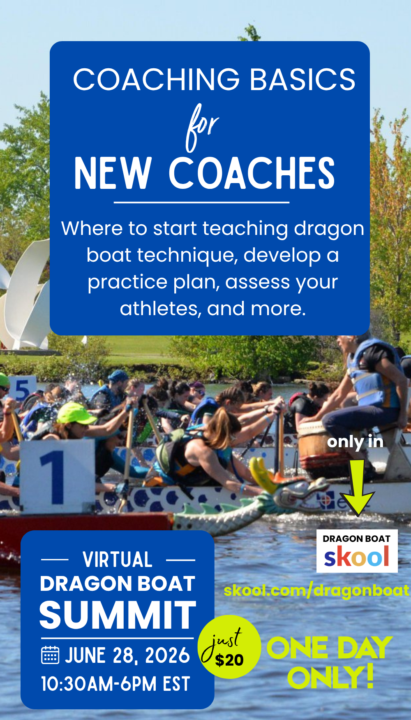
Got Your Summit Access Pass Yet?
We're feverishly putting the finishing touches on all the sessions and looking forward to having a great day with everyone! How to get your pass: Click the Classroom tab, and the Summit will be the first "course" you see. Click, pay, access granted! How to attend the summit: Click the Calendar tab, find the session(s) you want to attend, click to open and then follow the prompts to add the session(s) to your own calendar. At the appointed time, either click the session link in your calendar, or come back to this community calendar to join. What if you can't attend a session: Replays will be posted late Sunday or Monday morning in the same summit classroom area. Any other questions? Let us know below!
1 like • Jun 27
I've registered but probably only able to attend the later sessions : coaching in the morning.

Mar 29 •
Belt Pack PFD
Hi All, I saw this posted in Facebook. Thought I'd share it here, it shows PFD belt pack deployment. https://www.facebook.com/share/p/1D3QgzC8HK/ Do you use a belt pack? If so do you use it properly? Have you checked it recently, does it have a working canister? Share your thoughts.
0 likes • May 14
Thanks for sharing that Joann!
Jan 12 •
Homework: Prepping for races at the race site
In the comments below tell us: 1. The steps you'd take to get ready for steering a race. 2. How you'd prepare for a 200 m vs a 2k. #level2
1 like • Mar 18
Prep for steering a race - Review race rules as provided by the race producer. Attend any pre-race meetings online or in person, as scheduled by race officials. Know how boat needs to be loaded and unloaded, directions for heading to the start line from the docks, and returning. Review maps for the body of water where the race will be held, and research direction of race course (if unfamiliar). Monitor weather forecasts for wind direction. If tidal, research tides for that location. On site, ideally the day before, or very early before racing begins, if possible walk the race course with drummer, and possibly coach. Depending on experience level of the drummer, possibly discuss where the finish will be called. Review race grid and note which lanes the crew is assigned. If possible, watch some other races before own crew's race. During morning 'team chat', if not being covered by the coach, inform the whole crew of important race rules and directions from race officials directly relevant to them. 200m race - be prepared to pay attention to own balance and a 'fast start'. Aim to be well lined up because very little time to correct. 2k - carefully review rules with focus on right of way, turn corridor and how the start for each boat will be called. Attend a 2k pre-race meeting if scheduled. Need to know how boats will be directed to line up and intervals between boats starting, and specific race calls. Ensure the full crew is aware and emphasise the need for them to respond quickly to any commands. Ensure drummer knows how they can signal if a boat is close to overtaking. Once course is set up for the 2k, if possible, look at all the turn makers and be clear on those marking the turn corridor. If possible, watch a race or two.
1 like • May 14
@Liisa Reimann Oops - typo. Should have been 'turn markers', (buoys).
1-10 of 19

@lesley-blyth-9987
Founder and coach of WAM Dragon Boat Club.
Active 11d ago
Joined Jan 21, 2026
Powered by