Activity
Mon
Wed
Fri
Sun
Aug
Sep
Oct
Nov
Dec
Jan
Feb
Mar
Apr
May
Jun
Jul
What is this?
Less
More
Owned by Justin
Supporting construction and home service worker by developing the companies they work for. Great Company, Great Talent, Great Results!
Memberships
Learning & Development Hub
35 members • Free
20 contributions to Learning & Development Hub

1 like • Dec '25
That’s a big Monday.

Dec '25 •
The AI discussions are going to drive me mad!
I'm not sure if anyone else is seeing it, but it feels like I can't read more than 2 sentences on any L&D post/article/blog without someone talking about AI (just like I'm doing now😂). Is it just my algorithm, or is this everywhere, like it seems? I just want to read about a good training analysis or a new teaching method. I don't need to hear about how AI creates cool infographics... Rant complete.
1 like • Dec '25
AI can break down good training analysis and teaching methods for ya 🤣🤣. But yeah it’s the future… I guess
1 like • Dec '25
@Billy Daniel it’s not a straight LMS in the sense it’s only for training. It’s really like a host for all company info. From pre-boarding to off boarding. It does host training and is largely training, but is also a place to for general documentation that may need to be referenced by the whole company.
1 like • Dec '25
That’s a good way of looking at it. But does have some good features such as testing, course completions, assigning by role or location, completion dates. It is a pretty cool system. Really good for SMB
Nov '25 •
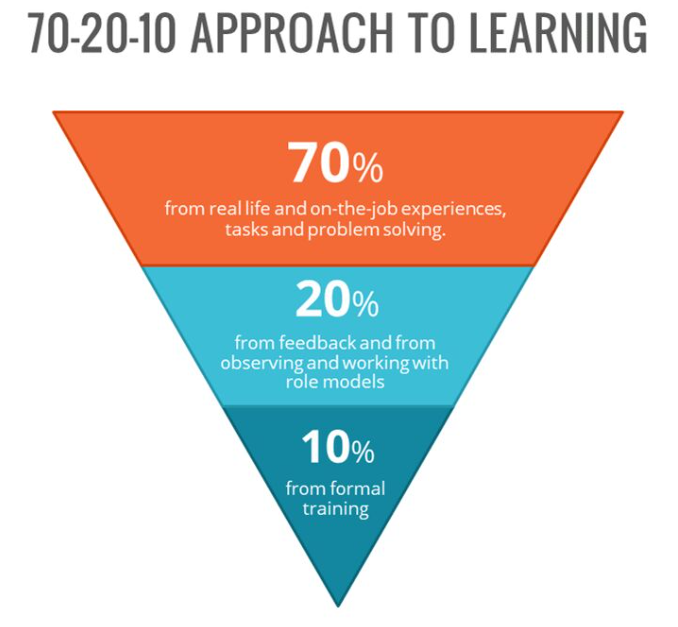
70-20-10 Approach
I saw this on another platform and thought I would share here too. At first glance, it looks like it put's L&D at the lowest priority. However, I think it shows more: 70% of learning is done on-the-job. I really don't think many people would argue this point. This allows people to take experiences and knowledge and directly apply it in real time to their work. 20% of learning is done through mentoring and peer discussions. Again, I think this is valid. A mentor can make the difference between a good employee and an excellent employee. 10% of learning is from formal training. My ego wants this higher, but it's probably accurate. People don't retain 100% of the stuff we teach and if they are sitting in training, they aren't doing their jobs that support the company bottom line. All this is to say that it's the training program that builds the framework for the whole pyramid. Without the formal training program, the mentors have no direction and the OJT can easily devolve into bad habits and shortcuts. That's why L&D matters. It's not just the content in the classroom, but the whole picture of learning at an organization!
2 likes • Nov '25
I agree with you that formal training is foundational and provides the guards rails of learning. From past experience without a clear set frame of framework you get wildly inconsistent results. I really don’t know that companies truly understand how to leverage instructional designers as data analysis in deciphering. I also don’t agree with mentoring and peer discussion being only 20%. I would wait that scale heavier because I believe it’s more foundational than the actual learning of skill. Mentoring and peer discussion encompasses more than just the how to, it addresses the culture in the thought process of the company as a whole.
Nov '25 •
Preferred Breakfast
Taking a break from the usual L&D stuff, what is your go-to "most important meal of the day"?
Poll
3 members have voted
2 likes • Nov '25
@Billy Daniel 🤣🤣 Being raised in the south my favorite is biscuits and gravy, but my body just can’t support that any more. 🤣
1-10 of 20
@justin-daniel-4977
Blue collar worker on a mission to help companies develop cultures that support employee buy-in while maintaining sustainability and growth.
Active 50d ago
Joined Sep 12, 2025
ISFJ
Maryville Tennessee