Activity
Mon
Wed
Fri
Sun
Jun
Jul
Aug
Sep
Oct
Nov
Dec
Jan
Feb
Mar
Apr
What is this?
Less
More
Memberships
AI SEO Mastery with Caleb Ulku
3.3k members • $27/m
AI SEO | Rank & Rent Lead Gen
1.8k members • Free
Solomon Select
565 members • $297/month
AI Ranking
505 members • $27/month
AI Money Lab
71.5k members • Free
UpHex Ads Lab
725 members • Free
Tonvaro - Client Acquisition
229 members • $9/month
Local Sites Pro
664 members • Free
Freedom Forge Pro
240 members • $99/month
3 contributions to AI SEO Operators

1 like • 18d
Nice Poll ... curious to see what people are trying out there, because I've heard a few things. Reddit commenting Press Releases Making sure your reviews are diversified outside of GBP reviews like on Yelp, Trust Pilot, BBB etc. Web 2.0's pointing back to your site Parasite pages with listicles Listicle style pages on your own website(heard Google updated the algo for that already though)

Mar 23 •
AI Changed My Life And Made Me A Better SEO 💥
I used to be an in-house SEO manager working with a well-resourced media team, a real budget, and serious effort going into content. It sucked because none of it was compounding. The portfolio was losing traffic despite everything we threw at it. New pages flatlined. Updates had no impact. And I couldn't figure out why. I was too buried in execution to think. Keyword research, content briefs, technical fixes, my job was feeding the machine. Every day. But then I started giving the repetitive stuff to AI. Not all at once. Just the pieces where it could speed things up. Within a few months I'd automated most of the repetitive work on my plate. I finally had space to actually think. I dove deep into the data. Ran analyses I'd never had time for. That's when I found it, something fundamental we'd been getting wrong. Our content was great. Our site architecture was broken. Everything we published was landing on a flawed foundation. I put together a theory and tested it on one of our smaller sites. Within two weeks, we saw significant ranking improvements on the tested money pages. We thought it was a fluke. We tested on three more sites. Same thing. Two weeks in, pages that got the treatment shot up. Pages that didn't stayed flat. It was real. We rolled it out to the entire portfolio. A few weeks later, we started seeing traffic and rankings shooting up. All because AI took the repetitive execution off my plate and gave me back the one thing that actually matters, time to think. We grew organic traffic from 160k to 1.7 million on one site. The peak hit after I'd already left. The system I built was still compounding on its own. It's been declining since. The system works, but only if someone's running it.
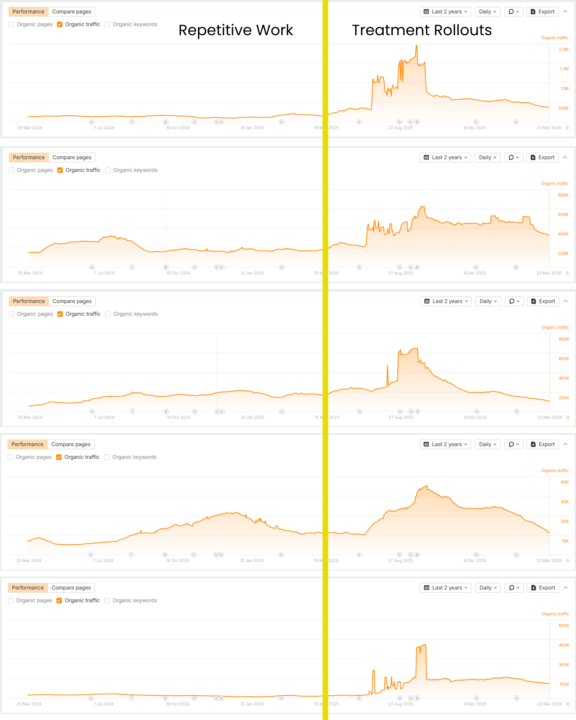
1 like • Mar 23
I'm curious as to what changes were made? I'm currently an SEO account manager and want to do rank and rent/pay per lead on the side. But I feel like without a GBP, I wouldn't have a dog in the fight because ranking just the site organically doesn't seem to cut it anymore and it's all about ranking the GBP due to the change in landscape Google has done with ads and Ai Overview. I have some client sites I manage where they have solid rankings organically and for their GBP but still not getting a good amount of leads.
Dec '25 •
The Best URL Structure: Thematic Grouping
URL structure quietly determines whether your entire website succeeds or fails. Short, clean URL structures only matter because they influence crawl depth, internal linking, and how authority flows through your site. Hub pages always outrank their child pages because hubs sit closer to the homepage, get crawled more often, and accumulate far more internal links and backlinks. A page becomes a hub not because of its URL, but because the architecture, internal links, and backlinks all signal its importance. Clusters, silos, hubs + spokes, and entity attribute pairs are all similar concepts: grouping related pages under a single authoritative topic hub. Top-level hub pages must target broad, high-value keywords because every child page exists to reinforce the hub. Child pages only rank well when they live inside a strong topical cluster built around a powerful hub page. Top-level URLs rank better because they sit higher in the hierarchy and get discovered and recrawled more frequently. Hub pages attract dramatically more internal links and backlinks than any individual child page, amplifying their ranking power. Broad hub pages always rank for hundreds or thousands of keywords, while child pages can only rank for narrow intent queries. You must build both a broad hub page and many attribute-level child pages to maximize keyword coverage and dominate a full topic. Planning site architecture from the start guarantees the strongest results because you can build clean clusters without messy redirects. Changing URL structures on existing sites requires 301s and updating internal links, which introduces risk but can dramatically improve rankings when executed correctly. Structural URL layouts organize content by type, but they waste top-level pages that could be used for powerful ranking hubs. Structural hubs like “/tools” or “/generators” cannot rank for broad queries because search intent favors thematic, comparison, or solution-focused pages. If a top-level structural page cannot rank, every child page under it becomes weaker because the parent passes no authority downstream.
1 like • Dec '25
This is interesting... I mainly deal with local and have always done Services in the menu and under that have all their services and with the homepage linking to those services and from each service page linking out to each service area. Then Service Areas in the menu and list their service areas, then from each service area page linking that to each service. In your example wouldn't you have to essentially create the service for each city/location which seems like a lot more pages and seems like it would waste a lot of crawl budget on Google's end.
1-3 of 3

@john-r-1797
IT guy turned into a Digital Marketer to now Day Trading as well !
Online now
Joined Oct 31, 2025
Powered by