Activity
Mon
Wed
Fri
Sun
Apr
May
Jun
Jul
Aug
Sep
Oct
Nov
Dec
Jan
Feb
Mar
What is this?
Less
More
Memberships
The Watch Manual
16 members • Free
4 contributions to The Watch Manual

1d •
🚩 When Cartier Isn’t (Truly) Cartier: The "Must de" Paradox
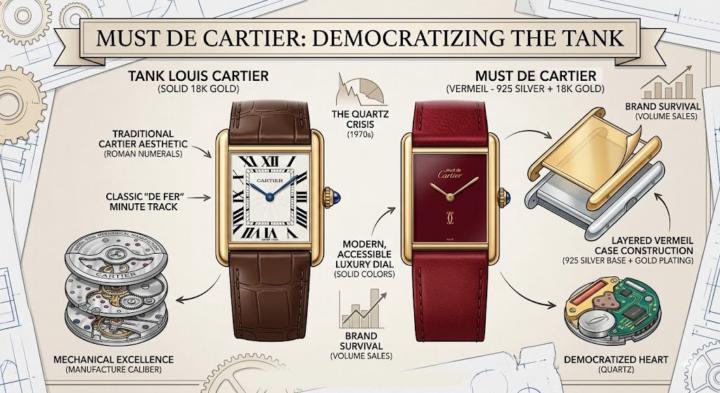
In the 1970s, the watchmaking world was on fire. The "Quartz Crisis" wasn’t just killing small Swiss manufacturers; it was bringing the giants of Place Vendôme to their knees. Cartier’s response to this commercial apocalypse was a maneuver we now study in marketing textbooks as a masterclass in survival—but for the purists of the time (and the old horologists of today), smelled like borderline heresy: the Must de Cartier line. 1. The Origin: "Le Must" The name wasn't an accident. "Le Must de Cartier" essentially meant "the things one must have." The goal was clear: to democratize luxury. Until that point, Cartier was "The Jeweler of Kings and the King of Jewelers." With the "Must" line, Cartier had to become the jeweler of the New Bourgeoisie. 2. The Vermeil Heresy (Gold "Halfway") The first major technical shock was the material. A true Cartier Tank was, by definition, 18k solid gold or platinum. The Must de Tank, however, introduced Vermeil. - What is Vermeil? A sterling silver (.925) base coated with a layer of 18k gold (at least 20 microns thick). - The Technical Flaw: As charming as it is, Vermeil is prone to oxidation and wear. Seeing a "Cartier" turn black or lose its gilding on the edges was unthinkable for High Jewelry pre-1977. And even today it is a ho-hum, if you ask me. 3. The Heart of the Machine: Quartz Enters the Temple If the metal was a compromise, the movement was the true revolution (or betrayal, depending on your perspective). While the Tank Louis Cartier housed ultra-thin manufacture calibers (or Piaget/JLC-derived ones), the Must line embraced Quartz. While mechanical versions did exist (often using ETA 2512 calibers), the bulk of production was driven by integrated circuits. Cartier stopped selling "mechanical excellence" and started selling "pure accessible design." 4. Aesthetic Distinction: The Dial as a Canvas To distinguish the Must from the "Royal" models, Cartier got bold with dials. This gave birth to the iconic burgundy, sapphire blue, and black lacquer versions, devoid of the classic Roman numerals and the chemin de fer (railway track) minute track. They were beautiful and modern, but they lacked the architectural rigor that made the original Tank immortal. And frankly, looked fashion-y, not elegant.

1 like • 1d
No "Must" here, and don't care to ever have one... appreciate the history lesson though...
4d •
The Sleeping Giant: Is the Gruen Revival Finally Happening? 🏛️⌚
James Bond wore a Gruen before he ever wore a Rolex. The legendary Curvex redefined 1930s design. So why do we find this brand today in American department stores for $50? The answer lies with MZ Berger (MZB). The Fact: MZB is a New York powerhouse that has "guarded" iconic brands like Gruen, Elgin, and Waltham since the 1970s. While they saved these names from vanishing, they also locked them into a mass-market business model (cheap quartz movements and high volume). Why it matters now? In 2026, the market is tired of the same old designs. A Gruen revival is in the air: collectors are demanding the return of mechanical curved movements and Art Deco aesthetics. Gruen is officially one of the most coveted "Sleeping Giants" for investment funds today. Is the brand "saved" or "held prisoner"? Comment below 👇: Would you buy a modern Gruen if it returned to the High Horology segment? And if you'd love to read about this in more detail, subscribe to the Premium version of The Watch Manual here on skool!

1 like • 4d
Wouldn't buy it; I'm not a rectangular watch fan. Nor quartz...
9d •
Welcome to the Stone Age 💎
We’ve officially moved past the "Steel Sports" fever of big, bulky braceletted hulks. As we navigate the Selective Normalization of the 2026 market, the focus has shifted from what the watch is made of to how it makes you feel. The explosion of pietre dure (hard stones) isn't just a fashion statement—it’s a rebellion against the digital and the mass-produced. 1. Uniqueness is the New Rarity: The "Organic One-of-One" In the early 2020s, "rarity" was often artificial—limited editions and controlled supply. In 2026, rarity is inherent. - Nature’s Fingerprint: When you choose a Malachite, Lapis Lazuli, or Tiger’s Eye dial, you are purchasing a geological event that took millions of years to form. - The "Soul" Factor: Because no two stone veins are identical, your watch is a "One-of-One" by default. This satisfies the modern collector’s hunger for authenticity—an organic "soul" that a perfectly uniform, machine-painted dial simply cannot replicate. 2. Technical Mastery: The Art of the "Impossible Slice" This is where the Technical Literacy of our community comes into play. A stone dial isn't just a piece of rock; it’s a feat of micro-engineering. - The Fragility Barrier: Artisans must slice these stones down to a staggering 0.2mm to 0.4mm. To put that in perspective, that is roughly the thickness of four sheets of paper. - The Yield Rate: At this thickness, the stone becomes incredibly brittle. One microscopic vibration during the cutting or polishing phase, and the dial shatters. - Human vs. Machine: While AI can optimize the cutting path, the final hand-polishing requires a "felt" touch to bring out the luster without causing a fracture. This is the "analog" prestige we talk about in 2026—celebrating skills that can't be coded. 3. Quiet Luxury & The 2026 Palette The visual language of horology has matured. We are seeing a move toward Quiet Luxury, where the value is evident to the owner but doesn't "scream" at the observer. - Petrol & Teal: These aren't just colors; they are the 2026 vibe. The deep, iridescent greens of Malachite and the celestial blues of Lapis perfectly embody this year’s dominant palette. - The 37mm Sweet Spot: These precious materials thrive in the 36mm–38mm range. By reducing the case size, the dial becomes a concentrated "jewel" on the wrist, fitting perfectly with the trend toward more refined, human proportions.

1 like • 9d
Do not own any "natural" dials at this time, but would not hesitate to acquire one or more if the "right one(s)" came along...
13d •
AI and Watches: A Minefield (and no Offense to Myself!) 🕰️⚠️
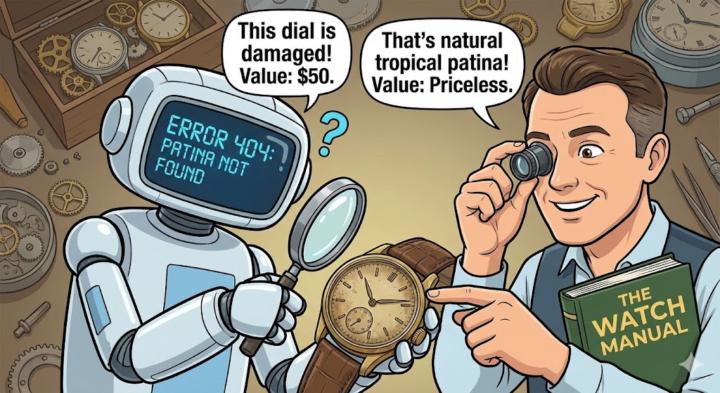
What follows is an AI answer: but I was intrigued to know what an AI would be telling about its inherent fallacies while evaluating vintage watches. And I have to add, apart from the quirky logical conundrum of an AI asserting it is inexact, the answer is worth a read and a thought. ____________________________ While AI is great at many things, in the vintage watch world, it can lead you completely astray. In a 2026 market that has finally normalized and rewards the "Thinking Collector", technical literacy remains your only true compass. Here is why you still can’t trust an algorithm when it comes to watches: - The "Franken-Watch" Trap: An AI might recognize an original logo, but it lacks the expertise to tell if a crown is period-correct or if a dial is a later replacement that kills the watch's value. - Patina vs. Damage: Most algorithms read a "Tropical" dial as a simple color defect. They can't distinguish between high-value natural aging and moisture damage that has compromised the movement. - Outdated Valuations: AI often pulls from obsolete data. It ignores that in 2026, secondary market prices have stabilized, rewarding technical rarity over speculative hype. - The Soul of the Mechanics: Recognizing the correct finish on a vintage caliber requires a sensitivity that goes beyond a database scan. It’s a matter of horological culture, not bits and bytes. - In our digital world, true prestige in the watch market remains "analog". It’s about your ability to analyze a piece with a loupe in hand. Don’t let a chatbot make your next big investment decision for you. Let’s talk: 💬 Would you ever trust an AI to authenticate a high-stakes vintage piece, or do you still believe a human expert is non-negotiable? Share your thoughts in the comments!
1 like • 12d
Would never trust AI to authenticate any watch...
1-4 of 4
Active 1d ago
Joined Feb 18, 2026
Green Bay, WI