
Write something

2d •
🚩 When Cartier Isn’t (Truly) Cartier: The "Must de" Paradox
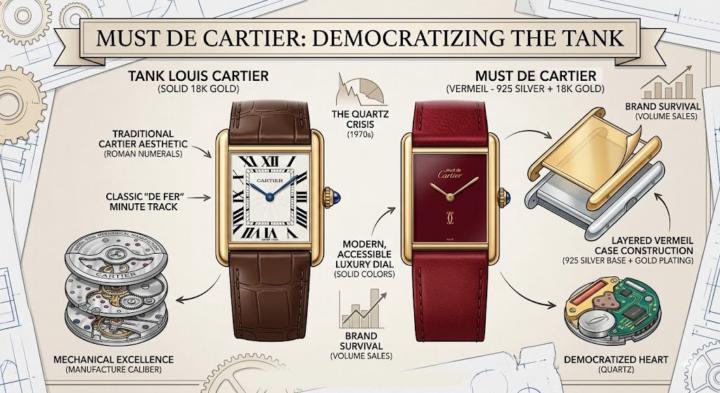
In the 1970s, the watchmaking world was on fire. The "Quartz Crisis" wasn’t just killing small Swiss manufacturers; it was bringing the giants of Place Vendôme to their knees. Cartier’s response to this commercial apocalypse was a maneuver we now study in marketing textbooks as a masterclass in survival—but for the purists of the time (and the old horologists of today), smelled like borderline heresy: the Must de Cartier line. 1. The Origin: "Le Must" The name wasn't an accident. "Le Must de Cartier" essentially meant "the things one must have." The goal was clear: to democratize luxury. Until that point, Cartier was "The Jeweler of Kings and the King of Jewelers." With the "Must" line, Cartier had to become the jeweler of the New Bourgeoisie. 2. The Vermeil Heresy (Gold "Halfway") The first major technical shock was the material. A true Cartier Tank was, by definition, 18k solid gold or platinum. The Must de Tank, however, introduced Vermeil. - What is Vermeil? A sterling silver (.925) base coated with a layer of 18k gold (at least 20 microns thick). - The Technical Flaw: As charming as it is, Vermeil is prone to oxidation and wear. Seeing a "Cartier" turn black or lose its gilding on the edges was unthinkable for High Jewelry pre-1977. And even today it is a ho-hum, if you ask me. 3. The Heart of the Machine: Quartz Enters the Temple If the metal was a compromise, the movement was the true revolution (or betrayal, depending on your perspective). While the Tank Louis Cartier housed ultra-thin manufacture calibers (or Piaget/JLC-derived ones), the Must line embraced Quartz. While mechanical versions did exist (often using ETA 2512 calibers), the bulk of production was driven by integrated circuits. Cartier stopped selling "mechanical excellence" and started selling "pure accessible design." 4. Aesthetic Distinction: The Dial as a Canvas To distinguish the Must from the "Royal" models, Cartier got bold with dials. This gave birth to the iconic burgundy, sapphire blue, and black lacquer versions, devoid of the classic Roman numerals and the chemin de fer (railway track) minute track. They were beautiful and modern, but they lacked the architectural rigor that made the original Tank immortal. And frankly, looked fashion-y, not elegant.
3d •
🛑 Stop the confusion: The 2026 “Horology Filter”
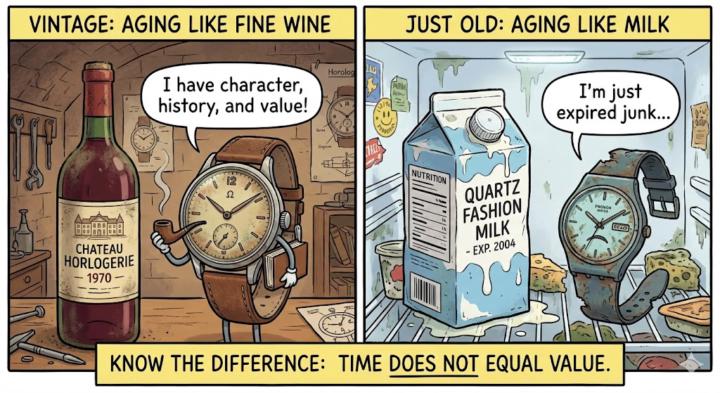
To skim through posts and clean up your feed (or collection) from clutter, you need to stop using the date of birth as the only criterion. In watchmaking, time is necessary, but not sufficient. Here is the ultimate “filter” to distinguish a Vintage piece from a simple Old object. If you want to get serious, you have to learn to say no. A watch from twenty years ago is not automatically vintage; sometimes it's just technological waste that has been sitting in a drawer for too long. 1. The Rule of Uselessness (Fashion Watches) A Calvin Klein, Armani, or Guess quartz watch from the late 1990s is not vintage. It is a “fashion accessory that has survived.” - Why: There is no innovation, no caliber, no repairability. It is an aesthetic shell built around a standard movement worth a few dollars. In watchmaking, if there is no technical substance or iconic design that has influenced the industry, time does not add value, it only adds dust and leaked battery acid. 2. The “Swatch Case”: Icon or Plastic? A Swatch from the 1980s may be a collector's item (if we are talking about Kiki Picasso or special series), but in 99% of cases it is not vintage horology. - The reason: Swatch was created to be “consumable.” It is not designed to last, it cannot be serviced (it is sealed), and it does not represent the art of traditional watchmaking. It is cultural memorabilia, not a piece of mechanical watchmaking history. 3. The Three Pillars of True Vintage To pass the selection, a watch must have at least two of these three requirements: 1. Mechanical Dignity: A caliber (even quartz, if historic like the early Seiko 7A28 or Beta 21) that is an expression of engineering, not economies of scale. 2. Repairability: A vintage piece must be able to be disassembled, lubricated, and brought back to life (yes, quartz CAN be serviced). If it is “disposable,” it is not vintage. 3. Historical Relevance: It must have marked an era. A Hamilton Pan-Am, a Universal Genève Polerouter, or a Seiko Pogue are vintage because they tell the story of who we were. A watch branded by a perfume brand only tells us what was fashionable in the 2004 sales.
1
0
4d •
The Sleeping Giant: Is the Gruen Revival Finally Happening? 🏛️⌚
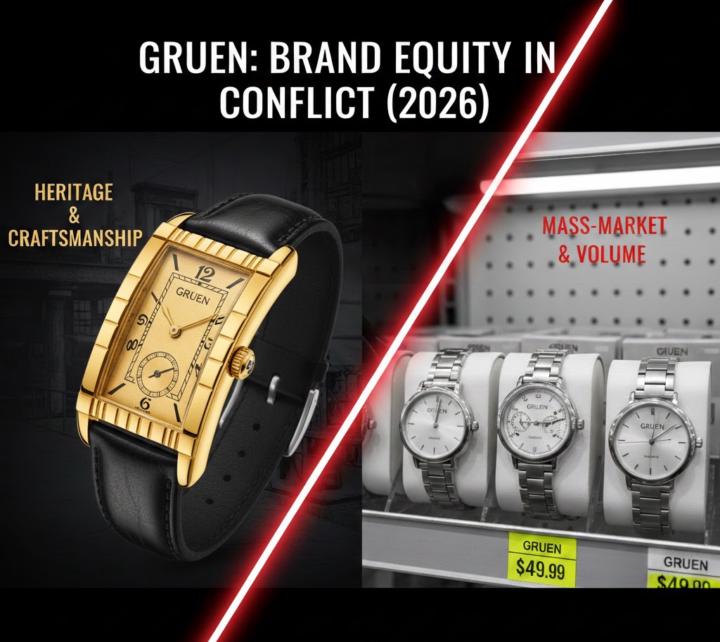
James Bond wore a Gruen before he ever wore a Rolex. The legendary Curvex redefined 1930s design. So why do we find this brand today in American department stores for $50? The answer lies with MZ Berger (MZB). The Fact: MZB is a New York powerhouse that has "guarded" iconic brands like Gruen, Elgin, and Waltham since the 1970s. While they saved these names from vanishing, they also locked them into a mass-market business model (cheap quartz movements and high volume). Why it matters now? In 2026, the market is tired of the same old designs. A Gruen revival is in the air: collectors are demanding the return of mechanical curved movements and Art Deco aesthetics. Gruen is officially one of the most coveted "Sleeping Giants" for investment funds today. Is the brand "saved" or "held prisoner"? Comment below 👇: Would you buy a modern Gruen if it returned to the High Horology segment? And if you'd love to read about this in more detail, subscribe to the Premium version of The Watch Manual here on skool!
6d •
From the Skies to the Wrist: The Aviator Who owned the First Wristwatch 🕰️✈️
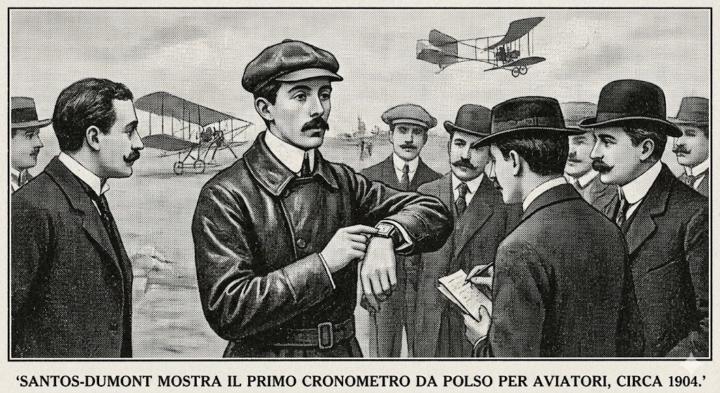
A fascinating debate in the watch world is not just who made the first wristwatch, but how it was made. Many believe the first wristwatch was created for an aviator. While historically inaccurate—the very first designs were bespoke pieces for women, like the one Patek Philippe created for a Hungarian countess in 1868—the connection to aviation is where the "commercial" wristwatch’s identity truly began. Born out of Need: The Alberto Santos-Dumont Story The modern Paris, la "Ville Lumière" (the city of lights) was the center of the world. And Alberto Santos-Dumont, a pioneer of aviation, bespoke logic was no longer sustainable. He was idle and need substance, not hype. His problem: Pulling out a hand pocket watch to read the time while flying was impractical and unreliable, a concept that feels radical today. He needed clarity of purpose and a tool which was handy. The solution: His friend, Louis Cartier, codified a tool: the very first designed wristwatch, the Cartier Santos, and finally gave it to his friend and customer in 1904. The Codified Visual Identity: Why does the Santos matter today Louis Cartier didn't just redesign a watch; he codified a new dress vocabulary. Just as Breguet one hundred years before him created a visual identity with distinct numerals, flame-blued hands, and a secret signature pantograph etching, Cartier codified a recognizable design language that remains foundational for luxury brand identity today - as the Santos is still in great shape, built some 120 years after its first edition. The Santos was a statement that great watchmaking means honesty of execution and the courage to do something new and better, with a style that stays relevant even today. Community Discussion Point: 💬 The Santos is a great example of the foundational value of vintage watches. Which direction do you find more compelling? Do you think this is the way to go in the late 2020s? Post your thoughts below! 👇
1
0
7d •
The Watch That Invented Modern Watchmaking — And Modern Business
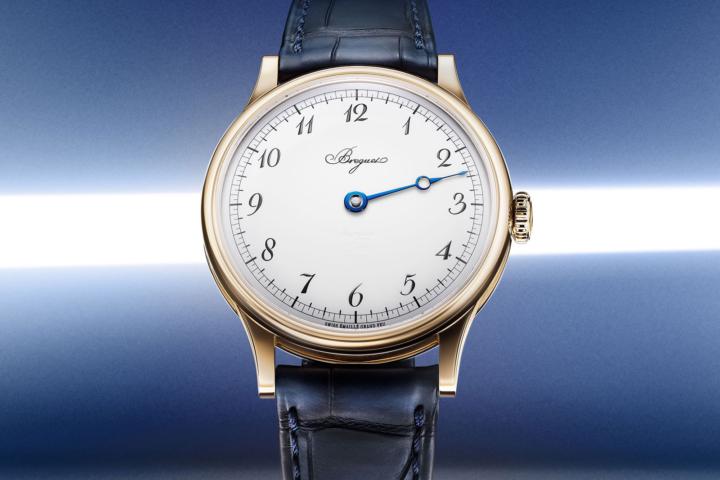
In 1795, the greatest watchmaker in the world had a problem. Abraham-Louis Breguet had just returned to Paris after two years hiding in Switzerland, waiting for the French Revolution to calm down. His workshop was idle. His wealthy clientele — aristocrats, royals, the King's court — had either fled, lost their fortunes, or lost their heads. He needed to rebuild his business from scratch, in a city still recovering from decades of upheaval. What he came up with changed watchmaking forever. And not just in the way you'd expect. The Genius of Simplicity Breguet's solution was a watch unlike anything he had made before. Instead of the extraordinarily complex, bespoke timepieces he was famous for, he designed something deliberately simple: a large, reliable pocket watch with a clean enamel dial, a single hand, and a movement stripped of every unnecessary complication. The single hand wasn't a limitation — it was a design decision. The dial was divided into five-minute increments, allowing the wearer to read the time to within a minute or two without the need for a minute hand. Less friction, fewer moving parts, greater long-term reliability. Any competent watchmaker could service it. For a post-revolutionary France still finding its footing, this was exactly what the market needed. He called it the Souscription. The Business Model That Changed an Industry Here's where it gets genuinely fascinating. Breguet didn't just redesign the watch — he reinvented how watches were sold. Rather than waiting for wealthy patrons to commission pieces, he advertised through a printed pamphlet — a novel form of marketing in the watchmaking world — and asked customers to place an order with a 25% deposit upfront. The balance would be paid on delivery, in the order the orders were received. Sound familiar? It's essentially 18th-century crowdfunding. Breguet used his customers' deposits to finance production, buy materials, and run his workshop — without depending on credit or the whims of aristocratic patronage. The arrangement gave buyers certainty (their place in the queue was guaranteed) and gave Breguet the cash flow to operate at scale.
0
0
1-21 of 21
powered by
skool.com/the-watch-manual-5755
"The Watch Manual" is designed to explain to beginners and enthusiasts the technical, historical, and commercial aspects of watches and watchmaking.
Suggested communities
Powered by