Activity
Mon
Wed
Fri
Sun
Oct
Nov
Dec
Jan
Feb
Mar
Apr
May
Jun
Jul
Aug
Sep
What is this?
Less
More
businessXP
423 members • Free
8 contributions to businessXP

Jan 22 •
Business is easy to understand — but hard to do well.
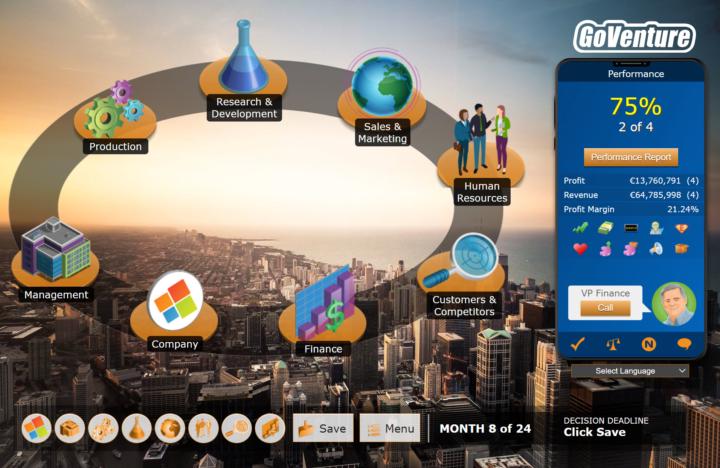
This may be one reason why so many people invest time and money to prepare to start a business, yet never actually launch one. They lack the confidence to move forward. Because when they stop learning and start doing, they run head-first into uncertainty about what to do next. One uncertainty after another becomes overwhelming. Analysis paralysis. Or the opposite — they move forward aggressively and break things along the way. Why does this happen? Because they lack business experience. But gaining this experience first in the real world requires significant time and money. The solution: play a realistic business simulation. Stop watching. Start practicing. Practice builds confidence. Confidence builds skills. Skills move you forward. PS: As a member of our businessXP community, you can click the CLASSROOM tab to access a wealth of free resources to get you started.

1 like • Jan 22
Absolutely correct, Maria Montessori once said "What the hand does, the mind remembers." Which means when you manipulate something such as assets, liabilities etc. through business game simulations, your brain treats it as a real experience. I think there's also a study where playing simulations is significantly better than theories or reading since there's no better teacher than experience itself, you can fail as many as you want and learn so many valuable things with low risk.
Jan 18 •
Another Insight That I Learned in GoVenture Kiosk Business Simulation
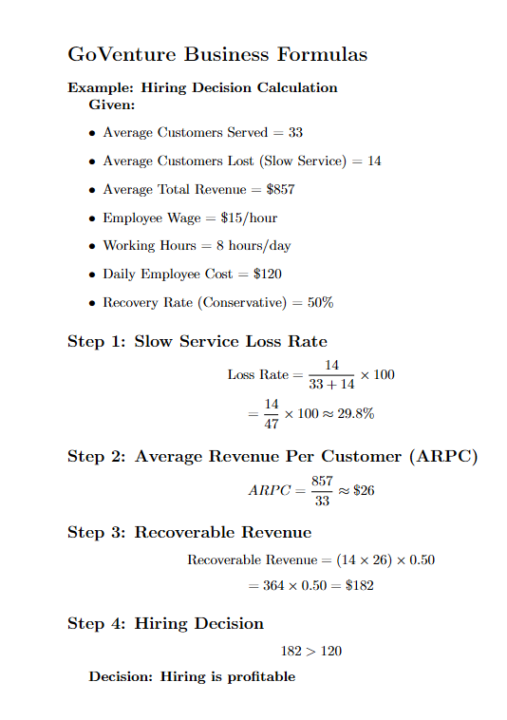
Hello everyone! I learned another valuable concept while playing the GoVenture Kiosk Business Simulation. From Slow Service Loss Rate -> Hiring Decision While going through the “1-Hour Entrepreneur Video Training” here in Skool, I remembered Sir Mathew demonstrating a situation where his kiosk business lost many customers due to slow service after marketing. He said something about considering how will we entrepreneurs know when to decide hiring an employee, so a question came up to my mind: "Does the extra revenue I gain from hiring someone exceeds the cost of paying them?" So, with the help of AI and what I’ve been learning in the simulation, I put together a simple, step-by-step way to think about this. 1. Slow Service Loss Rate First, we determine how many customers are leaving specifically because of slow service. Formula: Slow Service Loss Rate (%)= (Avg. Customers Lost due to Slow Service / (Customers Served + Customers Lost due to Slow Service)) × 100 For myself, I set a 10% threshold: - Below 10% -> normal loss, no immediate action needed - Above 10% -> investigate and consider intervention I think customer loss is unavoidable in business, but the key is knowing at what point it becomes a real problem. 2. Average Revenue Per Customer (ARPC) If the loss rate is above the threshold, the next step is to understand how much each customer is worth Formula: ARPC= Average Total Revenue / Average Customers Served This tells me how much revenue I earn per customer on average. 3. Recovery Rate This represents the percentage of lost customers I can realistically recover after hiring since not every lost customer will come back even if services improves. I decided to focus on two methods only: Method 1: Simulation-Based Recovery (After Hiring) Used after hiring, based on actual results. Formula: Recovery Rate= (New Customers Served − Old Customers Served) / Customers Lost This is the most accurate because it uses real outcomes. It answers:
1 like • Jan 19
@Mathew Georghiou Oh yes, I just realized that I don’t actually need to make my employees work every day. But in my current situation, this is my first time hiring an employee, so I reviewed the customer served and customer lost reports from the previous days up to the present. I noticed that a large portion of the customers lost were actually leaving due to slow service. You mentioned training employees, but I’m a bit confused about how to do that in the Kiosk Business. I don’t see an option to train them, so I’m not sure what actions I should be taking there. That said, it made me realize something interesting, investing in employee training to improve productivity seems smarter in some cases than immediately hiring another employee who demands a higher salary. But that also raises another question for me. How do we know when training an existing employee is more worth it than hiring a more skilled one? I assume training pays off more in the long run, but then there’s also the idea that once employees become more skilled, they might demand higher pay, and in real life there’s also the risk of resignation (though I think the simulation doesn’t model that, which is actually helpful). Ahh there are many things to think about, so I might be overthinking it a bit 😅 but I find it really interesting. I also wondered if this kind of mechanic could be expanded in the Full Business simulation. For example, having different types of employees, not just ones who serve customers, but perhaps advisory roles that help identify issues like losing more than 10% of customers due to service or capacity. But I’m not sure how that would affect gameplay, it might reduce the management skills the player is meant to develop. Or maybe something like that would fit better as part of the reporting system instead.
1 like • Jan 19
@Mathew Georghiou I see, I'm definitely looking forward to play the full business sim. in the future after I'm finished with the kiosk business 🙂
Jan 18 •
Kiosk Business Simulation - Key Insight I Learned
Hello everyone, I just want to share my insight that I just learned when I was playing GoVenture Kiosk Business Simulation. As I continue playing the GoVenture Business Simulation, one of the most valuable concept I’ve learned is Customer Loss Rate. A question I kept asking myself was: At what point should I actually intervene when I start losing customers? In any real business, some customer loss is normal and unavoidable. But the real challenge isn’t eliminating loss completely, it’s knowing when the loss becomes a problem worth acting on. Now this is easy to overlook when your business is small and serving only a few customers. But once you’re serving hundreds or even thousands, percentages matter far more than raw numbers. About my Intervention Threshold For my own decision-making, I set a rule: - Below 10% customer loss -> normal operational friction - 10% or higher -> intervention required Why 10% as my intervention threshold? Losing 10% of potential customers also means losing roughly 10% of possible profit, which becomes significant at big businesses with big numbers. Below that threshold, I feel like intervening too often can lead to over-optimization and unnecessary changes. So once customer loss exceeds 10%, that’s when I investigate the cause: - Is it slow service? - Pricing? - Product quality? - Capacity limitations? How I Calculate Customer Loss Rate With the help of AI, I found a simple and clear formula: Customer Loss Rate (%) =(Customer Lost ÷ (Customer Served + Customer Lost)) × 100 This shows the percentage of total demand that went unmet. For example: Let’s say in one day of operating the kiosk: - Customers Served: 29 - Customers Lost: 13 Total customer demand =29 (served) + 13 (lost) = 42 Now apply the formula: Customer Loss Rate (%) =(Customer Lost ÷ (Customer Served + Customer Lost)) × 100 = (13 ÷ 42) × 100= 30.95% So about nearly 1 out of every 3 potential customers walked away. Why I feel like this formula matters to me
1 like • Jan 19
@Mathew Georghiou I see, you're right sir Mathew, if the cause of losing customers is due to the lack of inventory, it makes sense to immediately intervene by buying more inventory the next day because it can be fixed easily without a lot of risk, and yes by being careful on not buying too much inventory. About losing customers due to slow service, that's exactly why i've come up with steps to predict if the extra revenue I gained from hiring an employee exceeds the cost of paying them. And by determining how many customers are leaving due to sow service, that's when I can consider if hiring could be worth it.
1 like • Jan 15
Thank you for this. It really made me facepalm when I realized why so many people say “business is a gamble” even though they’ve never actually experienced running one. The more financially literate you become, the more you start to understand the true nature of business, how it’s less about luck and more about learning, planning, and making informed decisions.
Jan '24 •
Comments | 1-Hour Entrepreneur Video Training
Add your comments to this post if you tried this classroom resource.
1 like • Nov '25
Wow, I learned so much from just this 1-hour entrepreneur video training! 👏👏I’m starting to see what really goes on inside a business, everything from marketing and accounting to hiring and managing people. I also realized that if you run a physical business, you have to pay attention to inventory spoilage, which I never thought about before and it makes sense. One of the most useful things was learning about psychographics, I didn’t even know this existed. But the biggest realization for me is how average people view business as “risky.” I now understand that risk really just means “unknown.” If you fail, it’s not because you’re bad at business, it’s because you didn’t know something (like wondering why you don't customers often). And that’s actually a good thing, because failure is the best teacher. (You now understand about sales and marketing) To most people, business might look like a gamble on the surface, but the more financially literate you are, the more you see it as a game. And why a game? Because to win, you need a plan, a strategy, and a clear understanding of how things work. This video taught me exactly that. How to plan strategically, scale a business, hire the right people, and so much more. And if the business fails along the way, that’s still a win, because you’ve learned something valuable and the more failure you have, the higher you can climb towards success.
1-8 of 8

@james-raineree-pino-8548
College student, aspiring to be a successful businessman one day.
Active 207d ago
Joined Jun 7, 2025
Powered by