Activity
Mon
Wed
Fri
Sun
Aug
Sep
Oct
Nov
Dec
Jan
Feb
Mar
Apr
May
Jun
Jul
What is this?
Less
More
Memberships
Freeschooling ecosystem
394 members • Free
SYNARCHY
135 members • Free
Syntropic Sunlands w/ Milan
181 members • Free
🌳 My Tree Legacy 🌳
14 members • Free
Aspen Movement Coaching
142 members • Free
2 contributions to Syntropic Sunlands w/ Milan

Feb 2 •
We're in for one of the wettest winters - What do we do about it ?
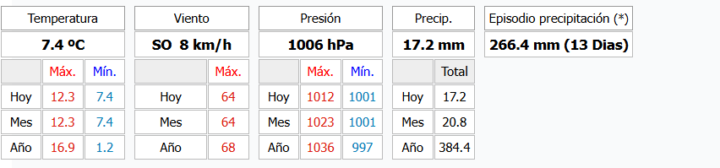
I’ve never seen such a wet January — it’s often the driest winter month here in Andalucía. Here’s a screenshot of the meteorological records for my area for January alone — nearly 400 mm! That’s almost what we usually get in a whole year, since the annual average is around 450–500 mm. If we add the rainfall since Autumn 2025, we’re probably already over 600 mm. It looks like we’re in the middle of a La Niña influence. I’m no meteorologist, but here’s what my gut tells me: - The last two years, aquifers have been able to recharge more than during the previous drought years. - We seem to have perfect conditions for larger-scale plantings, thanks to the rainfall. This is one of the reasons why, after seeing the heavy autumn 2024 rains, and the total rainfall of 2025 we went ahead with a large syntropic planting (~6000 m²). Doing this is especially important when water is limited - mind you, we’re on a hill where wells dry up faster than in the lowlands. So why is this the right time to plant? El Niño and La Niña cycles don’t happen from one year to the next. Each phase usually lasts 2–7 years, because ocean and atmospheric systems take time to shift. This creates clusters of wet or dry years, rather than a perfect alternating pattern. For planting, this is crucial: if we’re at the end of a wet phase, it’s a great opportunity to plant. The soil still has moisture, the aquifers are recharged, and there’s a high chance of more rain during the rest of winter and spring, maybe even into early June if we’re lucky. Let the trees and the soil soak up that rainfall, we'll end up with deeply taprooted trees that will grow more vigorously than in drought years, it's the perfect opportunity - the timing couldn't be better !
1 like • Feb 2
The folk who brought our property in West Aus went from 200ml to over 1000ml this year! We had done alot of earthworks to create larger water catching capacity & redirect the flow in heavy rain events, it still all overflowed. Because of our compact clay soils & granite outcrops, we had built our soils up & the footage they've sent me, they did lose some acacia acuminata & tagastase & even mulberry which were in their third & fourth years. Can only assume it was from the wet feet or maybe poor pruning practices as they were new to food forestry. Really cool to see the overall resiliency of a system in both extremes at that young stage though, out of hundreds of trees they lost only 3 or 4.
Jan 21 •
Powerhouse Plants for the Mediterranean Climate
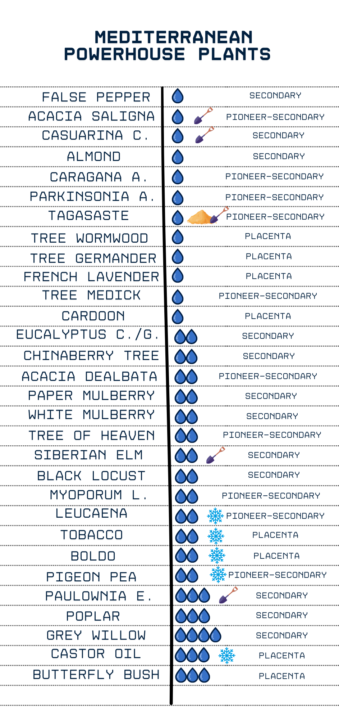
Electing your plant species for your syntropic system is a very difficult process for many. It's this typical overwhelming process where you don't know which plants to choose, that's why I aimed at making it much easier for you; condensing it down to 30 plants that grow very fast. Bear with me, it doesn't include later succession species, but don't worry, it's much more important to elect the right species entering into the secondary phase of a forest rather than thinking too much about which species will come later, as you can plant these later anyway. Most important advice here, don't overthink it, use whatever species grows fastest in your context to establish your system ASAP. I've separated the low water needs plants from the moderate water needs from the high water needs plants - symbolized by the water droplets. To be clear this is about water requirements at establishment, many plants in the moderate water needs will become tough as nails over time but if not watered enough at establishment, they will die. As well, the pile of sand (only tagasaste) symbolizes the need of the plant to be in loose or sandy soil. The shovel means these plants require good decompaction to get a good headstart - meaning breaking down the hardpan in a clay compacted soil - ex: using a subsoiler. Also, the snowflake means that these plants are frost sensitive, typically when temperatures go lower than 2 degrees they can exhibit damage. these plants are truly meant for a mild Mediterranean climate - especially mild winters. Lastly, the successional role of these plants is added at the end : - Placenta : Short-lived - Usually about 5 years maximum within a Mediterranean syntropic system. They can reach maturity within 6 months to a year and provide the fastest growth at establishment of your system. - Pioneer - Secondary : Plants that consolidate the transition from scrubland to forest. They are fast-growing too - but not as much as the placenta plants, usually reaching maturity around year 2 or 3. They create these conditions for the secondary forest to take place by providing high amounts of biomass and shade for the secondary seedlings below.
1 like • Jan 26
Interesting about the tagastase with sandy soils, this was not my experience on our hardpan clay soils in West Aus, they were a very active part of the weedscape as well as a powerhouse in our system alongside acacia saligna & our endemic eucs. Perhaps because they had the support of those other 2 species they thrived?
1 like • Jan 26
@Milan Marquis definitely noticing the precipitation impacting how it grows, we were on 200ml annually back there and now where we have moved to a different climate context I'm struggling to get them to establish in what I considered better soil conditions. Really interesting to observe how these species behave in different Mediterranean contexts.
1-2 of 2