Activity
Mon
Wed
Fri
Sun
Jan
Feb
Mar
Apr
May
Jun
Jul
Aug
Sep
Oct
Nov
Dec
What is this?
Less
More
Memberships
AI Automation Mastery
21.5k members • Free
Marketing and Cupcakes™
230 members • Free
Max Business School™
261.5k members • Free
AI Automation Society
208.5k members • Free
Brendan's AI Community
21.9k members • Free
AI Automation Agency Hub
274.8k members • Free
Upscale (Free)
24.9k members • Free
2 contributions to Brendan's AI Community

Aug 20 •
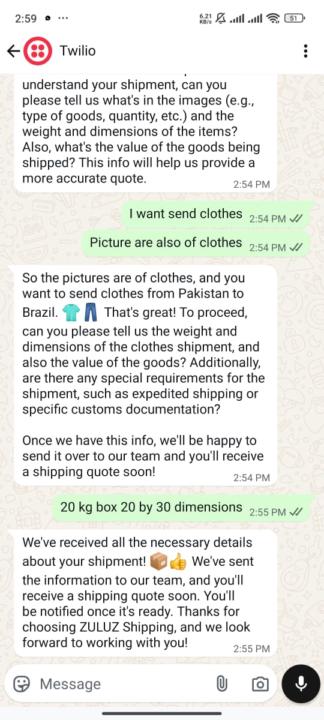
🚀 How I Built an AI Agent with Multi-Channel Input + WhatsApp Integration (and Solved a Real Bottleneck)
Recently, I built an **AI agent** that collects necessary information from users (via **audio, video, or text**) and then **triggers an email to the manager** requesting a quotation. The idea was to streamline client interactions and make the communication seamless. 💬 Client Request: WhatsApp Integration The client wanted the AI agent to also work over **WhatsApp**, so that users could chat directly. I integrated this using **Twilio Webhooks** — incoming WhatsApp messages were routed to the backend, processed, and then the agent responded. ⚡ The Problem During testing, I noticed a major issue: - If a user sent multiple messages quickly (e.g., multiple texts or images), the webhook would forward them individually. - Since my backend was processing messages one at a time (effectively single-threaded per user), **any new messages arriving while processing was still happening were ignored**. - This broke the experience — especially when users uploaded several images or fired off multiple texts in a row. 🧠 The Fix: Redis Message Buffering To solve this, I added **Redis as a temporary message queue**: - Every incoming message was stored in Redis. - Instead of processing immediately, the system would **wait 5 seconds**. - During that window, if multiple messages came in (text + images, etc.), they were grouped together. - After 5 seconds, **all messages were processed at once** and sent as a single batch to the backend. ✅ The Result - Users could now send multiple messages naturally without anything being dropped. - The agent received a **complete context** (all related messages/images together). - **Cost efficiency improved** since instead of firing multiple API calls for each message, one batched call was made per user session. - The whole interaction flow became **smoother and more reliable**. 🌟 This small change made a big difference in both **user experience** and **system efficiency**. It’s a reminder that sometimes the best optimizations come from watching how **real users interact** and designing around those patterns.
1
0
Jul 28 •
Is the Cost of Automation Tools Like Make and Voiceflow worth it?
If a client asks about the monthly expense for tools like Make and Voiceflow, how should we respond? Is the investment really worth it, and will it deliver a return?
1-2 of 2

Active 21d ago
Joined Jul 27, 2025
Powered by