Activity
Mon
Wed
Fri
Sun
Aug
Sep
Oct
Nov
Dec
Jan
Feb
Mar
Apr
May
Jun
Jul
What is this?
Less
More
Memberships
Marlowe and Christie Writers
331 members • Free
15 contributions to Marlowe and Christie Writers

Apr 20 •
Toxic positivity and feedback.
Hi there all! I received some (not M&C) competition feedback this morning. I've had bad experiences with feedback in the past, with comments that had little to do with my manuscript or were bland generic restatings of the submission guidelines. In this case the reader clearly had read and commented directly on the submission, praised the prose, the plotting and the use of formatting and epistolary elements... Once my heart settled a little I realised that it gave me absolutely nothing to work on, nothing to improve. It's not as though it was the greatest thing their readers had ever seen, I didn't make the list let alone place. Where do you go for constructive feedback? Are there competitions and publications/sites that you've found helpful on the past? Does the necessity of payment go hand in hand with people just wanting to please you?

2 likes • Apr 26
@Tom McDonough and to think about that 1) there are people paid £350 to TLC to receive a similar feedback as the one you got (the first one); and 2) perhaps without getting to such extremes, such extreme subjectivity is true also when it comes to querying agents.

Mar 19 •
Query letters - London Book Fair
Morning all, I managed to get to the Writers' Summit at the London Book Fair last week, and was on a roundtable discussion with a literaty agent. I asked her how much detail to include, about the story, in a query letter. She said the main thing is that it demonstrates the main question within the story. Acccording to her, there is no definitive rule as to whether we should focus on the inciting incident and/or the climax, as long as the question being answered by the story is clear and compelling. I hope this helps.
1 like • Mar 20
I was at the Writers' Summit (and at the LBF) too! I hope you found it useful
2 likes • Mar 20
@Danielle Crofts Nothing too groundbreaking, I'd say. But it's nice to go and connect with other writers as well. I gained a beta readers, amongst other things, from the Writers Summit =D

Mar 7 •
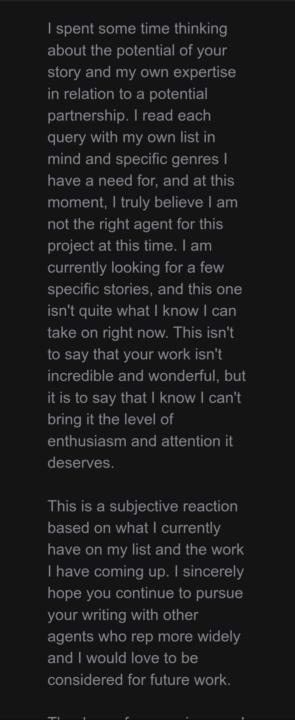
Manuscript assessment?
I've attached my best rejection to date, which I received this morning. I guess that means that my queries are getting closer to hitting the mark. I've already repositioned it as YA rather than MG, but I feel like I maybe need a manuscript assessment by a professional editor. Ideally, this would be someone who works as an agent as well and knows the market. There are plenty of American agents doing both jobs, but can anyone recommend a UK person for it, please?
2 likes • Mar 7
Quite a good rejection! Jericho Writers, UK-based, offers manuscript assessment. Jericho is a respectable business based on the services they provide and the agents they collaborate with, but I can't vouch for the quality of the MS assessment.

Feb 26 •
Filter Words Query in 1st Person novels
Hi. I am currently editing my novel. It's in the first person and I was told from a previous writing competition that I should remove the filter words as they create distance between you and the reader. (e.g. I saw, I heard, I realised etc...) However, I wonder if there are situations where it is okay to leave them in and I wanted to check if anyone has any general rules with removing filter words or knows of any good books or online articles about them. e.g. 1) If it is in speech and one of the characters says 'I saw something in the dark'- okay to leave in as it's in speech?. 2) She heard me call her name and ignored me- okay as not the main character in the filter? (e.g. she heard and not I heard?) 3) I saw him on the overhead TV screen. (Okay as the main character is watching a TV screen?) as opposed to 'I saw him come towards me' (which could have the filter removed with 'He came towards me'. ) 4) 'I couldn’t believe no one else heard it.' okay as hearing is the central focus? 5) 'I saw no sign of him'. Okay as a common expression? I'd been really keen to hear other people's experiences and expertise at editing out filter words and if there is a general technique for it. I'm just looking for a general quick set of rules if possible. If anyone knows of any that would be really helpful. Thanks so much.
4 likes • Feb 26
As a preamble I'll say that every writing "rule" should be seen more as guidance than a strict rule. Which means there will always be numerous exceptions where that specific advice doesn't apply, for whatever reason. Your examples can all work fine on a standalone basis, but I wonder if the frequent repetition of certain filter words can become too distracting. So this is also something to consider, rather than the filter word in and of itself. I would also think about whether some of these are actual filter words, or just perfectly plausible ones. In your example #4, "heard" is not a filter per se, so that shouldn't even be a question (like you implicitly assume). The use and frequence of such words can also depend on the rhythm you want your sentences to have, the genre you're writing into, the emotions you want to convey. The sentence "And then I saw him" carries a different weight than its "unfiltered" equivalent, because you'd then have to explain who it is that you saw. While maybe your intention in the first place was to let the tension rise, before telling the reader who the character saw.
2 likes • Mar 1
@James Blair And, personal preference, I'd add Haruki Murakami, whose novels are mostly written in the first person
Feb 19 •
Agent query/pitch advice
Hi all! I was lucky enough to attend an Agent led event last night, discussing queries, pitches and the editing process. Here's a couple of (hopefully helpful) things that came out of the discussion: 1. Make your query letters as short and professional as you can. You might want to fill it with loads of lovely detail, but they find it refreshing and attractive when one is brief. 2. Lead with your "comp" books. Don't start by getting into the plot or characters, show that you know the market and have an idea of where your book sits by comparing it to successful, well regarded (recent if you can) books in that area. Then tease the plot in two or three sentences, then end on a question or note of suspense. 3. Don't bother trying to "hide" your genre. People are tempted to claim a different genre because they're worried their novel isn't currently marketable. The agent will know immediately when they start reading the sub, so why bother hiding it? 4. (In the UK) Avoid querying in March or October. The London and Frankfurt book fairs pull a lot of agents away from reading at those times. 5. Agents give EVERYTHING a read... But bear in mind they have existing clients and an inbox of up to 20 subs a day. They also then let some of us pitch to them and get live feedback (which was heartening and super useful), so do keep an eye out for similar events. Even if it's not stated, there might be a similar learning opportunity offered.
0 likes • Feb 22
@Petra Glover Yes, that is also very true.
1 like • Feb 26
@Ralph Levinson Fair point. In my view, the best agents are those who get a sense from your comps of what your novel is about, without being put off by seeing it compared to big household names, and then they find even better, more marketable comps, when they submit to editors.
1-10 of 15

@gabby-martini-1396
Former investment banker turned writer, based in London. Working on my first novel, a book club dark comedy set in the art world
Active 7d ago
Joined Jan 5, 2026
Powered by