Activity
Mon
Wed
Fri
Sun
Aug
Sep
Oct
Nov
Dec
Jan
Feb
Mar
Apr
May
Jun
Jul
What is this?
Less
More
Memberships
Black Belt Institute Online
70 members • Free
6 contributions to Black Belt Institute Online
May 25 •
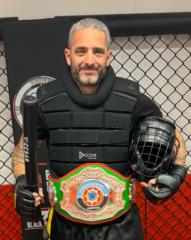
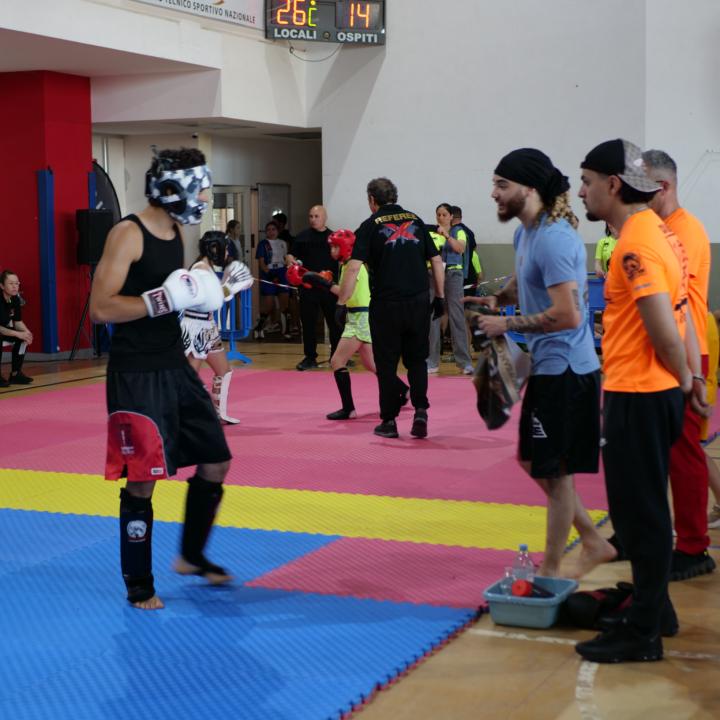
🥊🇨🇭 Léon Salijevic vs Warren Brelleur — Kick Light (-70 kg) 🇫🇷
🏆 XFC European Championship 2026 in Rome After capturing his first European belt, Léon Salijevic immediately entered another category to face French fighter Warren Brelleur in Kick Light under 70 kg. And at that point, the level rose even higher. Standing in front of him was a true product of French kickboxing. Warren Brelleur had recently won a major kickboxing gala in Brittany and arrived with an extremely high technical level. Coached by three coaches, he displayed a style that was fast, powerful, explosive, and highly polished. Very quickly, the fight became extremely difficult for Léon. The French fighter hit hard, applied constant pressure, and truly pushed Léon to his limits. But often, it is in the hardest moments that true fighters reveal themselves. It is important to understand that Léon is first and foremost one of the best fighters on our team in boxe libre, with methods and reflexes very close to MMA. His dream is clearly to build a future career in MMA. And under pressure, when facing difficult situations, some of his free-fighting instincts naturally returned. Several times, he grabbed the opponent’s leg to attempt a takedown, which is completely forbidden in this discipline. The referee immediately warned him, and at one point we were even close to disqualification. The opposing corner later tried to use that penalty situation after Léon threw a very high kick while Warren ducked underneath to evade it. The movement created very close contact near the face with Léon’s knee, which would have been illegal. However, the referees immediately understood the action correctly: it was clearly a high kick and not an intentional knee strike. No damage was caused and the fight continued. And what a fight it was… The technical level from both athletes was exceptional. Warren attempted several extremely dangerous spinning kicks that Léon narrowly managed to avoid. Honestly, if one of those had landed cleanly, it probably would have ended the fight immediately.
0 likes • Jun 9
Félicitations à Léon
May 17 •
🇨🇭 Road to Rome – XFC European Championship 2026 🇮🇹
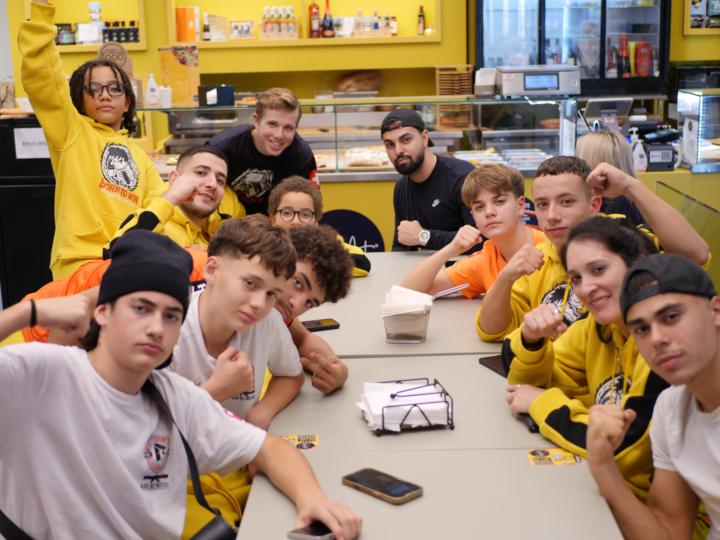
From Friday, May 22 to Sunday, May 24, 2026, the Swiss team will travel to Rome to compete in the XFC European Championships 2026. This major event is also the perfect opportunity to look back at the historic moment experienced during the XFC World Championships 2025. In 2025, Team Switzerland achieved an exceptional result by bringing home two amateur world championship belts: 🥇 Leon Salijevic in MMA 🥇 Daniel Garcia De Oliveira in Boxing This year, the Swiss team will be represented by: 🔥 Denise 🔥 Alned 🔥 Attila 🔥 Abdulaziz 🔥 Leon 🔥 Daniel 🔥 Léo 🔥 Mattia 🔥 Riad 🔥 Mohammad 🔥 Marco Junior 🔥 Noé 🔥 Bryan All our competitors are ready to give everything to represent Switzerland with honor, respect, and determination, hoping to qualify for the World Championships in Rome this November. A huge thank you to Alessio Cecchini, organizer of XFC, and to his entire team for the quality of the event, officiating, and infrastructure. We have been waiting for this moment for many months. Now the time has come. 🇨🇭🔥Destination Rome — May 22–24, 2026. 🏆 Du vendredi 22 mai au dimanche 24 mai 2026, l’équipe suisse prendra la route de Rome pour participer aux championnats d’Europe XFC 2026. Une échéance importante qui marque aussi le moment idéal pour revenir sur un instant historique vécu lors des championnats du monde XFC 2025. En 2025, l’équipe de Suisse a réussi un exploit exceptionnel en ramenant deux ceintures mondiales amateurs : 🥇 Leon Salijevic en MMA 🥇 Daniel Garcia De Oliveira en boxe anglaise Cette année, l’équipe suisse sera représentée par : 🔥 Denise 🔥 Alned 🔥 Attila 🔥 Abdulaziz 🔥 Leon 🔥 Daniel 🔥 Léo 🔥 Mattia 🔥 Riad 🔥 Mohammad 🔥 Marco Junior 🔥 Noé 🔥 Bryan Tous nos compétiteurs vont tout donner pour représenter la Suisse avec honneur, respect et détermination, avec l’objectif de décrocher leur sélection pour les championnats du monde de novembre à Rome. Un immense merci à Alessio Cecchini, organisateur de l’XFC, ainsi qu’à toute son équipe pour la qualité de l’événement, des arbitrages et des infrastructures. Nous attendons ce rendez-vous depuis des mois et des mois.
Poll
2 members have voted
1 like • May 19
Comme on dit chez nous bonne merde (bonne chance) à tous pour vos combats 💪🏻🇨🇭🥊
May 19 •
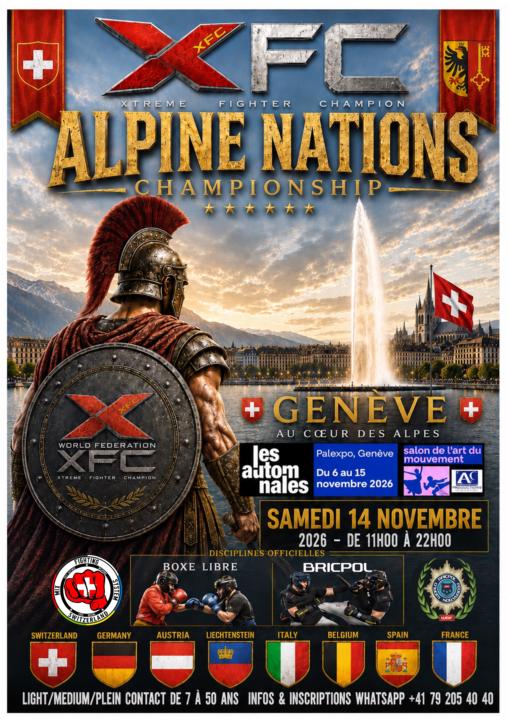
🔥 ALPINE NATIONS CHAMPIONSHIP 2026 — THE RETURN OF REAL COMBAT TO GENEVA 🔥
It is now official.With the approval of the Geneva Automnales, Claudio Alessi and AC Productions Organisation, Santiago Bongo for BRICPOL, John Lelong and the International Mixed Fighting System Federation, we are extremely proud to officially announce the ALPINE NATIONS CHAMPIONSHIP 2026, one of the biggest martial arts and combat sports events ever organized in Switzerland. 📍 The event will take place on Saturday, November 14th, 2026, during the prestigious 16th Salon de l’Art du Mouvement at the Geneva Automnales in Palexpo. This event also marks an important symbolic return, as more than ten years ago the Swiss BRICPOL Championships had already made a strong impact at Palexpo. Today, a new generation returns to make Geneva vibrate again with a modern, realistic and international vision of combat. It is a great honor for me to preside over the stand of the Swiss Mixed Fighting System Federation, bringing together the disciplines of BRICPOL, Boxe Libre, English Boxing, Kickboxing and Grappling. 🔥 Only true enthusiasts will understand.It is difficult to teach real self-defense when you have never experienced the pressure of combat, fatigue, stress, timing or confrontation. Training students requires credible, realistic and effective techniques for protection and survival. 🥊 This OPEN competition will gather fighters from 7 to 50 years old from several European nations, with light, medium and full contact fights. More than one hundred selected fighters are expected in front of what promises to be an exceptional audience. 🏆 Each division winner will receive a trophy, while medals will be awarded to all those who had the courage to step onto the fighting area and defend their colors with honor and respect. Because in the end, stepping onto a combat surface in front of hundreds of people already requires something many people will never have: courage. 🇨🇭 For one day, Geneva will become the European capital of real combat 🔥 ALPINE NATIONS CHAMPIONSHIP 2026 — LE RETOUR DU RÉEL À GENÈVE 🔥
1 like • May 19
Dommage je suis trop vieux pour participer j'ai 58 ans Oss
May 14 •
🇬🇧 🎥 24 HOURS INSIDE THE OPEN DE FRANCE BOXE LIBRE – MAY 2025
Today, I want to share with you a special video created by one of our members, a communication student who followed our team for 24 hours during the Open de France in Boxe Libre in May 2025. 🇫🇷🥊 This semi-professional documentary offers a unique immersion into the reality of competition life — far beyond the fights themselves. Because some emotions, sacrifices and moments can never truly be explained with words alone. As the saying goes :“A film is worth more than a thousand words.” 🎬 Through this experience, you will discover :🔥 The commitment behind every athlete🤝 The camaraderie within the team🥋 The passion that martial arts create😴 The fatigue, stress, motivation and emotions❤️ The human side of combat sports When people truly fall in love with martial arts and combat sports, it becomes much more than training…It becomes a lifestyle, a family and a lifelong passion. Our mission is to transmit knowledge, values and experiences, and this video perfectly reflects how powerful and magical transmission can truly be. 🙏 — Black Belt Institute Online 🇫🇷 🎥 24 HEURES EN IMMERSION – OPEN DE FRANCE DE BOXE LIBRE – MAI 2025 Aujourd’hui, j’aimerais vous partager une vidéo un peu spéciale réalisée par l’un de nos membres, étudiant en communication, qui nous a accompagnés pendant 24 heures lors de l’Open de France de Boxe Libre en mai 2025. 🇫🇷🥊 Ce reportage semi-professionnel permet une immersion unique dans la réalité d’une compétition, bien au-delà des combats eux-mêmes. Car certains moments, certaines émotions et certains sacrifices ne pourront jamais être réellement expliqués avec des mots. Comme on dit souvent :« Un film vaut mieux que mille mots. » 🎬 À travers cette immersion totale, vous allez découvrir :🔥 L’engagement des combattants🤝 La camaraderie dans l’équipe🥋 La passion que créent les arts martiaux😴 La fatigue, le stress, la motivation et les émotions❤️ L’aspect profondément humain des sports de combat Quand on devient réellement passionné par les arts martiaux et les sports de combat, cela dépasse largement le simple entraînement…Cela devient une manière de vivre, une famille et une passion de tous les jours.

1 like • May 15
De sacrés combattants 👍💪🏻🥊
May 7 •
Consistency and Discipline:
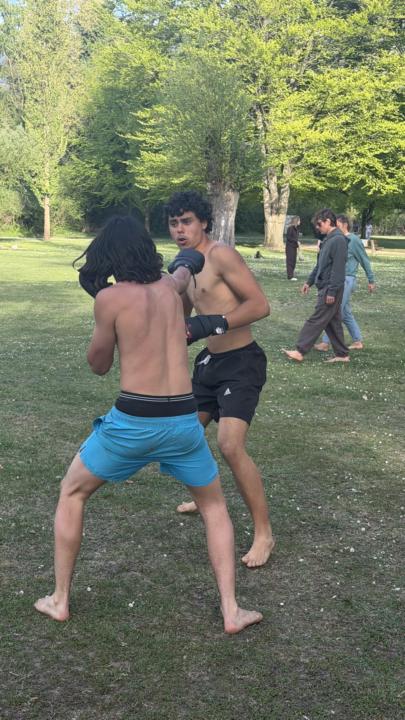
The Invisible Foundations of a Future Champion After more than forty years in combat sports, one reality has become undeniable over time: performing well as a child or teenager is one thing… lasting and succeeding as an adult is something completely different. Many young fighters, parents, and sometimes even coaches do not fully understand the enormous gap between youth categories and the adult world. In children’s competitions, the structure is designed to protect physical and psychological development. Categories are divided into very close age groups — often only two years apart — with weight differences limited to around five kilograms. This means that a 5- or 6-year-old child weighing between 20 and 25 kg will only compete against very similar profiles. And above all, the number of participants remains relatively small. In some youth competitions, there may only be three, four, or eight participants in an entire category. This means that a child who trains consistently and takes practice seriously already has a very high chance of reaching the podium quickly. That is why a young athlete who trains every other day — or even daily — will almost always become successful in children’s and teenage divisions. But everything changes at the age of 18. Moving into the adult category is probably one of the biggest psychological shocks in combat sports. Suddenly, the young athlete is no longer facing teenagers of similar age. They enter an open division that can range from 18 to 35 years old — up to 17 years of difference in physical, tactical, and mental experience. Weight categories also become much broader: - 60 to 70 kg, - 70 to 80 kg, - over 80 kg. Mathematically, this greatly increases the number of possible competitors. Where a young athlete may previously have needed only two or three fights to reach a podium, an adult may now face brackets of 32 or even 40 fighters. The entire system becomes completely different. To earn a podium place at a major event, an athlete may have to go through:
2 likes • May 7
Tout à fait d'accord Senseï Si j'avais pu pratiquer un sport de combat étant petit (ne pouvant pas à cause de mon handicap) mon grand père maternelle étant boxeur et des cousins pratiquant les sports de combats et karaté étant passionné et ayant un cousin qui le pratiquait j'aurais opté pour le kick boxing (y'avait le club de Juan Pinilla dans le village où j'ai grandi) et je suis certain que j'aurais atteint un bon niveau, hélas mon handicap à plus de 80% au niveau des jambes m'empêchait de faire du sport, c'est vers l'âge de 23 ans après plusieurs interventions chirurgicales aux jambes ai ayant pu marcher sans assistance à l'âge de 13, ans que j'ai commencé par le taijiquan style yang, ensuite le wing chun, le Mastro Défense Système, le krav maga avec cours de boxe anglaise et muay thaï durant les entraînements, et depuis fin octobre 2025 je suis au KSDK 😉
2 likes • May 8
@Marco Garcia Gonneau merci à toi Ma devise est détermination, courage, espoir, volonté, persévérance, Mon handicap est une Charcot Marie Tooth qui touche les nerfs périphériques des 4 membres, ce qui entraine un manque de force de préemption des membres supérieurs, je suis incapable de soulever un haltère de 10kgs à une main, je suis obligé de le prendre à deux mains, j'ai aussi du mal a de bouchonner une bouteille de soda, boutonner ma chemise et d'autres choses du quotidien qui sont faciles à faire pour les autres, au niveau des jambes, je n'ai pas les muscles jumeaux au mollet droit, pour ma jambe gauche le mollet est plus ou moins normalement constitué, petit j'avais les pieds tournés vers l'extérieur et les plantes de pieds tournées vers le haut, je ne tenais pas debout je tombais comme une poupée de chiffon, de ce fait je me déplaçais soit en tenant la main, soit en déambulateur, soit en fauteuil roulant, a l'âge de 10 ans j'ai subit ma première intervention à la jambe gauche, greffe de cheville (le greffon est un os de cochon) et allongement du tendon d'Achille, à 11 ans seconde intervention au pied droit, greffe de cheville le greffon est l'os de ma hanche droite, par contre il ne m'ont pas allongé le tendon d'Achille de ce fait je suis limité lors de la flexion pour les squats arrivé à un certain niveau j'ai le talon qui se lève, entre et après les interventions c'était rééducation et ergothérapie, kiné deux fois par jour du Lundi au dimanche jusqu'à l'âge de 13 ans ou j'ai enfin pu marcher sans assistance, comme il me manque le tendon externe aux deux pieds je ne sais pas ramener mon pied en dorsiflexion, j'ai les pieds tombants ce qui fait un steppage lors de la marche, de ce fait je doit porter des orthèses surtout pour faire du sport pour éviter les entorses, j'ai toujours un manque d'équilibre mais les arts martiaux m'ont permis d'acquérir plus d'équilibre Tant que mon état me le permettra je continuerai à pratiquer. Oss A bientôt Fabrice
1-6 of 6
@fabrice-ponchaux-3294
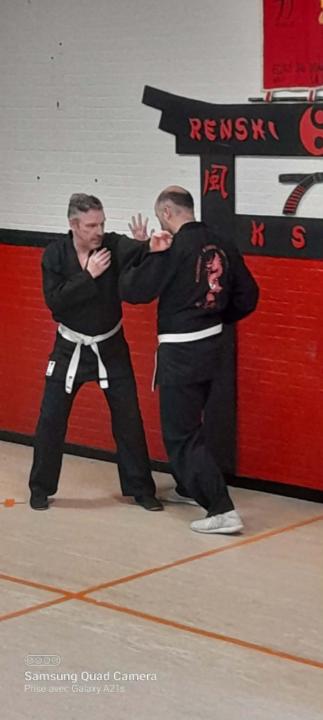
Fab 59 ans de Mons Belgique pratiquant le Kempo self défense Karaté, boxe libre, mix fighting system, wing chun kung fu
Active 30d ago
Joined May 6, 2026
Powered by