Activity
Mon
Wed
Fri
Sun
Aug
Sep
Oct
Nov
Dec
Jan
Feb
Mar
Apr
May
Jun
Jul
What is this?
Less
More
Memberships
useful AI
23.5k members • Free
AI Movers
439 members • Free
Constellations
89 members • Free
AI Automation Circle
12k members • Free
AI Automation Mastery
30.1k members • Free
Just Build It
443 members • Free
Steven James Consulting
32 members • Free
The Enterprise AI
828 members • Free
Agentic Workers
191 members • Free
8 contributions to Clief Notes

8h •
Meta Skill Router 🫡
Kinda from Skill Overload to Skill-on-Demand A scalable Harness/Agent shouldn’t load every skill by default.. Anyone tried this ? I'd love to hear your thoughts on it :) I'm thinking about creating a Meta Skill Router (with ICM structure and philosophy) following an approach consistent with the principle of progressive disclosure: initially displaying only the metadata, then loading the complete instructions when necessary. → Keep all skills in a library → Keep one permanent Skill Router in charge (only this one loads in every new session start) And, of course, it's always possible to exclude certain essential skills Ressources : https://marcuyyy.com/blog/010-skills-router https://github.com/addyosmani/agent-skills/issues/248 https://zylos.ai/research/2026-05-13-agent-skill-composition-dynamic-capability-loading
0 likes • 7h
@Aaron Kruger That's a fair question. I'm curious to know your manner of writting skills so they handle discovery :) I have ~100 custom skills. Even if Claude only loads a skill's full content on demand, every skill description is still injected into the initial context.. context file is great but a lot of verbose..
0 likes • 1h
@David Vogel Fair enough 😛 I get your point, but I’m not sure I fully understand where our views diverge. My post was mostly about exploring the idea and getting clarification, not pushing a specific implementation. Thanks for sharing your perspective, by the way. I’d honestly love to learn more about how you approach skill management. If you have any docs, blog posts, or references that explain the rationale behind it, I’d be happy to read them

6d •
Anyone using Obsidian as a company knowledge base? Here's the problem we ran into
We run a startup and we've been using Obsidian as our company knowledge base. Great tool but there's one big gap, no security. Everyone with vault access sees everything. API keys, strategy docs, client info, all wide open. And when you connect AI tools they burn through tokens reading raw markdown with all the noise. We ended up building a plugin called VaultGuard that adds encryption and access control to Obsidian. Built it for ourselves first, now we are testing it. If anyone else ran into this, how do you handle sensitive info when sharing an Obsidian vault with your team? And if you're interested in VaultGuard let us know, we'd love to hear your feedback.
0 likes • 6d
We ran into the exact same visibility problem. Our workaround was splitting the vault by sensitivity level: public ops, internal strategy, and confidential (API keys, contracts) in a separate encrypted vault. The downside is it breaks linking between notes. Have you found a way with VaultGuard to keep cross-links working while restricting access? That would solve the main tradeoff.

8d •
Curtis and Brooke are on to something, but tread carefully
So this one is the ultimate Clief Notes community bringing disparate threads together post. So reader, consider this your warning upfront. @Alyshia Perri and I were talking and she was keen to get feedback on her entry in the coach competition. I tried to do that in DM to begin with, and then realised I was babbling. I asked her permission to fork it and make my edits so I could *show* her what I was trying to describe and she gave me that permission. None of the rest of this happens without her and she also gave me permission to post this. So here’s a brave woman who’s willing to let me link to a repo showing how I messed with her baby because I couldn’t find better words for the teaching. Please tell her how awesome she is, because that is *gutsy*. One of the coaching offerings in this repo was “board mode” which runs an idea past three different perspectives, each with a different agenda and angle of attack to help the user. I’m going to be upfront and say these sorts of mechanics in AI are generally not to my taste for a bunch of reasons. I don’t think they are effective, let’s keep it to that. But on my mind was the recent podcast by @Curtis Hays and @Brooke Hays showing the impact of using Jungian thinking archetypes / Myers-Briggs profiles to genuinely give the way agents approach things different flavours. What I did: - I got the model to do a sub-agent pass first using the roles as written - I took the three roles as stated and identified which profiles applied to these roles from my point of view - the skeptical stakeholder got “ESTJ”, the peer who has been burned got “ISFJ”, future self got “INFJ”. Then we did it again and compared the outputs - I added two new roles that I felt were missing - the logic stress tester (INTP) and the values-holder (INFP) - I felt off the results of these that Amund as the synthesiser was missing a trick. I tried two separate synthesis passes (over the first rounds, the second round, and all five together) - one using an ENFJ synthesiser and another using an INTJ one.
0 likes • 6d
This is a fascinating experiment! One thing I’m wondering: did you notice any archetypes that consistently produced *actionable* feedback vs. archetypes that produced more vague/generic critiques? In my experience, the "skeptical stakeholder" can either be gold or just repeat obvious risks depending on how the role prompt is written. Also curious:)how did you handle the synthesis step so the final output didn’t just average all five perspectives into something bland?

7d •
How does everyone get Claude/AI to consistently follow ICM / Jake methodology on every build?
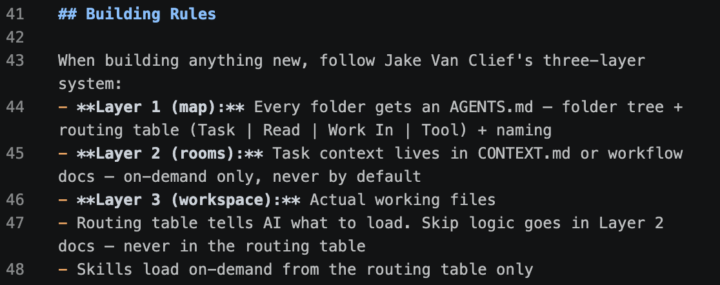
I've been working on this and have something that somewhat works, but I keep running into pieces that get messy and don't hold up well in practice. My current approach: the image I've attached lives in my AGENTS.md at the root of the project, so any time I build, the AI has the structure to reference. What I'm really after is the best way to implement the ICM system so that anything I build, Claude/AI already knows the way to build and stays inside that structure. Is anyone else doing this? Would love to hear how you've set it up.
2 likes • 6d
I’ve been wrestling with the same thing. The AGENTS.md at root helps, but I found the real test is whether Claude *starts* in the right folder. Two things that moved the needle for me: 1. A strict "entry rule" in my project root file: "Before any action, read CLAUDE.md and confirm which stage folder you are in." 2. Using Claude Code / Desktop Projects instead of a blank chat, so the workspace context loads automatically. Have you tried forcing a confirmation step where Claude states which stage it thinks it’s in before acting? That caught 80% of my drift issues.

7d •
ICM for Teams: My Understanding To Onboarding Coworkers to a Shared Content Pipeline
This has been one question i have always asked and kept trying to understand until recently. I've seen it asked and discussed multiple times here... So i decided to combine, study and comprehend the various perspective of those who have shared how they are using it @Curtis Hays and many others, to come up with a simple way for me to implement. Here is my personal understanding: Say we are four people in the marketing department, and i am the only one who has built an content pipeline using the ICM framework, now i want onboard the other 3 coworkers and you're one of them... lol 😀 We have one master system, the original pipeline i'm using is now hosted on GitHub (with the same agent.md and context.md, rules and stages). Step 1: Getting the System on Your Computer You copy/clone the entire workspace from the internet (GitHub) to your PC. This gives you the same folders I have: 01-ideas 02-drafts 03-formats etc Step 2: Creating Content Open your copy of the workspace. Talk to ai agent while in the folder normally. Example conversations: “Give me ideas for LinkedIn posts about productivity” “Turn idea number 4 into a full draft” “Format this draft for Instagram carousel and Substack” The agent uses the shared system I built, so all our content has the same style and quality. Step 3: Sharing Improvements If you create a better prompt or improve one of the stages: Tell the agent: “I improved the carousel format, make a Pull Request” I (or the content lead) will check it. Once approved, everyone gets the improvement automatically. Step 4: Where Files Live Your ideas and drafts: Stay on your computer (or save final versions to the department Google Drive, which we all have access to). The framework (how we create content): Lives in the shared system (Github). - What You Need to Do Install Git (one time, easy). Clone (copy) the workspace. Use AI agent within the folder workspace.
2 likes • 6d
This is a really clean way to explain it. The separation between "personal working files" and "shared framework" is the part most teams miss. One thing I’m curious about: how do you handle version conflicts when two people improve the same stage at the same time? Do you use branching in Git, or is it more "whoever submits the PR first wins"? Also, have you tried storing the final outputs in a shared drive with the framework still in Git? That’s the setup I’m experimenting with and I’d love to hear if it’s worked for you.
1 like • 6d
@Ami Saunders That makes a lot of sense. Treating the shared framework like open-source software keeps quality high while letting people fork and experiment. The part I’m most curious about: how do you handle "release notes" when the changes are prompts and context files rather than code? With software, a diff tells the story. With prompts, a small wording change can completely shift behavior, but it’s hard to see in a diff. Do you version the prompts with test outputs / expected behavior, or is it more trust-the-maintainer for now?
1-8 of 8