Activity
Mon
Wed
Fri
Sun
May
Jun
Jul
Aug
Sep
Oct
Nov
Dec
Jan
Feb
Mar
Apr
What is this?
Less
More
38 contributions to WIN/WIN

1 like • Mar 10
@Adam Atkinson 🫡

Mar 3 •
Seeing Is Believing — Or Is It?
“Seeing is believing” sounds logical. But magicians rely on it. So do liars. So does confirmation bias. We don’t see reality as it is.We see it as we want it to be. The mind fills gaps. It filters evidence. It protects ego.And when we believe something strongly enough, we unconsciously look for proof to support it. That is where deception lives. In Trading Trade what you see, not what you hope. The market does not care about your bias. It does not reward prediction. It rewards disciplined execution. When you trade what you think will happen: - You anticipate. - You force entries. - You move stops. - You justify losses. When you trade what you see: - Structure confirms. - Conditions align. - Risk is defined. - Emotion is reduced. Clarity replaces ego. The Deeper Principle This isn’t just trading. In business. In relationships. In negotiations. Emotion distorts perception. We see opportunity where there is risk. We see loyalty where there is convenience. We see validation where there is manipulation. Stepping outside your own viewpoint is a skill. That is why a third-party opinion matters. Not because they are smarter.But because they are not emotionally invested. Distance creates objectivity. The Discipline Critical thinking is not natural. It is trained. Pause.Assess. Question your own bias. Ask: - What evidence contradicts my belief? - What would the opposite side argue? - Am I reacting… or evaluating? The ability to detach from emotion is not coldness. It is control. And control is leverage. Understand... 🙏
1 like • Mar 10
💎
Mar 5 •
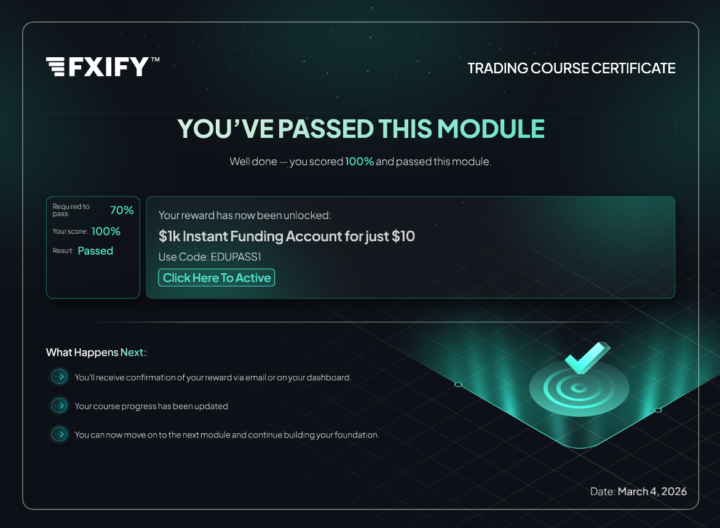
$1k live acc for $10
Last night I passed all 5 courses on FXIFY.com. I even did it by copy pasting to Chat Gpt questions. So now I know you can do the same. It took about 1 hr to complete all 5. This is a win for the community. Not only do you learn more about trading. But you additionally get discounts on challenges through their site. They have recently made a lot of changes to rules and now much easier to trade with bots. However, it looks like the 1 step challenge is the best for this. Do not get the instant funded unless you only want the manually trade. Go to fxify.com and do the same. Realistically the $1k account will probably blow up. 6% ($60) DD is just not much in forex. Even with min lot size. But its a great learning curve in risk management. And 1hr, $10 is a small investment towards financial freedom, if you take it seriously. I want to see more screen shots in chat of these wins. Lets keep momentum moving forward. 🙏
1 like • Mar 10
💪🏽
Mar 5 •
Money Moves Like a River
Ever noticed how much financial language comes from water? • Cash flow • Currency (from current) • Liquidity • Capital flows • Liquidity pools • Floating exchange rates • Market depth • Banks • Income streams Even the word bank refers to the side of a river — a place where something flows past and gathers. This isn’t just coincidence. Money behaves a lot like water. It flows toward opportunity. It pools where resistance is low. It floods markets when liquidity increases. And it dries up during crises. Your income streams are like tributaries feeding your river. The more streams you create, the stronger the overall flow becomes. Central banks even act like dams, controlling how much money flows through the financial system by adjusting interest rates and liquidity. Understanding this concept changes how you see wealth. Instead of thinking about money as something static, think about where it is flowing, what controls the current, and how many streams feed into your river. Because in markets—and in life—the real skill is learning how to read the current and position yourself in the flow. Understand... 🙏
1 like • Mar 10
💎
Mar 5 •
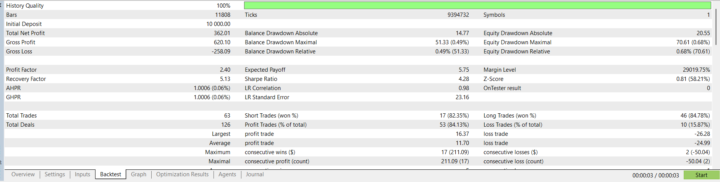
New Bots
These are the results from the 'New' bots I have running at the moment. Testing period is 6 Months. AUDCAD ($362 @ 0.7% DD) USDCAD ($455 @ 1.4% DD) USDCAD ($417 @ 0.6% DD) AUDJPY ($226 @ 0.6% DD) GBPUSD ($403 @ 1.7% DD) USDJPY ($570 @ 1.7% DD) AUDCHF ($577 @ 1.8%DD) What are your thoughts ? Which ones should we work on ? I think USDCAD ($417 @ 0.6% DD) has most potential. But would like more than 1. Maybe 2nd is AUDCAD ($362 @ 0.7% DD). If I double the lot size on both that would get about $1560 in 6 months (still under 4%) . Or 15% (30% a year. 2.5% a month) ROI on $10k acc. Or just get the most profitable one USDCAD ($417 @ 0.6% DD) and 5x lot size ($2k in 6 months @ 3%DD) $333 a month.
1 like • Mar 10
[attachment]
1-10 of 38