Activity
Mon
Wed
Fri
Sun
Aug
Sep
Oct
Nov
Dec
Jan
Feb
Mar
Apr
May
Jun
Jul
What is this?
Less
More
Owned by Matt
Amazon KDP authors using Amazon Ads to sell more books, increase royalties and build passive income 💰
Memberships
Non-Fiction Author Lab
1k members • Free
KDP Publishers by PublishFlow
375 members • Free
Publish & Profit Challenge
5k members • Free
KDP Publishing
1.3k members • Free
Royalty Guild. Amazon KDP
416 members • Free
PublishingOS (Free)
14.8k members • Free
Driven Publishers
4.4k members • Free
Skoolers
165k members • Free
The 1% KDP Publishing Club
1.5k members • Free
29 contributions to Royalty Guild. Amazon KDP

Mar 17 •
Niche Research in One Click
Finally, ver. 2.1 of Royalty Guild Market Analyst is approved by Google, and now you can conduct niche research in one click. The review collection functionality of the extension remains intact. If you are on a book page, you can collect the reviews and paste them into an LLM with the readily available prompt. If you are on an Amazon search page, you will collect the books' titles, BSR, review count, and price to paste into an LLM with the research prompt. Also, if you need to, you can save reviews and/or niche data as .csv files. So, two major research processes are now fully automated. Please, share your experience with the extension. Would you like to tweak something? To add some functionality?

🔥
2 likes • Mar 18
Great tool @Igor O !
Jan 19 •
📈 22x More Royalty. From Low-Content to Sustainable KDP
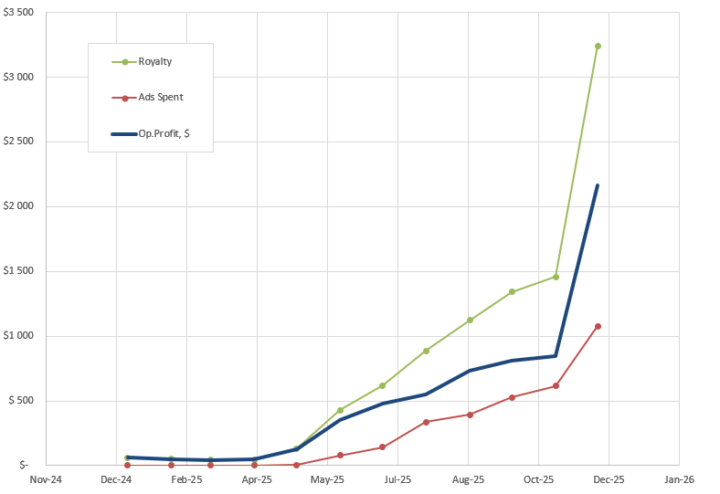
I had no plans to publish my 2025 results not to create unproductive comparisons. On one hand, we have members with results in tens of thousands of dollars a month. On the other hand, nine out of ten publishers' earnings are measured in tens or hundreds of dollars a month. After much thought, I decided most of the Guild members are adult enough to understand that the only productive comparison is the comparison with your previous self. And example of the possible trend, not exact numbers, would be inspiring for publishers, struggling to break the plateau. So, in late April 2025 I had catalog of about 50 low-content journals which generated a total $50 a month in average, zero ads spent. At the time I was bored and searched for an idea for productive daily activity. KDP seemed like an decent candidate for it and I started process of re-train myself to modern day publishing in May 2025. Now, eight month later, royalties are increased 22 times with healthy 15 times increased profit. On the way I learned a few things: 1. All necessary information is freely available on the internet: you do not need to spend money on gurus, magical recipes for success, or expensive software. At the same time, a good mentor (not necessarily a human; an LLM works well in this role too) and useful tools can save you a lot of time and effort. And the time saved usually means money earned. 2. As in any business, in KDP there are no magic tricks; instead, feedback loops and effective processes win the game. 3. No matter how low your results are now, if you are ready to grow, you can increase your earnings rather fast. The only limit to the results is your own mindset. What's next? I have a book of my own that has been sitting at "half-finished" for weeks because I've been so focused on our community. To be the best host I can be, I need to finish what I start. I'll be a little quieter here for a short bit while I finish this manuscript. I'm handing the "microphone" to you guys: keep the discussions going, help the newcomers, and let's see who can post the next big growth story!
🔥
5 likes • Jan 20
Thanks for sharing @Igor O , great trend!
🔥
1 like • Mar 10
@Lara Knutzen Hello again, great to see you! :)
🔥
Feb 24 •
🚀 KDP Ads Bootcamp (Starts March 9th) - $50 off for Guild Members
@Igor O and I have teamed up to offer something special for the Royalty Guild. If you’re serious about scaling your book sales with Amazon Ads, this is your opportunity to build a structured ad system - inside a 6-week, hands-on implementation Bootcamp with my direct support at every stage. The Goal: 🔸You’ll have Amazon Ads running with a clear structure 🔸You’ll know exactly how to launch, optimize, and scale ads with confidence 🔸You’ll either have profitable ads or precise data showing exactly what to fix No guessing. No random tactics. No overspending. What’s Included: ✅ 6 weekly live group Q&A calls ✅ Step-by-step training videos for each stage of the process 🔸 Keyword research 🔸 Book optimization 🔸 Ad campaigns Launch, Adjustment, Optimization, Scaling (L.A.O.S. Framework) 🔸 Final results interpretation 🔸 Full program outline in the attached PDF ✅ Unlimited 15-minute 1:1 bottleneck calls if you get stuck between stages 🔸 This is only available for the beta cohort ✅ Priority DM support so you can get quick answers to your questions ✅ I’ll personally run your niche keyword research using Helium10 Cerebro ✅ Continued access to the fully finished training afterward ✅ Recordings of all group Q&A calls 🎁BONUS: You can grant me access to your Ads Console for direct troubleshooting 🎁BONUS: 1-year access to my future premium Skool subscription for ongoing support This is the beta version of the Bootcamp, so the price is just $599. 🎁 Guild Member Bonus: After purchasing the Bootcamp, message me “GUILD50” within 24 hours, and I’ll refund you $50. Spots are limited, so you’ll get my full attention. Reserve your spot now: 👉 Join Now! You’re a good fit if: 🔸Your book earns at least $5 in royalties per sale 🔸You’re either new to Amazon Ads or already running them but not getting consistent results and want a proven, structured system 🔸You’re ready to spend at least $500 on ads to generate meaningful data (paid directly to Amazon, separate from the Bootcamp fee)

🔥
0 likes • Mar 3
For anyone joining the March edition of the Ads Bootcamp (max 5 people), I’m offering UNLIMITED 15-minute 1:1 calls to remove any bottleneck. This is to make sure no one gets left behind. Everyone will achieve the goal - I’ll make sure of that 🔥 (Each week includes 1 hour of training videos + 1 group Q&A call.)
🔥
Feb 21 •
🎥 Bestseller Strategy Explained
Becoming a bestseller doesn't necessarily mean selling hundreds of books a day. In this material, I break down exactly how Amazon’s ranking system works and how we can increase our chances of earning that Bestseller badge. Is that something that you've been doing already with your books?
🔥
1 like • Feb 22
@Thomas Juuls Exactly! So many spammers are just looking for the categories with the weakest competition, not caring about relevancy at all.
🔥
1 like • Feb 22
@Ana-Rita Piirainen Thank you for your feedback Ana-Rita! 🎉
Feb 16 •
Book DNA: The One File That Changes Everything
You know that feeling when you hire a cover designer, and what comes back looks... nothing like what you imagined? Or when you brief an editor on your book's tone, and they completely miss the mark? It's not their fault. And it's not yours either. The problem is communication. Getting what's in your head into someone else's hands is where most author-freelancer relationships fall apart. That's why I created something I call "Book DNA" – a master document that captures the soul of your project in a way that actually translates to the people you work with. Here's how it works: Step 1: The Setup Download the Book DNA Interview.md ⤵️ file from the Publisher Persona & Book DNA page and upload it to ChatGPT, Claude, or Gemini. Type "Execute" and let it guide you through questions about your book. Step 2: The Secret Sauce Here's the trick – don't type your answers. Use the microphone instead. Why? Because typing filters your thoughts. Speaking captures the nuance, the emotion, the real vision behind your book that gets lost when you're staring at a blinking cursor. Step 3: The Brain Dump Just talk. Let the AI dig deeper into what makes your book unique – the vibe, the reader experience, the details that matter. Step 4: The Result Run it through "Fast Mode" to get a clean, summarized TXT file. That's your Book DNA – the blueprint every freelancer needs to nail your vision on the first try. Before I show you all the ways to use this (and trust me, there are more than you'd think), I'm curious: What would YOU use a Book DNA file for? Drop your ideas below. I want to hear how you'd put this to work in your publishing process.
🔥
3 likes • Feb 17
Great tool and advice @Igor O
1-10 of 29
🔥
@matt-radkiewicz
62,000+ books sold 📚 Helping Amazon KDP authors scale book sales with profitable Amazon Ads
Active 5m ago
Joined Nov 12, 2025
Poland
Powered by